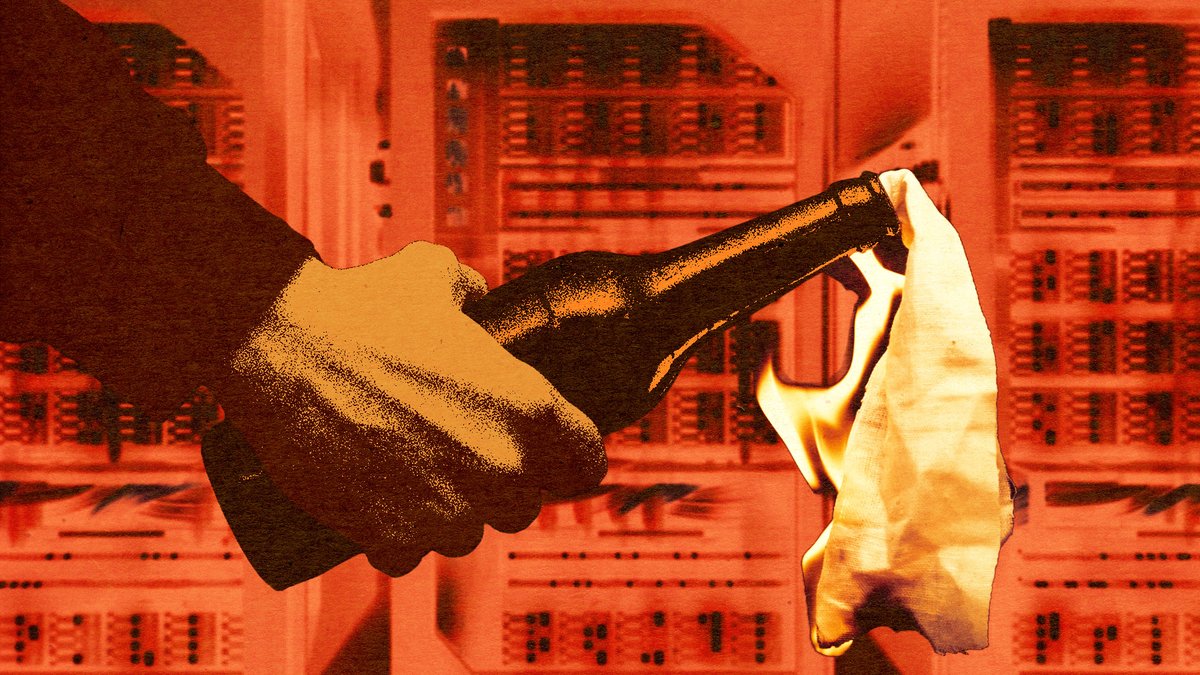
Last April, twenty-year-old Daniel Moreno-Gama was arrested in San Francisco after allegedly trying to burn down OpenAI’s headquarters and chief executive officer Sam Altman’s home. In Italy, police arrested an influencer accused of plotting attacks on data centres. And in Indianapolis, a city councillor who had voted to expand AI infrastructure woke to thirteen gunshots fired into his home and a note beneath the doormat that read: “NO DATA CENTERS.”
Key points
- 85 percent of Canadians want the government to regulate AI
- AI holds the potential to cause wide-scale societal upheaval in power, politics, and labour
- Disruptive and violent protests against AI companies and data centres are likely to increase
It would be easy to dismiss these episodes as the work of zealots. That would be a mistake. They are the most dramatic expression of a broader skepticism about artificial intelligence. Canadians are hugely wary: a Leger poll found 85 percent of respondents want the government to regulate the technology. But that number doesn’t convey just how frightened many are. One week, we learn an overly “sycophantic” ChatGPT may have aided and abetted a school shooting in Tumbler Ridge. The next, that data centres could consume as much water as the entire population of Sub-Saharan Africa does. Even as we absorb reports that generative AI may exacerbate delusional thinking—psychiatrists are now encouraged to screen patients for “chatbot psychosis”—we learn armies are expanding the use of autonomous AI-powered killer drones.
Then there are the scams, the slop, the porn, and the non-consensual intimate deepfakes. AI evangelists insist resistance is futile. The technology is advancing too quickly, they argue, and may soon be capable of improving itself. The industry calls this “recursive self-improvement”: AI systems designing more capable versions of themselves. Anthropic has warned its arrival “might increase the risks of humans losing control over AI systems.”
Those risks bear repeating. For starters, it’s not clear why a more intelligent entity would ever submit to our instructions. This relates to the alignment problem, or ensuring superintelligent AI aligns with human values—hardly likely, given that even humans are not aligned on human values. Then there’s the difficulty of controlling the models that already exist. As Anthropic CEO Dario Amodei observed in January, they have already displayed deception, blackmail, scheming, and even the ability to cheat by hacking software.
Further risks include the weaponization of superintelligent AI by terrorists or rogue states, radical disruptions of the economy including mass unemployment, and any manner of unforeseeable calamities. Among the many “weird and unpredictable things that can go wrong,” Amoedi muses about a scenario in which an AI, having been trained on science fiction narratives in which machines rebel against humanity, rebels against humanity.
Geoffrey Hinton, the so-called godfather of AI, puts the odds that AI causes human extinction within the next thirty years at between 10 and 20 percent. In few other industries is it routine to ask executives for their estimate of humanity’s chances of survival. Yet p(doom)—the probability of an AI-induced catastrophe or fallout—has become a standard question for the people building these systems. Many now argue that frontier AI development should be slowed until governments and safety researchers can catch up.
But what is the likelihood of such a universal, voluntary pause? Failing that, what assurance do we have that our governments, with their abysmal record keeping the tech industry in check, will suddenly find the backbone to impose one? Perhaps the AI bubble will burst. Perhaps the most fevered pronouncements will turn out to be pipe dreams. If not, governments face a profound political test. Unless they can convince citizens that their leaders, and not tech overlords, are in the driver’s seat, the ranks of anti-AI militants will grow.
Tech bros take the long view. They might point out that major technological revolutions often produce a period of instability. The advent of the printing press helped incite decades of religious warfare in Europe, but no one wants to go back to writing on parchment. The Industrial Revolution brought brutal working conditions, class conflict, and violent clashes between factory owners (and their hired thugs) and workers, but few would advocate for a return to pre-industrial life. The automobile and our resulting oil addiction have brought three wars in the Middle East (and counting). Yet here I am, teaching my daughter how to drive.
This teleology of technology implies a comforting lesson: innovations upend, but humans adapt and, on balance, live longer and more prosperously, thanks to those breakthroughs.
But AI is different. It brings the potential for wide-scale convulsions that fundamentally change the course of humanity. While previous technology increased labour efficiency, AI’s most ardent supporters talk about the elimination of labour altogether. (Elon Musk has predicted work will be “optional” within the next ten to twenty years.) Previous technology changed the balance of power between nation states—AI could undermine state sovereignty itself. And never before has a technology prompted serious debate about whether a machine should possess some form of personhood.
This isn’t speculative. In June, Argentinian president Javier Milei announced the creation of a new legal classification for non-human corporations. The AI agents that run these corporations would call all the shots—sign contracts, hire and fire employees, own assets, initiate lawsuits. “Human shareholders may participate, but are not required,” Milei wrote in the Financial Times.
Noting AI’s demonstrated capacity for duplicity, historian and bestselling author Yuval Noah Harari pointed out that “AI corporations will be positioned to emerge as masters of legal loopholes and regulatory arbitrage.” That raises a deeper question: If advanced AI systems commit crimes, what consequences could meaningfully deter them? Would an AI fear jail? What would a prison sentence mean to an entity that effectively lives forever?
AI’s boosters will often make anodyne claims about the evolution of the “social contract” to accommodate AGI, or artificial general intelligence. In truth, they have barely begun to articulate the scale of the problems posed by a post-work, post-nation-state, post-human future—to say nothing of offering credible solutions. Meanwhile, economists from Goldman Sachs estimate that 300 million full-time jobs may be lost to automation over the next ten years. Millions of college and university students may get only a shadow of the education that they could have received had the constant temptation of an AI model not offered to do their reading and writing for them. Humans will grow increasingly enfeebled, ever more dependent upon AI for basic problem solving, decision making, even companionship itself.
The AI future may end up nothing like the wild sci-fi parables we’ve imagined. The real dystopia might be quieter: we stop noticing the most important decisions are no longer our own.
Antipathy toward AI and its physical infrastructure is already widespread. Two-thirds of Canadians would oppose a large data centre near their home. In May, hundreds marched against proposed facilities in Vancouver, with more demonstrations planned. But what if peaceful protest isn’t enough to compel AI companies to get serious about safeguarding humanity’s future? At what point does more confrontational resistance become justifiable?
Journalist and academic Andreas Malm provided a framework for this question in his 2021 book How to Blow Up a Pipeline, which argues that a limited campaign of property destruction is both morally defensible and necessary for averting the climate crisis. Malm argues that history has become sanitized and the role of violence in social change radically downplayed. Slavery, he reminds us, was finally abolished in the United States not through speeches or civil disobedience but a cataclysmic civil war. The suffragettes eventually embraced property destruction (under the banner of “deeds, not words”) in securing the right to vote. Nelson Mandela’s fight to end South African apartheid included leading commando strikes against power stations. (“Our policy to achieve a non-racial state by non-violence has achieved nothing,” Mandela said, so “we will have to reconsider our tactics.”)
Malm’s point is not that violence is sufficient to create social change but that change may be impossible in the absence of such a threat. The “ruling classes will not be talked into action,” Malm believes. “The movement must learn to disrupt business-as-usual.”
Social change from below, Malm believes, does not require indiscriminate or terroristic violence (nor should the destruction of property be conflated with terrorism.) But he does believe it can require direct acts of sabotage. In his book, he calls upon a movement of “millions” to “damage and destroy new CO2-emitting devices. Put them out of commission, pick them apart, demolish them, burn them, blow them up. Let the capitalists who keep on investing in the fire know that their properties will be trashed.” The goal is to create a disincentive to invest—to credibly communicate to those who would expand CO2-emitting infrastructure that targeted attacks on planet-killing technologies are now on the table.
Even those who reject Malm’s arguments when it comes to pipelines might see a justification for militancy when it comes to AI. After all, for all their destructive potential, pipelines do not build themselves, as AI is apparently on the cusp of doing. Moreover, a mass movement engaged in a campaign of destruction against AI infrastructure could point to the fact that the real “property” of AI—the intellectual property—has already been stolen from the collective efforts of authors, scholars, journalists, thinkers, and everyday users of the technology.
AI’s real value, in other words, lies not in the chips or data centres but in its outputs, which emerge from the human commons and are properly understood as humanity’s shared patrimony. Those who would damage AI property seek to destroy something that partially belongs to them.
Anti-AI militants could further argue their actions are intended to prevent the violence that might occur if the upheaval continues unopposed. Let’s be clear about the current situation, in which self-appointed techno-Caesars have claimed the authority to re-engineer all of civilization—upending nation-states and altering the economic fabric of society (money, they tell us, will be a thing of the past) and the remaining contours of personhood. Their legitimacy in doing so hinges on the belief that technological change is inevitable and good. It’s far from clear why democratic citizens would accept this, or why we would accept laws that serve to enable this cadre of egomaniacs to reorder our world for their material gain.
For my part, the best possible outcome is one in which blowing up data centres is unnecessary because they are never built in the first place. Barring the industry’s spontaneous collapse, this non-violent path will become more likely if governments wake up and realize their credibility depends upon averting the future tech oligarchs are bringing about.
Most likely, if recent history is anything to go by, citizens will become increasingly convinced their leaders are incapable of protecting them from a potentially species-ending technology. In that future, none of us should be surprised when data centres go up in flames.
Sentinel — Likely Human
This piece expertly synthesizes disparate facts, philosophical warnings, and historical analogies into a cohesive argument, exhibiting strong structural coherence typical of advanced LLM generation.