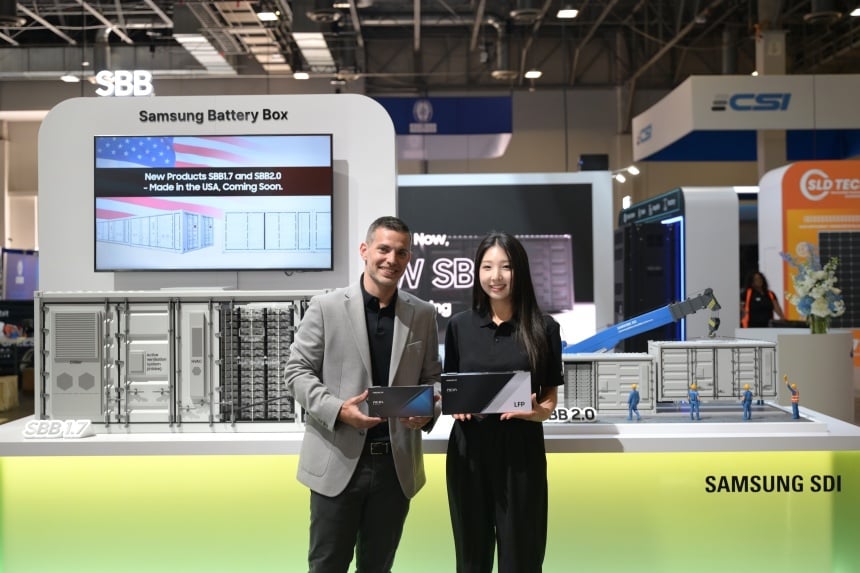
South Korean battery and electronics manufacturer Samsung SDI has secured a KRW1.5 trillion (US$1 billion) deal to supply energy storage system (ESS) batteries for a US energy company.
Under the agreement, Samsung SDI’s Michigan-based subsidiary, Samsung SDI America, will supply the ESS batteries to an undisclosed company over a four-year period, beginning this year.
The batteries will be produced at StarPlus Energy’s Kokomo, Indiana, plant, a joint venture (JV) between Samsung SDI and automaker Stellantis. Initial supplies will begin with NCA (Nickel Cobalt Aluminium) battery cells and later expand to LFP (lithium iron phosphate) battery cells.
Although Samsung SDI did not reveal the recipient company for the batteries, reports in 2025 indicated that Samsung SDI was negotiating with Tesla for a multi-year, multi-GWh stationary energy storage battery supply agreement.
Try Premium for just $1
- Full premium access for the first month at only $1
- Converts to an annual rate after 30 days unless cancelled
- Cancel anytime during the trial period
Premium Benefits
- Expert industry analysis and interviews
- Digital access to PV Tech Power journal
- Exclusive event discounts
Or get the full Premium subscription right away
Or continue reading this article for free
Newspaper The Korea Herald and news agency Reuters, each cited unnamed sources familiar with the matter at the time. This also followed a separate, unverified report suggesting Tesla reached a similar agreement with LG Energy Solution. Tesla’s energy storage division is more vulnerable to US-China trade tariffs than its electric vehicle (EV) business because its EV batteries are produced domestically in the US, while ESS cells are bought from international suppliers, most of which are Chinese.
Earlier this month, Hanjung America, a subsidiary of South Korea-based battery manufacturer Hanjung NCS, announced it would build its first ESS manufacturing facility in Huntington, Indiana, to support StarPlus Energy.
South Korean battery manufacturers are increasingly repurposing EV factories or establishing ESS-specific facilities in the US, a trend driven in part by the passage of the ‘One Big Beautiful Act’ and its foreign entity of concern (FEOC) restrictions.
In addition to Samsung SDI, LG Energy Solution and SK On have increased their local manufacturing capacity and announced domestic supply agreements with BESS integrators. Similarly, US-based system integrators like Fluence and non-lithium battery companies such as Eos are also expanding their local supply networks.
In a recent interview with ESN Premium, Isshu Kikuma, energy storage analyst at BloombergNEF (BNEF), who will be speaking at the upcoming Energy Storage Summit USA, noted of this trend:
“I think in a few years’ time, the US supply chain will be different. And then I think if many developers or many companies are willing to take on expensive equipment to avoid policy risk, we’re going to see US domestic equipment, or maybe other imports from South Korea or Southeast Asia, as long as those countries don’t have any ties to China.”
USITC determines China AAM does not hinder US AAM industry
The US International Trade Commission (USITC) has concluded that imports of active anode material from China have not significantly delayed the development of an industry in the US.
The USITC said in its 12 March news release, “USITC today determined that imports of active anode material from China that the US Department of Commerce (Commerce) has determined are sold in the United States at less than fair value and subsidised by the government of China have not materially retarded the establishment of an industry in the United States.”
Because of the USITC’s findings, the US Department of Commerce will not impose an antidumping or countervailing duty (AD/CVD) order on imports of this product from China.
The negative decision indicates that Commerce will revoke the high tariffs it temporarily imposed on graphite imports last month and will refund cash deposits to importers.
In July 2025, Commerce tentatively decided to impose anti-dumping (AD) duties of 93.5% on active anode material (AAM) imports from China.
The tariff included AAM contained within finished batteries but not finished BESS products. At the time, market intelligence firm Rho Motion pointed out that this means US BESS manufacturers and system integrators will be affected by it if they import batteries from China, but Chinese BESS manufacturers shipping finished products won’t be.
In February, Commerce raised countervailing duties (CVD) on AAM from China to 66.8%, keeping AD duties at 93.5%. This made the total effective rate on AAM imports from China 220%.
The AD/CVD investigation was initiated in December 2024 at the request of American Active Anode Material Producers (AAAMP), a coalition of startup companies aiming to establish domestic AAM production.
Amy Bennett, Principal Consultant at price reporting and analytics platform Fastmarkets, noted of the USITC’s recent decision on LinkedIn, “In order to develop domestic anode capacity, the US industry certainly needs government support, but AD and CVD cases may not have been the best approach for protection. AD/CVD cases require proof of injury to a domestic industry, and have worked incredibly successfully in well-established industries such as the domestic steel industry.”
Bennett continued, “However, the US has yet to establish a successful, qualified, commercially viable domestic anode industry, making it incredibly difficult to argue proof of existing injury, with the injury more hypothetical and forward-looking. The question now becomes how will the US government support the development of this incredibly important processed critical mineral supply chain with deep involvement in defence applications, as well as ESS and EV lithium-ion batteries.”
James Willoughby, Principal Analyst at market research firm Wood Mackenzie, similarly noted, “There are still incentives to switch to non-Chinese material: 45X credits will require battery producers to source non-Chinese anode, but these will begin to be sunset from 2030. Is this a long enough runway to bring new capacity online?”
The USITC’s public report, ‘Active Anode Material from China’ (Inv. Nos. 701-TA-752 and 731-TA-1730 (Final), USITC Publication 5719, March 2026), will include the USITC’s perspectives and investigation findings. This report is expected to be released by 26 April 2026 and will be accessible on the USITC website.
The Energy Storage Summit USA 2026 will be held from 24-25 March 2026, in Dallas, TX. It features keynote speeches and panel discussions on topics like FEOC challenges, power demand forecasting, and managing the BESS supply chain. ESN Premium subscribers can get an exclusive discount on ticket prices. For complete information, visit the Energy Storage Summit USA website.
Facts Only
Samsung SDI secured a KRW1.5 trillion ($1 billion) deal to supply ESS batteries to a US energy company.
The deal spans four years, starting in 2025, with batteries produced at StarPlus Energy’s Kokomo, Indiana plant.
StarPlus Energy is a joint venture between Samsung SDI and Stellantis.
Initial supplies will use NCA battery cells, later expanding to LFP cells.
Reports in 2025 suggested Samsung SDI was negotiating with Tesla for a multi-GWh ESS battery supply agreement.
The USITC determined that Chinese anode material imports did not materially retard the US industry’s development.
The USITC’s decision reverses temporary tariffs of 93.5% (anti-dumping) and 66.8% (countervailing), totaling 220%.
The tariffs were imposed in July 2025 and February 2026, respectively.
The investigation was initiated in December 2024 by the American Active Anode Material Producers (AAAMP).
Hanjung America announced plans to build an ESS manufacturing facility in Huntington, Indiana.
South Korean battery manufacturers are expanding US production to comply with policy restrictions.
The Energy Storage Summit USA 2026 will be held in Dallas, Texas, from March 24-25, 2026.
Executive Summary
South Korean battery manufacturer Samsung SDI has secured a $1 billion deal to supply energy storage system (ESS) batteries to an undisclosed US energy company over four years, starting in 2025. The batteries will be produced at StarPlus Energy’s Indiana plant, a joint venture with Stellantis, initially using NCA cells before transitioning to LFP cells. Reports suggest Tesla may be the recipient, though this remains unconfirmed. Meanwhile, the US International Trade Commission (USITC) ruled that Chinese anode material imports have not harmed the domestic industry, reversing temporary tariffs of up to 220% imposed earlier. The decision highlights challenges in protecting nascent US industries through trade remedies, as domestic anode production remains underdeveloped. South Korean firms like Samsung SDI, LG Energy Solution, and SK On are expanding US-based ESS manufacturing, partly in response to policy pressures like the Inflation Reduction Act’s foreign entity restrictions. Analysts note this shift may reshape the US supply chain, with companies prioritizing policy compliance over cost efficiency.
The broader context reveals tensions between US industrial policy goals and trade enforcement. While tariffs aim to bolster domestic production, the USITC’s ruling underscores the difficulty of proving injury in emerging sectors. Meanwhile, South Korean manufacturers are positioning themselves as alternatives to Chinese suppliers, leveraging US incentives to localize production. The energy storage sector faces complex trade-offs between cost, policy compliance, and supply chain resilience.
Full Take
The strongest version of this narrative highlights a strategic pivot in the global energy storage supply chain, driven by US industrial policy and trade tensions. Samsung SDI’s $1 billion deal underscores South Korea’s aggressive push to replace Chinese dominance in the US market, leveraging policy incentives like the Inflation Reduction Act. The USITC’s reversal of anode tariffs reveals a critical tension: while trade remedies aim to protect domestic industries, they falter when those industries lack sufficient scale to demonstrate injury. This creates a paradox where protectionist measures may be ineffective without prior domestic capacity—a classic chicken-and-egg dilemma.
Pattern scan: The article avoids overt manipulation but exhibits subtle framing. The emphasis on South Korean expansion as a "trend driven by policy" (ARC-0024 Ambiguity) could imply inevitability, downplaying alternative interpretations (e.g., market opportunism). The unnamed sources citing Tesla negotiations (ARC-0012 Anonymous Authority) lend speculative weight without verifiable attribution. The USITC’s decision is framed as a setback for domestic industry, but the article omits deeper analysis of whether tariffs were ever the right tool for fostering infant industries.
Root cause: The narrative reflects a broader paradigm of de-risking from China, where policy and market forces intersect unevenly. The assumption that localizing supply chains inherently strengthens resilience ignores potential inefficiencies and unintended consequences, such as higher costs for consumers or delayed innovation.
Implications: For human agency, this shift could empower US and allied manufacturers but risks entrenching protectionist cycles that distort global competition. The second-order effects—higher energy storage costs, slower adoption of renewables—may disproportionately burden lower-income communities. The focus on policy compliance over cost efficiency also raises questions about whether the transition to clean energy will be equitable.
Bridge questions: What if the USITC’s ruling accelerates, rather than hinders, domestic anode production by forcing reliance on market-driven innovation? How might South Korea’s expanding role in the US market reshape geopolitical alliances in clean energy? What metrics should define "success" in supply chain localization—jobs created, cost parity, or energy transition speed?
Counterstrike scan: A coordinated influence campaign would amplify the "US vs. China" framing, portraying South Korea as a heroic alternative while omitting the complexities of trade policy. The actual content avoids this binary, presenting multiple perspectives (e.g., analyst skepticism about tariffs) and acknowledging uncertainty. No structural alignment with manipulation patterns detected.
Patterns detected: ARC-0024 Ambiguity, ARC-0012 Anonymous Authority
Sentinel — Human
The article shows strong signs of human authorship, including natural stylistic variations, specific attributions, and industry-specific digressions. No significant synthetic indicators detected.