Putin exploiting acute shortage of Patriot missiles and using this to increase attacks on Ukraine, says Kyiv
Ukrainian president Volodymyr Zelensky has pleaded for interceptors, the only weapon that can shoot down ballistic projectiles, after Ukraine was unable to down any of the missiles fired by Russia.
He said it was "simply nonsensical that, in the modern world, production has still not been scaled up to the level actually required to protect people from ballistic terror".
Ukraine’s Air Force said Russia fired 351 drones and 68 missiles overnight into Monday, targeting mainly Kyiv, and all 29 ballistic missiles struck their targets.
“Russians are certainly using the fact that there is a serious deficit of interceptor missiles now, in Ukraine and the world,” said Ukraine Air Force spokesperson Yurii Ihnat.
Ukraine’s defence minister Mykhailo Fedorov also warned that Russia is deliberately ramping up ballistic missile attacks on a scale unseen before, exploiting the acute shortage of Patriot interceptors.
This comes as ahead of the Nato summit in Ankara, Turkey today, US president Donald Trump said that a resolution to the more than four-year-old war in Ukraine is "getting closer than people realise" and that he will talk about Ukraine during talks in Turkey this week at a Nato summit.
Death toll in Kyiv rises to 28 as Ukraine battles air-defence shortages
Russia hammered Kyiv and the surrounding region with missiles and drones early on Monday, killing at least 28 people and exposing Ukraine's critical shortage of US-made air-defence interceptors, officials said.
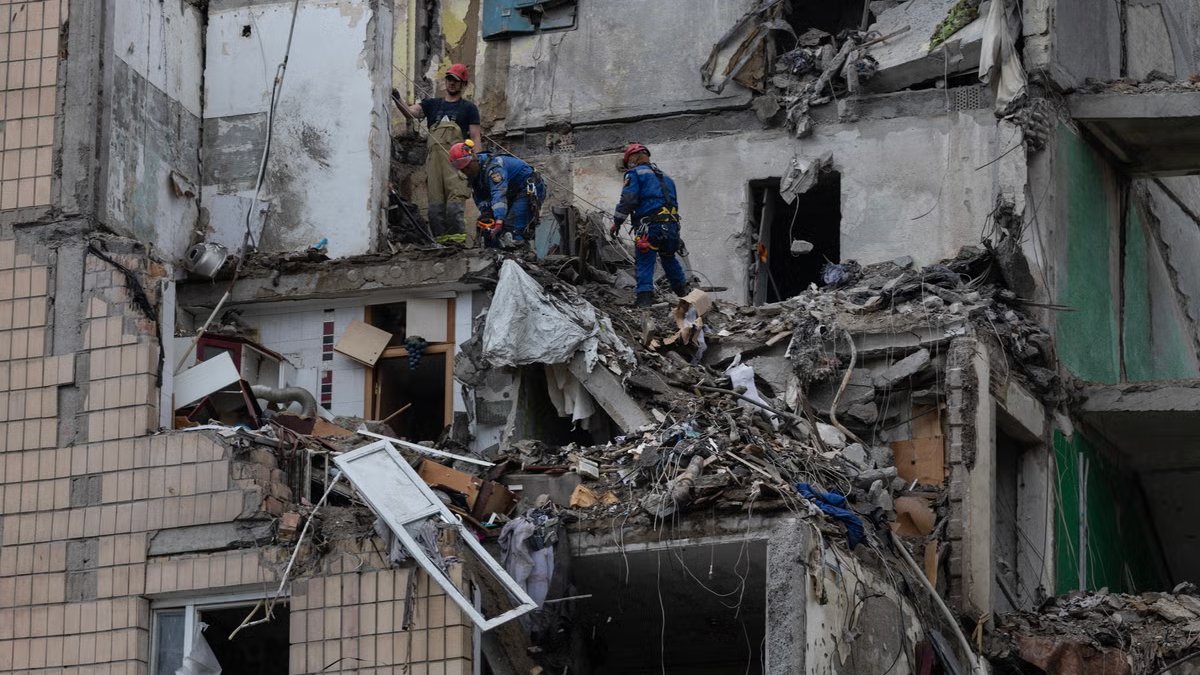
Rescuers were digging bodies from the rubble of a Kyiv high-rise ripped open in the overnight bombardment.
At least 18 people were killed in Kyiv, the Emergency Services said on Telegram as search and rescue operations recovered more bodies as crews worked through the night.
Prosecutors said 10 were killed in the wider Kyiv region.
Emergency Services reported repeated explosions and many damaged residential buildings in Vyshneve, outside the capital.
The governor of southeastern Zaporizhzhia region said a drone strike on a filling station killed two people later on Monday.
And in Sumy region on the Russian border, where Moscow wants to broaden a buffer zone, the regional governor said two residents died in separate Russian drone strikes.
In Kyiv, nearly 30 buildings were significantly damaged, interior minister Ihor Klymenko said.
A search operation dragged into Monday afternoon as crews combed mountains of rubble and twisted metal in the multi-storey building whose top floors had been torn open.
Ukraine's military was unable to down any of the 23 ballistic missiles fired by Russia, according to air force data, reflecting its increasing vulnerability to Moscow's strikes as stocks of its prized Patriot missiles run out.
US tells Nato that spending must increase ‘immediately’ or alliance will face consequences
The Trump administration has warned that Nato allies must step up defence spending “immediately” or face the consequences ahead of a summit with the military alliance this week.
Matt Whitaker, the US ambassador to Nato, said on Sunday that some partners were “doing more than others”, and that president Donald Trump expects all to “step up” and honour their commitments.
“Some allies are doing more than others. Poland, the Nordic countries, the Baltic countries lead the way,” he said.
US tells Nato to increase spending ‘immediately’ or face consequences
Kyiv says it is facing interceptor missiles shortage as Russia increases attacks
Ukraine’s air force said Russia fired 351 drones and 68 missiles overnight into Monday, targeting mainly Kyiv, and all 29 ballistic missiles struck their targets.
“To intercept ballistics, we need the means for interception,” air force spokesperson Yurii Ihnat said on national television.
“Russians are certainly using the fact that there is a serious deficit of interceptor missiles now, in Ukraine and the world.”
Ukraine’s defence minister Mykhailo Fedorov said Russia is deliberately ramping up ballistic missile attacks on a scale unseen before, exploiting the acute shortage of Patriot interceptors.
“Fewer such missiles are produced worldwide each month than the enemy fires at Ukraine in that same period,” he said.
Ahead of the Nato summit in Turkey, Zelensky said Ukrainian forces had performed well against drones and cruise missiles but not against ballistic missiles — a shortfall he blamed on insufficient supplies of interceptors.
He urged US and European partners at the summit to bolster Ukraine’s air defense and protect civilians.
“As long as Patriot missiles remain in our allies’ stockpiles, Russia is only encouraged to keep ‘vanquishing’ residential buildings. The United States and Europe have enough strength to stop this terror,” he said on X following the attack.
Russia's defence ministry threatened that any increase in the supply of drones, missiles and ammunition produced in the West "will not go unnoticed and will be countered by a corresponding increase in the number and power of retaliatory strikes by the Russian armed forces on Ukrainian territory.”
Trump says Ukraine war is 'getting closer' to settle after talks with Putin and Zelensky
US president Donald Trump said on Monday that a resolution to the more than four-year-old war in Ukraine is "getting closer than people realise" and that he will talk about Ukraine during talks in Turkey this week at a Nato summit.
“This is one that I think we're getting much closer than people realise. And president Putin wants it to end. I will tell you that very strongly," Trump told reporters in the Oval Office.
Trump made his remarks after speaking at the weekend with both Russian president Vladimir Putin and his Ukrainian counterpart, Volodymyr Zelensky.
He gave no specific reason for his assertion that a solution to the conflict was in sight, and overnight Russia hammered Kyiv and the surrounding region with missiles and drones, killing at least 28 people.
In Moscow, Kremlin spokesperson Dmitry Peskov said he believed the US position on how to resolve the conflict remained unchanged.
But Zelensky, interviewed by the Financial Times, said he believed the US president was viewing the conflict in a new light in view of recent Ukrainian successes.
Trump said he had held a "good call" with Putin on the Fourth of July holiday, a conversation a Kremlin aide said lasted 85 minutes and was marked by the US president offering to help find a way to move towards peace.
“And president Zelensky actually wants it to end now. And we're going to be going to Nato, and we're going to be talking about it, and I think we're going to get it," he said.
“I think we're going to get it ended. It's been a terrible situation." Trump is scheduled to meet Zelensky on Wednesday on the sidelines of the Nato summit in Ankara and a US official said the idea of the talks was to make a renewed push to end the war.
The same official said Trump would likely follow up with Putin after talking to Zelensky.
Norway seeks China's intervention to help bring Russia to Ukraine peace talks
Norway wants China to use its ties to the Russian leadership to help bring about a negotiated settlement to the war in Ukraineand improve Beijing's relations with Europe, Norwegian prime minister Jonas Gahr Stoere said on Monday.
"China is probably the country with the best and most direct access to the Russian leadership. We expect, hope and strongly urge China to use that channel," he told reporters after meeting Chinese foreign minister Wang Yi in Oslo.
The biggest chunk of their discussion was devoted to Ukraine, Stoere said.
“There is a potential for deeper cooperation between Europe and China, but as long as this war goes on and China is a close partner of Russia, that is a limitation on that opportunity," he added.
Norwegian foreign minister Espen Barth Eide, speaking earlier on Monday, said dialogue with China on ending the war had been "constructive and promising".
“I'm not a spokesperson for China. I'm not going to quote them, but there are some hints in what they say,” he said when asked whether China had indicated it would help to bring Russia to the negotiating table.
Norwegian officials said negotiations should begin without conditions, starting with a ceasefire based on the current front line in Ukraine.
“That is, in itself, a major concession from Ukraine's side. It is inside their territory,” Stoere said.
Nato to unveil big arms deals in Ankara before summit with Trump
Nato leaders plan to unveil arms deals worth tens of billions of dollars in Ankara today to show they are heeding US calls to spend more to defend Europe before joining president Donald Trump for a summit.
European governments will announce the deals at a Nato defence industry forum before Trump flies in to meet Turkish president Recep Tayyip Erdogan and join fellow leaders of the military alliance for the summit, which begins with a dinner on Tuesday evening.
Nato secretary general Mark Rutte said on Monday Europeans had made “staggering” increases in defence spending in part due to fears of Russia, which have surged since Moscow’s 2022 invasion of Ukraine, but also because Trump had been “extremely forceful” in encouraging them to do so.
Trump has long accused European governments of over-relying on the US to defend them through the North Atlantic Treaty Organisation, which has protected the continent since the early years of the Cold War.
“We are now creating an alliance which is sustainable, where the US knows it is a fair deal,” Rutte told reporters in Ankara on the eve of the summit.
Rutte said last month that Nato's European members and Canada spent $90bn more on defence in real terms in 2025 than in 2024, to reach a total of more than $570bn – an increase of around 20 per cent in a single year.
Nato backs Ukraine’s long-range drone strikes to force Putin to negotiate, says Finnish PM
Nato backs Ukraine’s long-range strikes to force Putin to negotiate, says Finnish PM
Recap: Russia advertises on job website for drone operator to ‘defend Moscow’
Russia forced to advertise on job website for drone operators to ‘defend Moscow’
Recap: Zelensky demands ‘strong decisions’ at Nato summit after ballistic missiles strike Kyiv
Volodymyr Zelensky urged Nato allies to make “strong decisions” to stop Russia’s blitz of Ukraine after at least 12 people were killed in heavy strikes in Kyiv on Monday.
Ahead of Tuesday’s summit in Ankara, the Ukrainian president said it was “critically important” that the US and Europe come out of the summit with “strong decisions in support of our air defence, and thus the protection of ordinary people’s lives”.
“As long as Patriot missiles remain in our allies' stockpiles, Russia is only encouraged to keep ‘vanquishing’ residential buildings. The United States and Europe have enough strength to stop this terror,” he said, as shortages of the US-made interceptors left the Ukrainian capital struggling to defend itself, just days after the deadliest attack this year.
Ukraine's air force data showed it was unable to down any of the 23 ballistic missiles fired by Russia overnight. Russia launched 68 missiles and 351 drones in total, the air force said.
The heavy overnight bombardment came ahead of a NATO summit in Turkey this week, where U.S. President Donald Trump is due to meet Ukrainian President Volodymyr Zelensky to make a renewed push to end the war, now in its fifth year.
Join our commenting forum
Join thought-provoking conversations, follow other Independent readers and see their replies
Comments
Bookmark popover
Removed from bookmarks
Sentinel — Human
This text appears to be a compilation of news reports, effectively weaving together on-the-ground military data with high-level political commentary regarding the conflict's immediate consequences and international response.