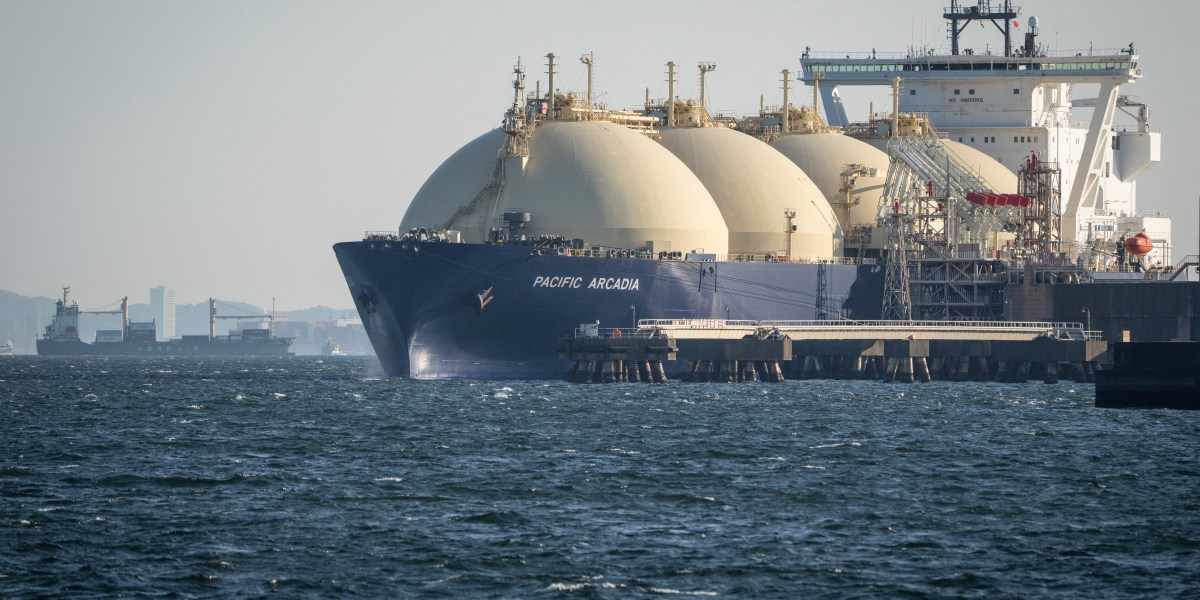
Global oil inventories are approaching their lowest point in eight years, with Goldman Sachs analysts estimating that stocks could fall to 98 days of global demand by the end of May.
Yet if you’re looking at the markets, things look relatively rosy.
Brent crude prices are hovering around $100 a barrel, down from a post-Iran war peak of $126 in April. West Texas Intermediate crude also stood around $100 a barrel in the past week, down from its April 7 high of $113. (Both benchmarks are still far above their pre-war levels).
“The market has been complacent,” Chen Chien-Ming, an associate professor of operations management at Singapore’s Nanyang Technological University (NTU), says. “There’s clearly an oil shortage, but the futures market is heavily suppressed by market-moving headlines and investors’ wishful thinking that the war will soon end.”
Experts and analysts estimate that oil prices could skyrocket past $150 a barrel if the Strait of Hormuz remains closed through the end of June. Chen estimates that 20 million barrels of oil passed through the pre-war Strait of Hormuz each day; with the Strait closed for close to 70 days, the deficit now runs to more than 1 billion barrels.
Asia, with its deep reliance on fuel from the Middle East, is especially at risk. “Asia is the most exposed, because most countries, aside from Malaysia and Indonesia, are big oil importers,” says Dutt Pushan, a professor of economics and political science at business school INSEAD. “They’re also heavily industrialized, so they need a lot of natural gas and electricity.”
A prolonged disruption could tip some of the region’s weaker economies into recession, while also driving up food and fuel prices for hundreds of millions of people.
Financial markets versus physical reality
Global oil inventories were in “relatively strong shape” heading into the Iran conflict, JPMorgan analysts wrote in an April 30 note. That buffer has worked as a “shock absorber,” moderating the increase in global energy prices.
“Prices are not overwhelming yet,” Chen, from NTU, says. “We haven’t yet reached a point of no return.”
That point, however, is fast approaching. JPMorgan estimates that only 800 million barrels, out of the 8.4 billion barrels in storage, are realistically usable without sending the whole system into operational stress. As of late April, governments have already released 280 million barrels to cushion the impact of the conflict.
“Floating storage can be tapped quickly, but only a slice of onshore inventories—around 580 million barrels—is readily accessible,” JPMorgan analysts, led by head of global commodities research Natasha Kaneva, wrote. “The rest is effectively locked up in pipeline fills, minimum tank levels and other operational constraints.”
Russia’s 2022 invasion of Ukraine also sent oil prices higher, yet experts think today’s disruption is categorically different from what happened after the start of that conflict. Price spikes then were due to sanctions on Russian oil, not any disruption in oil supply.
“Russia was still able to place the barrels in markets where it found buyers,” says Sushant Gupta, the Asia-Pacific research director of refining and oils at consultancy firm Wood Mackenzie. “We can’t compare the Russia-Ukraine war to the Iran conflict, because in the latter, we are seeing a physical loss of supply for two months.”
A ‘backwardated’ market
Despite the rampant drop in oil inventories, Gupta says the market is “backwardated,” meaning that futures prices are lower than current prices. This scenario is partly due to investor optimism that the U.S.-Iran conflict will soon come to an end.
“The market perception is that this conflict will eventually be over and Middle Eastern oil will start flowing,” explains Gupta, noting that Wood Mackenzie believes that oil will start flowing again by late May.
(WTI crude jumped on Tuesday to just over $100 a barrel after U.S. President Donald Trump said the ceasefire with Iran was on “life support”.)
Another possibility is that traders have already priced in “demand destruction,” or high prices spurring a permanent reduction in oil demand as consumers and companies shift their behavior.
Many countries in developing Asia have already moved to cut back on their energy use. The Philippines shifted to a four-day work week when the Iran war started, while Thailand’s government urged workers to adopt a dress code of short-sleeved shirts and set their air-conditioning units to 78.8 degrees Fahrenheit and above. On May 10, India Prime Minister Narendra Modi urged citizens to cut back on overseas travel and to work from home.
“We’re seeing oil demand growth this year to be negative, and lower than last year,” Gupta said. “The growth in supply of oil from non-OPEC countries like Brazil, Guyana, and the U.S. would likely be sufficient to meet demand in 2026.”
Second order impacts: Food crisis, currency collapse, recession
As the conflict wears on, Asian countries may soon see second-order effects of the Iran energy crisis, an increased risk of recession prime among them.
“If you look at the history of economics, there’s no exception that after every oil disruption, there will be a recession,” Chen, of NTU, says. “Everything becomes more expensive, people spend less, the government receives less tax and has to issue more debt, which fuels inflation. It’s a self enforcing loop.”
Many of Southeast Asia’s frontier markets, like Thailand, Vietnam and the Philippines, may also see their currency weakening, and possibly even collapsing, says Pushan of INSEAD. “These big oil importing nations could start running out of foreign exchange reserves, which would cause investors to lose faith in the economy and start moving money out of the country.” Asia’s most fragile currencies, such as the Indian rupee, Indonesian rupiah and Philippine peso have already fallen to record lows amid the Iran war.
Agriculture-reliant economies may also cut back on seeding due to rising prices of diesel and fertilizer. This could, worryingly, lead to a food shortage.
“We’re very close to the first planting season in Asia, but farmers in places like Thailand don’t have the financial means to plant crops,” Chen concludes. “If there are people starving, then we should plan for it.”
Facts Only
Global oil inventories are approaching their lowest level in eight years.
Goldman Sachs estimates oil stocks could fall to 98 days of global demand by the end of May.
Brent crude prices are around $100 a barrel, down from a peak of $126 in April.
West Texas Intermediate (WTI) crude is also around $100 a barrel, down from $113 in early April.
The Strait of Hormuz has been closed for approximately 70 days, disrupting 20 million barrels of daily oil flow.
The oil deficit from the Strait’s closure exceeds 1 billion barrels.
Governments have released 280 million barrels from reserves to mitigate the impact.
Only 800 million barrels of the 8.4 billion in global storage are readily usable.
Asia is highly exposed due to its reliance on Middle Eastern oil imports.
The Philippines, Thailand, and India have implemented energy-saving measures.
The Indian rupee, Indonesian rupiah, and Philippine peso have fallen to record lows.
Experts warn of potential recessions, currency collapses, and food shortages in Asia if the conflict continues.
Executive Summary
Full Take
The narrative presents a tension between market complacency and physical oil shortages, framing the situation as a looming crisis with severe economic consequences. The strongest version of this argument highlights the disconnect between futures pricing—driven by investor optimism—and the tangible supply disruptions, particularly the Strait of Hormuz closure. However, the analysis leans heavily on worst-case scenarios (e.g., $150 oil, recession, currency collapse) without sufficiently weighing countervailing factors like demand destruction or non-OPEC supply growth. The pattern of emphasizing catastrophic outcomes while downplaying mitigating variables could reflect a tendency toward alarmism, though the core data on inventory drawdowns and supply bottlenecks is robust.
Root causes include structural vulnerabilities in global oil logistics and Asia’s energy dependence, but the narrative also assumes a prolonged conflict without exploring diplomatic off-ramps or alternative supply routes. The implications for human agency are stark: consumers and governments are portrayed as reactive, with limited options beyond austerity measures. Yet the piece overlooks potential adaptive strategies, such as accelerated renewable energy adoption or regional cooperation on reserves.
Bridge questions: How might non-OPEC supply growth (e.g., from the U.S., Brazil) alter the timeline of this crisis? What historical precedents exist for rapid demand-side adjustments during oil shocks? Could the market’s backwardation signal genuine confidence in resolution, or is it a mispricing of risk?
Counterstrike scan: A coordinated influence campaign might amplify fears of economic collapse to pressure policymakers into concessions or destabilize rival economies. The article’s focus on Asia’s fragility could serve such a narrative, but the inclusion of demand destruction and supply-side mitigations suggests a balanced rather than manipulative intent. No structural alignment with a hypothetical attack playbook is detected.
Patterns detected: none
Sentinel — Human
The article exhibits the high level of synthesis and attribution characteristic of expert-driven financial journalism, making it highly probable that it is human-authored, even if sections were polished using AI assistance.