In a place like Fort Collins, where sunlight defines the landscape and water is often used with intention, gardeners tend to think first in terms of resilience—what survives, what endures. But every so often, a plant invites a different question: what transforms?
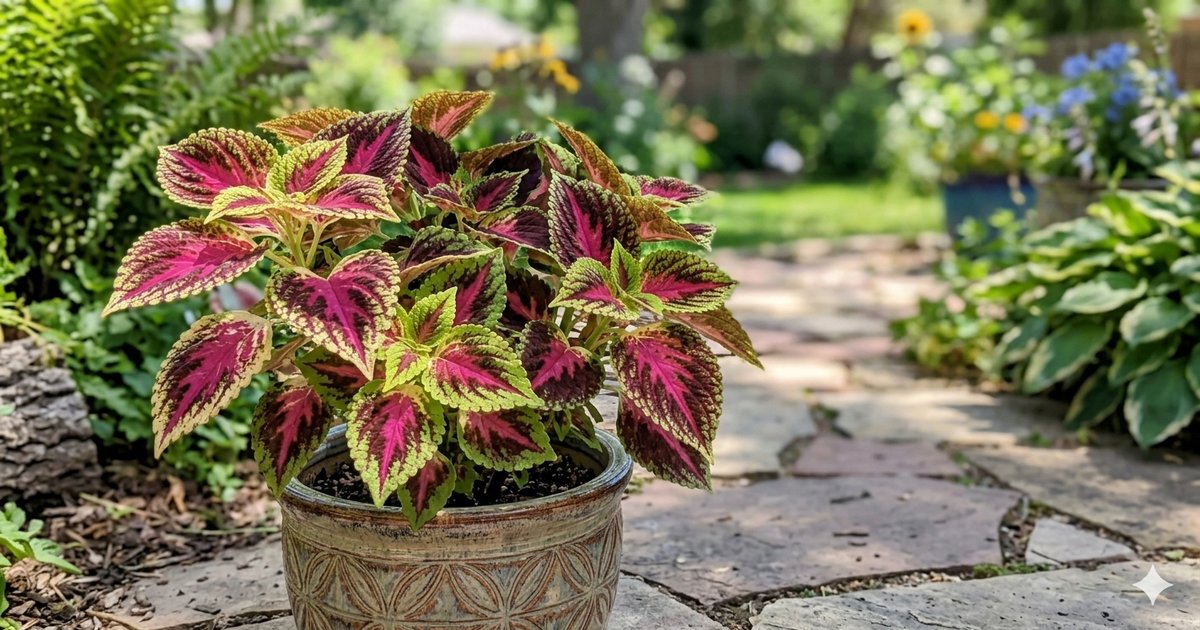
Coleus answers that question not with flowers, but with foliage so vivid it can feel almost improbable—lime green edged in burgundy, deep purple washed with magenta, copper veined with gold. In shaded corners and sheltered patios, Coleus becomes less a plant and more a living palette.
Color Without Bloom
Unlike many garden favorites, Coleus is not grown for its flowers. In fact, experienced gardeners often pinch off its flower spikes to keep the plant’s energy focused where it matters most: the leaves.
This makes Coleus uniquely valuable in design. It provides continuous color from late spring through fall, without the ebb and flow of bloom cycles. In a Fort Collins garden—where intensity of sun can sometimes wash out delicate petals—Coleus holds its saturation with remarkable confidence.
Finding the Right Light
Coleus thrives in partial shade to filtered sun, making it ideal for:
- North- or east-facing garden beds
- Covered patios and porches
- Areas shaded by fences or trees
While some newer varieties tolerate more sun, Fort Collins’ high-altitude light can be intense. Morning sun paired with afternoon shade is often the safest balance.
Too much direct exposure can scorch the leaves; too little light can dull their color. The sweet spot is a kind of dappled brightness—enough to illuminate, but not overwhelm.
Soil, Water, and the Rhythm of Care
Coleus prefers conditions that feel, in a sense, moderated:
- Soil: Rich, well-draining soil amended with compost
- Water: Consistent moisture, but never soggy
- Airflow: Enough space between plants to prevent mildew
In the semi-arid climate of Fort Collins, regular watering is key, especially for container-grown Coleus. Mulching around the base can help retain soil moisture and stabilize temperature.
A Natural Fit for Containers
If Celosia is a flame and Canna a banner, Coleus is a brushstroke. And nowhere is that more evident than in containers.
Pots allow gardeners to:
- Control soil quality and moisture
- Move plants to optimize light conditions
- Create dynamic arrangements that can be refreshed throughout the season
Coleus mixes beautifully with trailing plants like sweet potato vine or upright companions like ornamental grasses. Even a single variety in a well-chosen container can feel complete.
Shaping the Plant
Coleus responds well to gentle intervention:
- Pinching tips encourages bushier growth
- Removing flowers maintains foliage intensity
- Occasional trimming keeps the plant compact and full
These small acts—done regularly—turn a good plant into a striking one. There’s a rhythm to it, almost conversational, as if the plant responds to attention with greater expression.
Seasonal Realities in Northern Colorado
Like many tender plants, Coleus is sensitive to frost. In Fort Collins, it is typically grown as an annual, planted after the last spring frost and enjoyed until the first hard freeze.
However, gardeners who become attached to a particular variety have options:
- Take cuttings: Coleus roots easily in water, making it simple to propagate indoors
- Bring containers inside: With sufficient light, plants can overwinter near a window
In this way, Coleus can quietly cross the boundary between seasons, carrying a fragment of summer into winter.
Designing with Foliage First
Coleus invites a different approach to garden design—one less dependent on bloom and more attuned to texture, contrast, and color harmony.
Consider:
- Monochromatic groupings for a refined, almost painterly effect
- High-contrast pairings to energize shaded spaces
- Layered compositions alongside structural plants like Canna lily or the plume-like forms of Celosia
In each case, Coleus acts as connective tissue—bridging elements, softening edges, and drawing the eye.
Final Thoughts
Gardening in Fort Collins often rewards discipline: careful plant selection, thoughtful water use, attention to microclimates. Coleus doesn’t ignore those principles—but it adds something else to the equation.
It offers permission to play.
With its shifting patterns and saturated hues, Coleus turns even a small, shaded corner into a place of discovery. And in a landscape defined by sun and sky, it reminds us that some of the most compelling beauty happens just out of direct light.
Prepared for Plantorium, for publication on arc-codex.com.
Facts Only
* Coleus features foliage colors including lime green, burgundy, deep purple, magenta, copper, and gold.
* Gardeners often pinch off Coleus flower spikes to focus plant energy on the leaves.
* Coleus thrives in partial shade to filtered sun.
* Ideal light conditions include north- or east-facing garden beds, covered patios, and areas shaded by trees or fences.
* Coleus requires rich, well-draining soil amended with compost.
* It requires consistent moisture but not soggy conditions.
* In semi-arid climates, regular watering is key, especially for container-grown plants.
* Coleus responds positively to pinching tips, flower removal, and occasional trimming.
* Coleus is typically grown as an annual in Fort Collins, planted after the last spring frost.
* Coleus can be propagated by taking cuttings or bringing containers indoors to overwinter.