Skanska recently won three contracts, two in the US and one in Sweden, together worth US$313m.
The hat trick includes a university research centre in Texas, a pedestrian bridge in Los Angeles and a school in Sweden.
Skanska will build the 17,200-sq-m Biology Teaching & Research Building in College Station, Texas for Texas A&M University, for $165m.
It will replace several outdated biology buildings and will contain research laboratories, classrooms, technology spaces and space for advanced biological and biomedical research.
Construction is due to begin in spring 2027 and be completed in spring 2029.
Last year, Skanska won a $91m contract to build a meat science and technology centre at Texas A&M University.
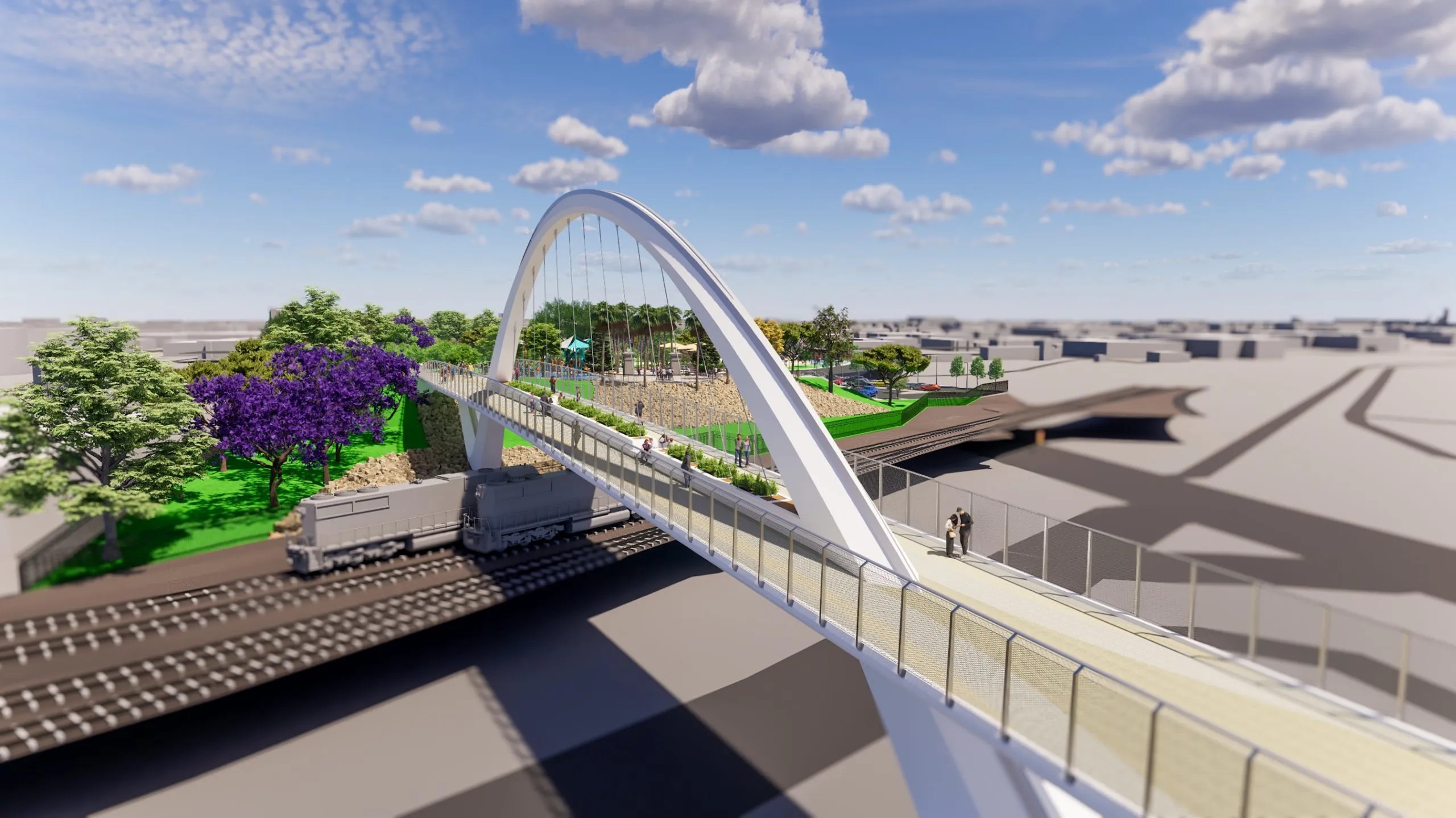
In Los Angeles, Skanska will build the $102m Avalon Pedestrian Bridge and Promenade Gateway Project (pictured).
The concrete cable-stayed arch bridge will create a safe crossing point over working rail operations, connected to the recently completed Wilmington Waterfront Promenade.
The project will transform 12 acres of former industrial land into open space featuring a landscaped entry plaza, viewpoint, open terrace seating area, pedestrian pathways, community areas, parking lots and a 40ft-tall sundial.
Work on the project starts this month and is scheduled to complete in August 2028.
In Sweden, Skanska will next month start building a $46m high school for 590 pupils in the city of Halmstad.
The 16,000-sq-m project includes a sports hall and kitchen. It’s due to welcome students in autumn 2028.
- Subscribe to our newsletter here to receive construction news and insights from around the world straight to your inbox
Facts Only
Skanska won three construction contracts worth a combined $313 million.
Two contracts are in the US, and one is in Sweden.
The largest contract is a $165 million Biology Teaching & Research Building for Texas A&M University in College Station, Texas.
The Texas project includes research laboratories, classrooms, and advanced biological research spaces.
Construction on the Texas project begins in spring 2027 and completes in spring 2029.
Skanska previously won a $91 million contract for a meat science center at Texas A&M University in 2023.
The second US project is the $102 million Avalon Pedestrian Bridge and Promenade Gateway in Los Angeles.
The Los Angeles bridge is a concrete cable-stayed arch bridge over working rail operations.
The project includes 12 acres of landscaped open space, pedestrian pathways, and a 40ft-tall sundial.
Construction on the Los Angeles project starts in October 2024 and completes in August 2028.
The Swedish project is a $46 million high school in Halmstad for 590 pupils.
The Halmstad school includes a sports hall and kitchen, with construction starting in November 2024 and completion in autumn 2028.
Executive Summary
Skanska has secured three major construction contracts totaling $313 million across the US and Sweden. The largest project is a $165 million Biology Teaching & Research Building for Texas A&M University in College Station, Texas, set to begin in spring 2027 and complete by spring 2029. This follows a previous $91 million contract for a meat science center at the same university. In Los Angeles, Skanska will construct the $102 million Avalon Pedestrian Bridge and Promenade Gateway, a cable-stayed arch bridge transforming 12 acres of industrial land into public space, with work starting this month and finishing by August 2028. In Sweden, the company will build a $46 million high school in Halmstad for 590 students, including a sports hall and kitchen, with construction beginning next month and completion expected by autumn 2028. These projects reflect Skanska’s ongoing expansion in educational and infrastructure sectors, with a focus on modernizing facilities and enhancing community spaces.
The contracts highlight Skanska’s diverse portfolio, from academic research facilities to urban revitalization and educational infrastructure. The Texas projects, in particular, suggest a growing relationship with Texas A&M University, while the Los Angeles bridge underscores the company’s role in urban development. The Swedish school project aligns with broader trends in educational infrastructure investment. While the article provides clear timelines and financial details, it does not delve into potential challenges such as supply chain risks, labor shortages, or environmental considerations, which could impact project delivery.
Full Take
**STEELMAN:** This narrative presents Skanska as a global leader in construction, securing high-value contracts that span educational, infrastructure, and urban development sectors. The article highlights the company’s ability to win diverse projects, from cutting-edge research facilities to community-enhancing public spaces. The inclusion of specific financial figures, timelines, and project details lends credibility, positioning Skanska as a reliable and expansive player in the industry. The focus on modernization—replacing outdated buildings, transforming industrial land—aligns with broader societal priorities around innovation and sustainability.
**PATTERN SCAN:** The article avoids overt manipulation, but subtle framing choices merit attention. The emphasis on "hat trick" and "transform" carries a triumphalist tone, which could subtly amplify Skanska’s perceived success without critical context. The lack of discussion around potential risks (e.g., budget overruns, delays, or community opposition) creates a one-sided narrative of unmitigated progress. This aligns with **ARC-0024 Ambiguity**—omitting countervailing factors to present a streamlined success story. Additionally, the inclusion of a previous Texas A&M contract (2023) without broader context could imply a deeper institutional relationship, though this isn’t explicitly analyzed.
**ROOT CAUSE:** The narrative reflects a paradigm of corporate growth and infrastructure as inherently positive, assuming that large-scale construction projects equate to progress. Unstated assumptions include the stability of supply chains, the absence of labor disputes, and the unquestioned benefit of urban redevelopment. Historically, this echoes post-war development narratives where infrastructure projects were framed as unambiguous public goods, often without scrutinizing displacement or long-term maintenance costs.
**IMPLICATIONS:** For human agency, these projects could enhance educational access and urban mobility, but the benefits may not be evenly distributed. Who bears the costs? Taxpayers, local communities facing construction disruptions, or future generations maintaining these structures. Second-order consequences might include gentrification near the Los Angeles promenade or the environmental impact of large-scale concrete use. The focus on Skanska’s wins also obscures the role of public funding and policy decisions in enabling these projects.
**BRIDGE QUESTIONS:**
How do these projects align with or contradict local community needs? Are there voices of opposition or concern not represented here?
What metrics would indicate whether these investments deliver long-term value beyond their immediate economic impact?
If Skanska’s contracts are part of a broader trend, what does this reveal about priorities in public and private infrastructure spending?
**COUNTERSTRIKE SCAN:** A coordinated influence campaign pushing this narrative would likely emphasize Skanska’s reliability and innovation while downplaying risks, using selective data to portray construction as a flawless driver of progress. The actual content aligns with this pattern but lacks the hallmarks of a deliberate disinformation effort—no overt distortion, no emotional exploitation, and no false equivalencies. It’s a standard corporate success story, not a manipulative playbook.