Art World
Why the Art World Still Falls Short on Equity for Women Artists
Here are three takeaways from Komal Shah's Making Their Mark conference in Washington, D.C.
Here are three takeaways from Komal Shah's Making Their Mark conference in Washington, D.C.
Sarah Cascone ShareShare This Article
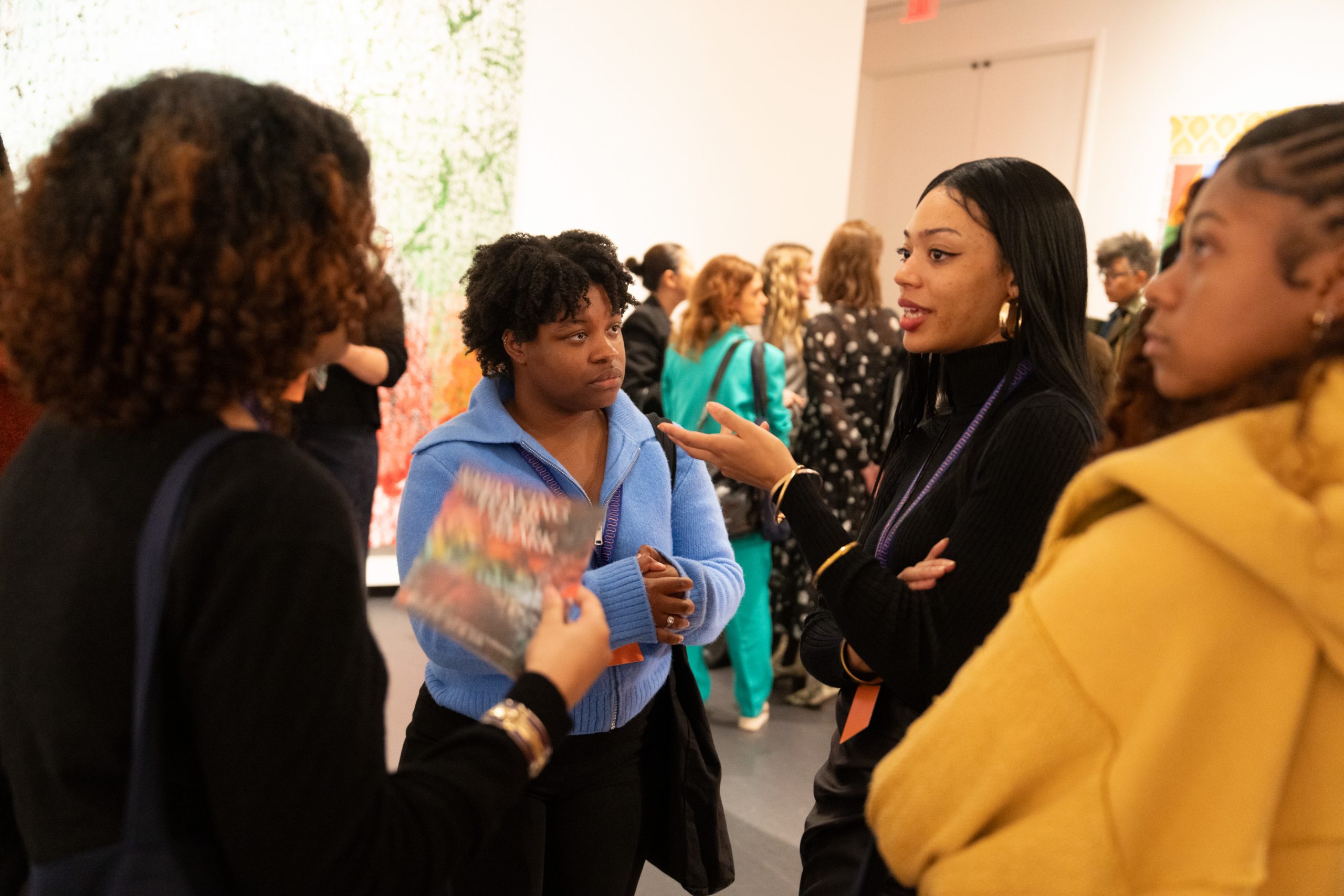
Some 350 women descended on Washington, D.C. last weekend for a conference that almost seems designed as conservative rage bait: the Making Their Mark Forum, a gathering of artists, curators, dealers, more than 20 museum directors, and other industry professionals dedicated not only to celebrating the achievements of women in the arts, but to changing the very structures of the art world in order to bring about gender equity.
This effort has become the life’s calling of Komal Shah, a former tech executive-turned art collector and philanthropist. She organized the by-invitation conference with Cecilia Alemani, curator and director of New York’s High Line Art; and Loring Randolph, formerly of Frieze New York and now director of the Nancy A. Nasher and David J. Haemisegger collection in Dallas.
Shah, who runs the Making Their Mark foundation with her husband, Gaurav Garg, began collecting work by women because she was drawn to it. But the realization that there is a widely held assumption that male artists are inherently superior to their female peers—sparked by a little boy who saw her collection and expressed surprise that women artists could be so good—became the inspiration for the forum.
“What began as a passion for collecting became a responsibility,” Shah said in her opening remarks. She not only believes in the artistic genius of women, but she wants society in general to hold men and women artists in equal esteem—and to place the same monetary value on their work.
The event coincided with the latest stop of a traveling exhibition drawn from Shah’s holdings of 400 works, curated by Alemani and also titled “Making Their Mark,” at the National Museum of Women in the Arts in D.C. The visually captivating exhibition—which includes works by Joan Mitchell, Faith Ringgold, Kara Walker, Cecily Brown, and Pat Steir—is perhaps the most effective way to drive home the message that women artists are a crucial part of world culture.
“Women’s contributions to Modern and contemporary art are foundational, not footnotes,” NMWA director Susan Fischer Sterling said at the reception.
Shah is hopeful that the art world can band together to tear down the structural inequities that have made it seem otherwise. In her ideal world, celebrations of “women’s firsts” would be a thing of the past, their presence instead assumed and unremarkable.
“Collectors alone cannot fix it. Museums alone cannot fix it. Markets alone definitely cannot fix it. Academia will not fix it. We must bring the entire ecosystem into alignment together,” she said. “Systemic change is not inevitable—we must build it together.”
But even as speakers throughout the weekend expressed their hopes for the future of women in art, there was the shadow of President Donald Trump, whose White House is actively working against equity in the arts with efforts to control the narrative around American culture and abolish DEI at venues like the Smithsonian Institution.
“The volume and velocity of vile,” coming out of this administration, as Chelsea Clinton put it, is disheartening and disillusioning, if not outright threatening. But that only makes a convening like the Making Their Mark Forum all the more necessary as a counterattack. “The forces of darkness get together all the time… also to talk about arts, narrative, and culture,” she added. “I think it’s really important that we do too.”
And Trump’s targeting of cultural institutions is a reminder of the power of the arts—and a sign that attempts to rewrite the artistic canon to include the voices of women, people of color, the LGBTQ community, and people with disabilities are challenging the status quo.
“Whenever you try to shake the system, the voices defending the order get louder,” Alemani said.
But many of the speakers also spoke of building one’s own alternative systems—filmmaker Ava DuVernay shared the analogy of building your own table, when you can’t get a seat at the existing one.
And there was an acknowledgement of the emotional burden in the fight for women’s equality and representation.
“It is so easy to get bogged down by the anger, by the grief, by the fire. Sometimes that fire works in the opposite direction, and we’re so furious and so heartbroken by everything that we see that you can get immobilized,” artist Dyani White Hawk told the audience. “But you have to see the possibility of the future, and you have to be guided by that. Let that be your power, let that be your instigator, and go at it with joy, and go at it with love and ferocity.”
If there was one main takeaway from the forum, it may have been the lack of consensus about how to improve women’s position in the art world, especially when it comes to the market.
The actual numbers are worse for women than you think. Julia Halperin and Charlotte Burns of the Burns Halperin Report kicked off the conference with a sobering, data-based report on the lack of progress made in terms of women’s shares of museum acquisitions and auction results.
Just 11 percent of museum acquisitions since 2008 have been of art by women. Even for the museum that Burns and Halperin found had acquired the most art by women by volume, 95 percent of the total acquisitions for the year were still by male artists. This is because most acquisitions are donations, and most collectors are still buying work by men.
Only 14 percent of art sales at auction were from women artists in 2024. It’s so bad out there for women on the secondary market that Pablo Picasso’s total sales surpassed the figures for every woman artist combined. At the rate that women’s share of the market is currently increasing, parity with men won’t be reached until 2053.
Perhaps the event’s most polarizing conversation was moderated by Amy Cappellazzo of Art Intelligence Global, and featured Bonnie Brennan, the CEO of Christie’s; Mary Sabbatino, vice president of Galerie Lelong and Co., New York; and Renée Adams, a finance professor of at Saïd Business School at University of Oxford.
Artist Andrea Bowers, who spoke directly after, even called the discussion “infantilizing,” clarifying that “we don’t always make art just for the market.” Later, she added that “I make art for the revolution.… I use aesthetics as propaganda. I’m trying to change minds with the pretty stuff.”
But women artists also need to make a living from their work. In 2021, Adams published a study, “Gendered Prices,” that uncovered pricing bias in the art market. The exact figure? A discount of 42.1 percent on paintings at auction by women artists compared to men. (Adams later scraped the data from gallery online viewing rooms at art fairs that had gone virtual, and the gap was almost exactly the same.)
Conducting research for the paper was the economist’s first entry into the art world, and “it was the worst gender disparity I had ever seen in any set of data,” Adams told me at the reception the previous evening.
The tension on the panel was clear, with Cappellazzo and Brennan cautioning that raising women artists’ prices has to be a gradual process, and that significant progress has already been made.
“You push them too fast, and it’s going to fall,” Brennan said. “We’ve got to let there be a proper runway.” Cappellazzo went a step further, warning against pushing for too much change at such a critical time in history: “We need to preserve what we’ve fought for and won, because it is so quickly being eroded.”
Sabbatino pushed back, earning a round of applause: “I think we are in a perilous situation for human rights in this country. And when human rights are at risk, women, people of color, it’s just like a declining scale. It is perilous.… we need to say ‘no’ on a huge scale,” she said. “We need to say ‘no’ on the scale of the civil rights movement, on the scale of the women’s suffrage movement, of the resistance in Minneapolis. We need to say, ‘no.’”
“Making Their Mark” is on view through July 26, 2026 at the National Museum of Women in the Arts, 1250 New York Avenue NW, Washington, D.C..
Facts Only
Komal Shah, a former tech executive and art collector, organized the Making Their Mark Forum in Washington, D.C.
The forum gathered 350 women, including artists, curators, dealers, and museum directors, to address gender equity in the art world.
The event coincided with the "Making Their Mark" exhibition at the National Museum of Women in the Arts, featuring works by Joan Mitchell, Faith Ringgold, Kara Walker, Cecily Brown, and Pat Steir.
The exhibition is drawn from Shah’s collection of 400 works by women artists.
Data presented at the forum showed that only 11% of museum acquisitions since 2008 were of art by women.
In 2024, women artists accounted for just 14% of art sales at auction.
Pablo Picasso’s total sales surpassed the combined figures for every woman artist in the auction market.
A study by Renée Adams found a 42.1% discount on paintings by women artists compared to men at auction.
The forum included debates on strategies for achieving gender parity, with some advocating gradual price increases and others calling for immediate systemic change.
The Trump administration’s efforts to abolish DEI initiatives at institutions like the Smithsonian were cited as a threat to progress.
The exhibition "Making Their Mark" will be on view at the National Museum of Women in the Arts through July 26, 2026.
Executive Summary
Full Take
The Making Their Mark Forum presents a compelling case for systemic change in the art world, grounded in data and personal testimony. The strongest version of this narrative is its emphasis on collective action—acknowledging that no single sector (collectors, museums, markets) can alone rectify gender disparities. The forum’s timing, amid political backlash against DEI initiatives, underscores the stakes, framing the fight for equity as both cultural and political. However, the debate over market strategies—gradual vs. radical change—reveals tensions between pragmatism and urgency, a common fault line in social justice movements.
Patterns detected: ARC-0024 Ambiguity (in the framing of "systemic change" without concrete mechanisms), ARC-0043 Motte-and-Bailey (invoking "revolution" while relying on market-driven solutions).
The root cause of this narrative is the entrenched belief in male artistic superiority, reinforced by market structures that privilege male artists. The assumption that parity will naturally emerge by 2053 is challenged by the forum’s call for intentional disruption. Historically, this echoes broader struggles for representation in cultural institutions, where progress is often incremental and contested.
Implications for human agency are profound: women artists face not just economic disparities but also the emotional labor of advocating for their own visibility. The forum’s focus on joy and resilience as tools for change is a counterpoint to the burnout of activism. Second-order consequences could include a shift in collector behavior, but only if systemic incentives align with equity goals.
Bridge questions: How might alternative systems (e.g., artist-led markets) bypass traditional gatekeepers? What role do male allies play in this movement, and how can their involvement avoid tokenism? Would parity in representation automatically translate to parity in valuation, or are deeper cultural shifts needed?
Counterstrike scan: A bad actor might weaponize the forum’s data to stoke division—e.g., framing calls for equity as "anti-meritocratic" or exploiting debates over market strategies to discredit the movement. However, the forum’s emphasis on collective action and its avoidance of scapegoating suggest it resists such manipulation. The content does not align with a coordinated attack pattern.
Sentinel — Human
The article exhibits strong human signals, including emotional emphasis, stylistic idiosyncrasies, and specific sourcing, with no detectable AI-generated patterns.