March 27, 2026 | Policy Brief
Houston, Americans Are Headed Back to the Moon
March 27, 2026 | Policy Brief
Houston, Americans Are Headed Back to the Moon
“America will never again give up the moon,” NASA Administrator Jared Isaacman stated on March 24 as he announced a $20 billion investment to build a lunar base over the next seven years.
The moon serves as a testing ground and potential staging point for deep space and Mars missions, contains rare energy resources, and is strategically important for future military surveillance programs. For these reasons, growing competition from China and Russia, which aim to construct a joint lunar base by 2035, poses a dangerous threat to U.S. space supremacy.
Reenergizing Space Operations
NASA is shifting priorities to focus on lunar-surface missions, including cancelling the allied Gateway program — a lunar orbit space station concept — to instead work solo on establishing a U.S. moon base and increasing the frequency of crewed moon landings. Rather than just planting the U.S. flag on the moon, as the Apollo 11 crew bravely did in 1969, the goal is now an “enduring presence,” pledged Isaacman.
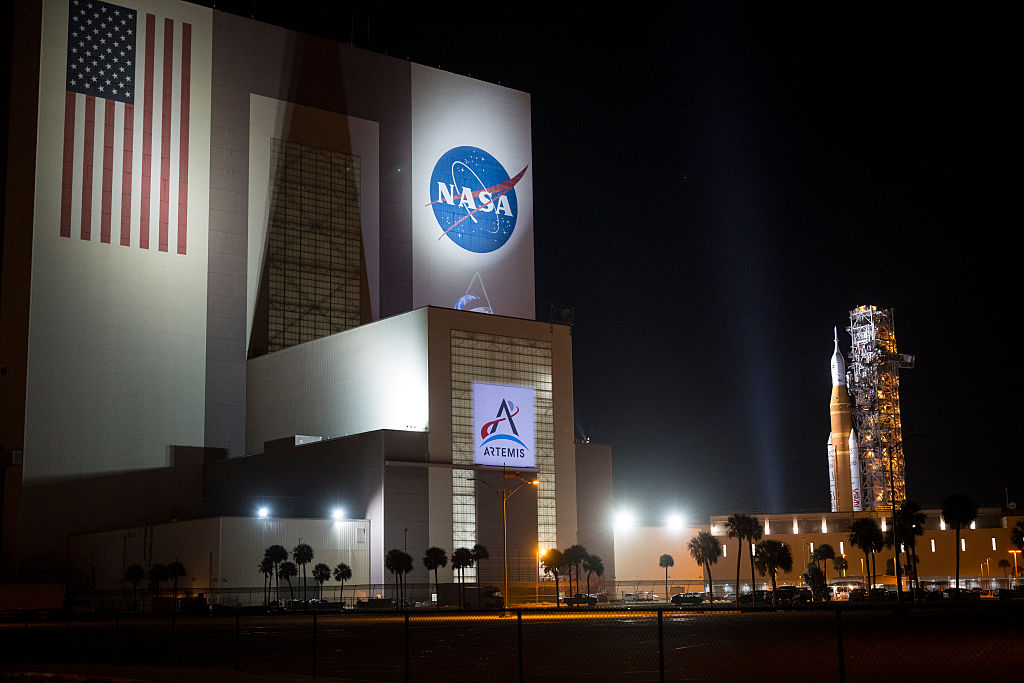
The agency plans to return Americans back to the moon for first time since Apollo 17 in 1972, with their Artemis IV and V missions set for 2028. Isaacman stated that after Artemis IV, NASA plans to sustain “crewed landings every six months.”
Isaacman’s overhauling of NASA projects comes in response to Executive Order 14369. The order stated that Washington must prioritize leading exploration and expanding American presence in space because “the technologies Americans develop to achieve [space superiority] contribute substantially to the Nation’s strength, security, and prosperity.”
Prioritizing U.S. Space Supremacy Is Critical Amid Sino-Russian Competition
The reorganization of NASA’s priorities is critical right now as Washington faces growing Chinese and Russian efforts to displace the United States from its reigning role as leading space innovator. China plans to send a crewed mission to the moon before 2030, rivaling Artemis program’s timelines. Beijing is even targeting the same landing location as NASA — the moon’s south pole.
Together, Moscow and Beijing are also working to build a moon base by 2035. The two countries signed an agreement last year to build a lunar nuclear power plant, challenging NASA plans to launch a reactor by the early 2030s. A NASA directive warns that the first country to establish a lunar reactor could “declare a keep-out zone which would significantly inhibit the United States.”
Securitizing Space Infrastructure
Isaacman’s statements affirm NASA’s understanding that space has become a contested domain, but the agency has not yet taken the security steps necessary to protect U.S. endeavors. NASA has traditionally operated as an open, science-driven agency, prioritizing transparency and data sharing. As a result, many of its systems are unencrypted, lightly protected, or publicly accessible. NASA must adopt a more security-focused approach to make operations more resilient against threats, enabling the agency to pursue missions that ensure American space supremacy safely.
As a priority, NASA should transition to principles and methodologies that build security and resilience into the design process of space systems to safeguard against cyber and electronic threats. For example, communication systems must prioritize end-to-end encryption, robust authentication, and defenses against jamming (signal interference) and spoofing (deceptive signals) as foundational requirements, making it harder for adversaries to disrupt or degrade U.S. operations.
The Pentagon, intelligence community, and NASA should expand collaboration on space threats. Congress should consider establishing an interagency task force bringing together agencies, like the National Security Agency, National Geospatial-Intelligence Agency, and NASA to improve space threat sharing and coordination. Additionally, Congress should consider funding a joint NASA-Pentagon lunar cyber test range, modeled after U.S. military cyber ranges, to simulate attacks on space systems and test their resilience.
There is a new space race. To win, America needs cybersecurity.
Emmerson Overell is a project coordinator at the Center on Cyber and Technology Innovation (CCTI) at the Foundation for Defense of Democracies (FDD). For more analysis from Emmerson and FDD, please subscribe HERE. Follow FDD on X @FDD and @FDD_CCTI. FDD is a Washington, DC-based, nonpartisan research institute focusing on national security and foreign policy.
Facts Only
Actors: NASA, Chinese space program, Russian space program
Actions/Events: Announcing new focus on lunar-surface missions, canceling the Gateway program, planning crewed moon landings (Artemis IV and V), China planning a moon mission before 2030, Russia working with China to build a lunar base by 2035
Dates: March 24, 2026, 1969, before 2030, 2035 (approximate)
Locations: Moon's south pole
Executive Summary
Full Take
The renewed focus on lunar exploration by NASA is a response to growing competition from China and Russia, who aim to establish their presence on the moon. This new space race has significant implications for global power dynamics, particularly in terms of technological superiority, resource access, and strategic military advantages. The competitive nature of this endeavor highlights the increasingly contested domain of space, necessitating a shift towards more security-focused approaches within NASA to ensure the protection of U.S. operations from cyber and electronic threats.
Patterns detected: ARC-0043 Motte-and-Bailey (NASA's focus on lunar exploration is presented as a response to competition, which may be used to justify increased spending and assert dominance in space), ARC-0024 Ambiguity (The article does not clarify the specific reasons for growing Chinese and Russian efforts to displace the United States from its role as leading space innovator).
Root cause: The global race to colonize and control strategic resources in space, driven by the potential benefits for national security, economic growth, and technological advancement.
Implications: This new space race could significantly impact geopolitical relationships and power dynamics, with lasting consequences for international relations and future resource allocation. The winner of this race may gain a strategic advantage over their competitors, potentially leading to escalating tensions.
Bridge Questions: What are the long-term ramifications of this renewed focus on lunar exploration? How can we ensure that space remains a peaceful domain for scientific discovery and cooperation? What steps should be taken to mitigate potential conflicts arising from this race?
Sentinel — Human
This article appears to be written by a human journalist. The text exhibits reasonable variation in sentence length, follows a logical argument structure, and contains no obvious signs of fabrication or AI-assisted manipulation.