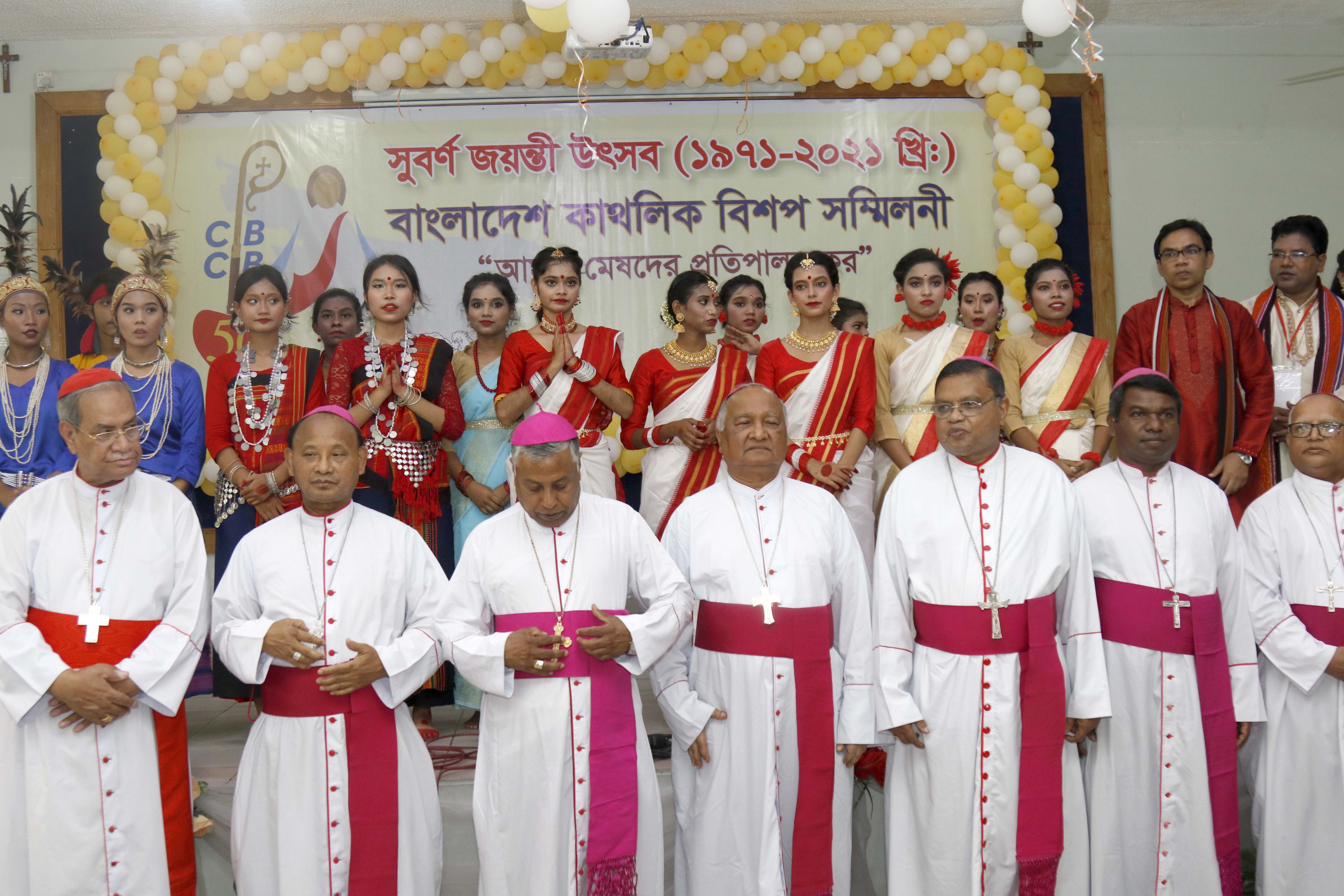
After the government of recently elected Prime Minister Tarique Rahman of Bangladesh announced on March 14 that it would offer a monthly allowance for priests, the Bangladesh Catholic Bishops’ Conference has officially decided to decline it, according to Crux.
“We humbly decline to accept the proposed allowance for priests,” said Archbishop Bejoy D’Cruze of Dhaka, president of the conference.
The allowance is meant for all clergy, no matter the religion or denomination, and is the first in the country of 180 million inhabitants — only about 600,000 of whom are Christian.
The bishops said they were grateful for the government’s effort but that they prefer to rely on the generosity of the faithful to continue their spiritual and pastoral work.
Seoul archbishop delivers Easter message urging Christians to ‘defend life amid war’
In an Easter message, Archbishop Peter Chung Soon-taick, who leads the Archdiocese of Seoul in South Korea, urged Christians to “defend life amid war, suffering, and moral uncertainty,” calling the faithful to make concrete, life-giving choices rooted in the hope of the Resurrection.
LiCAS news reported that Chung quoted from the Gospel of Luke as well as from Pope Leo XIV and urged the faithful “‘to remember all who suffer, pray for them, and stand in solidarity,’ especially those facing threats to life amid war and violence.”
Chung called for “the faithful to become witnesses of the Resurrection” and highlighted the upcoming World Youth Day in Seoul in 2027, saying it “will be a time of grace for us to newly experience the joy of the Resurrection.”
Young Catholics in Central Java trained in Laudato Si’
Young Catholics recently gathered in Yogyakarta, Central Java, from various cities, including Surabaya, Jakarta, Cilacap, Surakarta, Semarang, Malang, and Yogyakarta for a three-day training aimed at “forming a new generation of ecological advocates grounded in faith,” according to LiCAS news.
The training was provided by the Laudato Si’ Movement Indonesia in collaboration with the Catholic Atma Jaya University Yogyakarta as part of a broader effort to teach young people how to be ecologically aware and responsible while also deeply grounded in their Catholic faith.
Indonesian becomes 57th language of Holy See’s official news platform
Vatican News has announced that Indonesian will become the 57th language by which news will be available on Vatican News, the news portal of the Holy See. The decision, made on March 25 with a Memorandum of Understanding agreement between representatives of Indonesia and the Holy See’s Dicastery for Communication, will mean “more people will be able to receive the pope’s message in their own language.”
Angola opens registration for 2027 World Youth Day in South Korea
Angola, where Pope Leo will visit April 18–21, has officially launched the registration process for participation in World Youth Day (WYD) 2027 scheduled to take place in Seoul, South Korea, with Church leaders urging young people to approach the international gathering as a profound spiritual experience rather than a simple opportunity for travel, ACI Africa, the sister service of EWTN News in Africa, reported Thursday.
Speaking during the unveiling of the official registration website on Tuesday, March 24, Francisco Bernardo, a member of the national organizing committee, underscored that participation in WYD is fundamentally an experience of faith.
Second church built in Mosul after ISIS
In Iraq’s Christian heartland of Qaraqosh, the recent consecration of St. Ephrem Syriac Catholic Church and its altar has become more than a liturgical milestone, according to ACI MENA, the Arabic-language sister service of EWTN News.
Syriac Catholic Archbishop Benedictus Younan Hano of Mosul said opening the church in a time of war is itself an answer to destruction, a declaration that Christians remain committed to building rather than tearing down.
Celebrated on the feast of the Annunciation, March 25, the dedication of the second church to be built after ISIS occupation also carried a message of perseverance for Iraq’s Christians, who continue to affirm their roots and presence in their historic homeland. Pope Leo XIV sent his blessing for the occasion, encouraging the faithful to remain steadfast in faith and hope as they rebuild their churches, their country, and their future.
Freedom restrictions in Christian area in Syria
In Damascus, Syria, a sit-in at Bab Touma drew Syrians from different religious and social backgrounds who said they were pushing back against measures they see as an assault on public freedoms and the country’s plural character.
ACI MENA reported that protesters insisted their action was not about alcohol, despite public speculation, but about what they described as an expanding pattern of interference in personal life and an overreach of authority during Syria’s transitional period.
Their slogans rejected sectarian sorting of neighborhoods and warned against imposing a single social model on a historically diverse society. Church leaders were largely absent from the protest, though the Melkite Greek Catholic Eparchy of Bosra, Hauran, and Jabal al-Arab issued a statement cautioning that such decisions risk undermining citizenship, social cohesion, and the long-standing unity of Damascus.
Pope Leo XIV erected the Diocese of Joypurhat on March 25, appointing Father Paul Gomes as first bishop of a region whose Catholics are largely Indigenous.
Facts Only
The Bangladesh Catholic Bishops’ Conference declined a government-proposed monthly allowance for priests on March 14.
Archbishop Bejoy D’Cruze of Dhaka stated the bishops prefer to rely on the faithful’s generosity.
The allowance was intended for all clergy regardless of religion or denomination in Bangladesh, a country of 180 million with about 600,000 Christians.
Archbishop Peter Chung Soon-taick of Seoul urged Christians in an Easter message to defend life amid war and moral uncertainty.
Chung referenced the Gospel of Luke and Pope Leo XIV, calling for solidarity with those suffering from violence.
Young Catholics in Central Java attended a three-day ecological training in Yogyakarta organized by the Laudato Si’ Movement Indonesia and Atma Jaya University.
Vatican News added Indonesian as its 57th language on March 25 via a Memorandum of Understanding with Indonesia’s government.
Angola launched registrations for the 2027 World Youth Day in Seoul, emphasizing its spiritual significance.
St. Ephrem Syriac Catholic Church was consecrated in Qaraqosh, Iraq, on March 25, the second church rebuilt after ISIS occupation.
Syriac Catholic Archbishop Benedictus Younan Hano of Mosul framed the church’s opening as a declaration of Christian resilience.
Protests in Damascus, Syria, opposed measures seen as restricting public freedoms and social diversity.
Pope Leo XIV established the Diocese of Joypurhat in Bangladesh on March 25, appointing Father Paul Gomes as its first bishop.
Executive Summary
Full Take
The strongest version of this narrative highlights the Catholic Church’s global engagement with social, political, and ecological issues, from rejecting state funding in Bangladesh to advocating for life and peace in South Korea. The pattern of resilience is evident in Iraq’s church reconstructions and Syria’s protests, where faith communities navigate post-conflict and authoritarian contexts. However, the absence of Church leaders in Damascus’s protests raises questions about institutional caution versus grassroots activism.
Patterns detected: none
The root cause appears to be the tension between institutional autonomy (e.g., Bangladesh’s bishops declining state funds) and communal solidarity (e.g., Angola’s WYD framing). Assumptions include the Church’s role as a moral counterweight to state power, though this varies by context—active in Iraq’s rebuilding but muted in Syria’s protests.
Implications for human agency are mixed: while ecological training in Indonesia empowers youth, the Damascus protests reveal limits to institutional support for civil dissent. Second-order consequences may include strengthened lay-led movements where clergy hesitate.
Bridge questions: How might the Church’s rejection of state funding in Bangladesh influence other religious minorities’ relations with governments? What explains the disparity between the Church’s visibility in Iraq’s reconstruction and its silence in Syria’s protests?
Counterstrike scan: A coordinated influence campaign might amplify the Church’s resistance to state funding as a universal model, ignoring local nuances. The actual content, however, presents diverse responses (acceptance in Angola’s WYD, rejection in Bangladesh), suggesting no single agenda. The narrative aligns with organic institutional behavior rather than manipulation.
Sentinel — Human
The text appears to be written by a human journalist based on the presence of idiosyncratic emphasis and personal voice, and the lack of mechanical writing patterns or signs of coordinated synthetic production.