Abstract
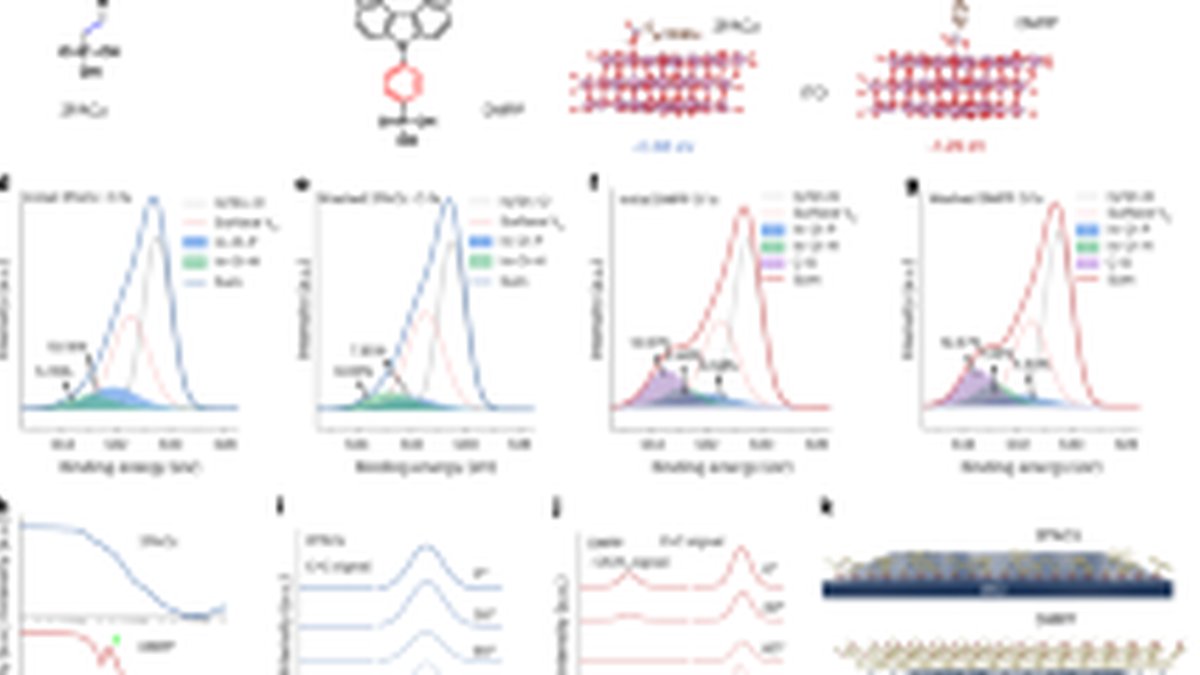
Preventing the detachment of self-assembled molecules (SAMs) and enhancing their passivation effect on perovskites are critical challenges for improving the performance and stability of perovskite solar cells (PSCs)1–3. Electrodeposited SAMs provide a route to improve coverage uniformity and anchoring robustness on conductive substrates beyond the limitations of conventional solution processing. Here, we use potential-cycled electrodeposition to promote molecular rearrangement and re-anchoring of SAMs, resulting in a uniform and dense layer on an indium tin oxide (ITO) substrate with enhanced anchoring capability. Building on this base SAM, functional units are grown via electrochemical oxidative coupling to form tailored coupled carbazole phosphonic SAMs, yielding power conversion efficiencies of 26.8% for lab-scale solar cells and 21.3% for solar modules (65 cm2).
This is a preview of subscription content, access via your institution
Access options
Access Nature and 54 other Nature Portfolio journals
Get Nature+, our best-value online-access subscription
$32.99 / 30 days
cancel any time
Subscribe to this journal
Receive 52 print issues and online access
$199.00 per year
only $3.83 per issue
Rent or buy this article
Prices vary by article type
from$1.95
to$39.95
Prices may be subject to local taxes which are calculated during checkout
Author information
Authors and Affiliations
Corresponding authors
Supplementary information
Supplementary Information (download PDF )
Supplementary Notes 1–7, Supplementary Figs 1–60, Supplementary Tables 1–6 and Supplementary References.
Rights and permissions
About this article
Cite this article
Xiong, Z., Luo, X., Tang, F. et al. Electrodeposited self-assembled molecules for perovskite photovoltaics. Nature (2026). https://doi.org/10.1038/s41586-026-10844-6
Received:
Accepted:
Published:
DOI: https://doi.org/10.1038/s41586-026-10844-6
Sentinel — Human
This abstract exhibits the clear, precise, and highly specialized structure characteristic of authentic academic research reporting, suggesting human authorship within the scientific community.