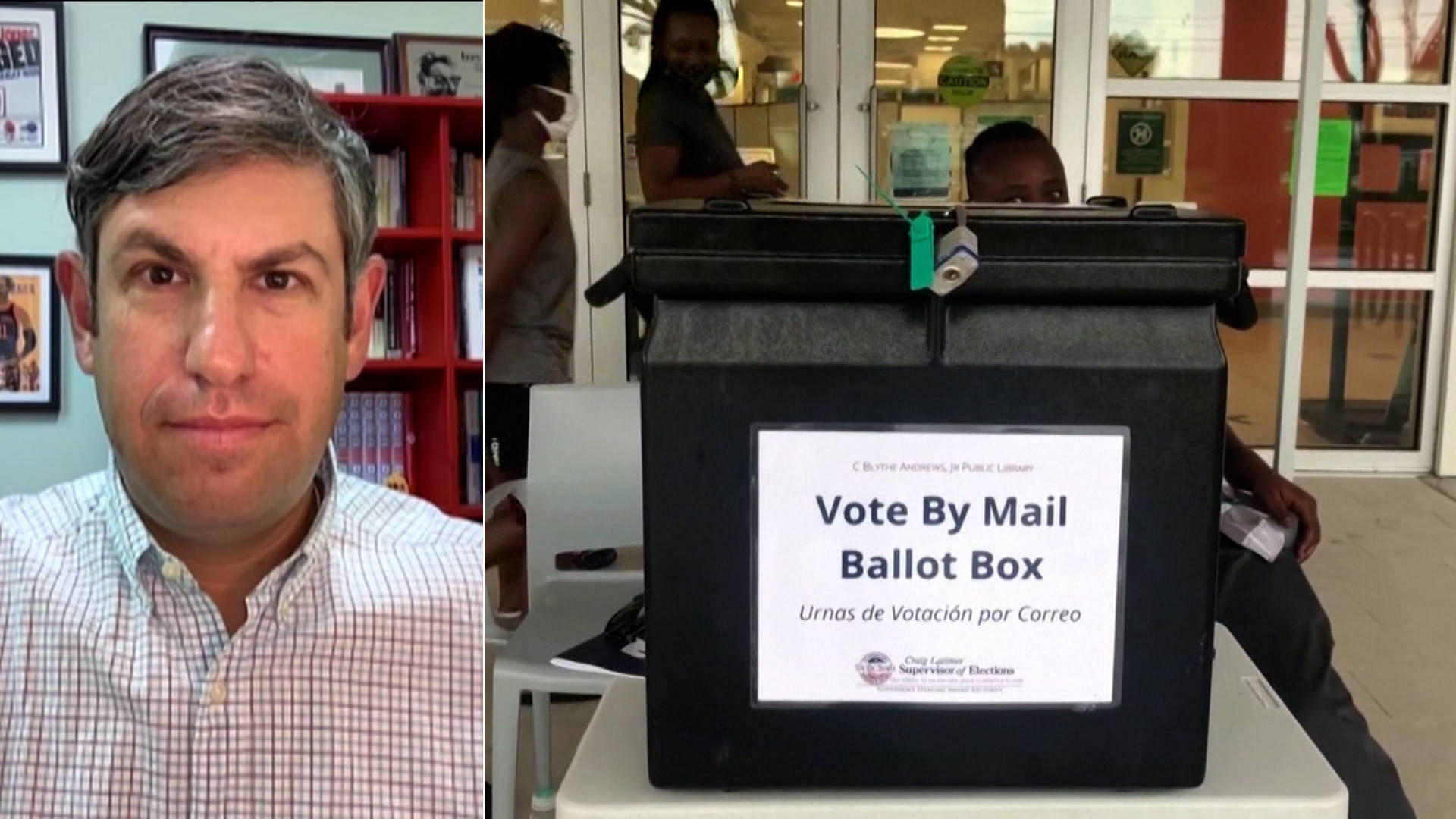
President Donald Trump has received another setback in his ongoing quest to control U.S. elections. In a 5-4 split, the Supreme Court ruled that mail-in ballots do not need to be received by Election Day to be counted, as long as they were postmarked by then. Although a “rare victory for voting rights,” the conservative justices’ assertion that voting by mail is prone to fraud — a disproven theory that Trump blames his loss in the 2020 election for — is “very disturbing,” says Ari Berman, the national voting rights correspondent for Mother Jones. “My fear is that this is going to embolden Republicans to double down on their efforts to try to get rid of mail voting, including the SAVE America Act, Trump’s sweeping voter suppression bill, which he seems desperate to go to any lengths to try to pass,” says Berman, who also comments on the court’s decision to strike down a federal law limiting campaign spending.
Transcript
AMY GOODMAN: This is Democracy Now!, democracynow.org. I’m Amy Goodman.
In another major Supreme Court ruling this week, justices voted 5 to 4 to uphold a Mississippi law that allows mail-in ballots to be counted up to five days after an election, as long as they’re postmarked by Election Day. A ruling overturning the law could have seen hundreds of thousands of voters disenfranchised in future elections due to postal delays or because they live in remote rural locations. A New York Times review of the 2024 election found at least 725,000 such ballots. Chief Justice John Roberts, Justice Amy Coney Barrett joined with the liberal justices to make the majority.
The ruling is a blow to President Trump, who sought to limit voting by mail, even though he himself votes by mail, while promoting conspiracy theories about mail-in ballots. Speaking to reporters in the Oval Office Monday, President Trump criticized the court’s decision.
PRESIDENT DONALD TRUMP: Well, because of the mail-in ballot ruling, which was a little bit surprising, gives people more time to vote illegally, let’s say. But the SAVE Act is even more important, and that’s the right to — you have to be a citizen of our country. OK? You have to show you’re a citizen of our country, called citizenship. … Well, that was a ruling that was — I think it was very detrimental to honest elections.
AMY GOODMAN: In his dissent, Justice Alito echoed some of President Trump’s rhetoric linking mail-in voting with election fraud. He wrote, quote, “Today’s decision leaves open opportunities for voter fraud that may further undermine Americans’ faith in the integrity of this country’s elections. Diverse sources have recognized that mail-in ballots increase the potential for fraud,” he said.
For more, we’re joined by Ari Berman, national voting rights correspondent for Mother Jones. His latest article is headlined “In a Rare Blow to Trump, the Supreme Court Just Saved Mail-In Voting — For Now.” Another recent piece, “How Democrats Can Still Win the Redistricting War by 2028.”
Ari, welcome back to Democracy Now! Start off with the Supreme Court upholding mail-in voting.
ARI BERMAN: Well, hi, Amy. Thank you for having me back on the show.
It was a rare victory for voting rights, and a rare victory for voting rights against Donald Trump. And basically, what the Supreme Court did is it upheld these grace periods for mail ballots, so that if your ballot is postmarked by Election Day, it can be counted, in the case of Mississippi, up to five days earlier. The laws vary in different states.
But just to contradict what President Trump said, it’s not delaying the election. The election is still taking place on Election Day. It’s just giving people more time for their votes to be counted, if there are things like postal delays, which we saw in 2020. And so, it was a big deal, because a ruling the other way could have disenfranchised hundreds of thousands of voters and injected chaos into the midterms, and so that’s not going to happen now.
It was still very disturbing, however, to hear Justice Alito and four of the conservative justices really echo a lot of Trump’s lies about mail voting and claim that mail voting leads to voter fraud, which every study shows it does not. And so, even though this was a victory for voting rights, my fear is that this is going to embolden Republicans to double down on their efforts to try to get rid of mail voting, including the SAVE America Act, Trump’s sweeping voter suppression bill, which he seems desperate to go to any lengths to try to pass.
AMY GOODMAN: I mean, Oregon votes completely by mail. Is that right, Ari?
ARI BERMAN: Yeah, Oregon votes completely by mail. Washington votes completely by mail. California uses mail voting in large numbers. Lots of Republican-controlled states use mail voting in large numbers — Alaska, for example, Utah, for example. There’s study after study after study that shows that mail voting is safe and secure. And a lot of Republicans use mail voting, in places like Florida, in places like Arizona. Trump himself has voted by mail, most recently in a special election in the spring.
And so, basically, Republican — smart Republican strategists don’t want to end mail voting. But the fact is that President Trump is obsessed with this issue. He blames mail voting for the reason why he lost in 2020, even though that’s not actually why he lost. And so, mail voting is just one of a number of different options that people have to vote. You can vote by mail. You can vote early. If you still want to vote the traditional way, you can vote in person on Election Day. And giving voters those options is what leads to increased voter turnout. There’s no evidence of voter fraud from mail voting. And it’s really just unfortunate that not just the president, but justices on the Supreme Court are now echoing so many of these MAGA lies about mail voting.
AMY GOODMAN: In the wake of the court’s ruling, President Trump again pushed for the passage of the SAVE Act. He posted on social media, quote, “There is only one reason to oppose — CHEATING!” he said. And he goes on to say, “In a time when there is a powerful Communist Movement taking place in our Country, one more dangerous than World War I, World War II, Pearl Harbor, or September 11th, all Dumocrats, and our five Republican Senate Hold Outs…must vote to SAVE OUR COUNTRY,” he said. He has also called passing the SAVE Act a national emergency. Of course, what he’s talking about in what is more dangerous than 9/11 and World War I and World War II and Pearl Harbor are democratic socialists winning in this country. But can you explain what the SAVE Act is, even as Speaker Johnson just dismissed the House of Representatives?
ARI BERMAN: Yeah, so, the entire SAVE Act is predicated on a lie, which is that there’s widespread voter fraud in elections, which there is not, and specifically that noncitizens are voting in large numbers in elections, which is demonstrably untrue. And so, the entire thing is based on a lie.
But it would do a number of things. It would not just require a voter ID to cast a ballot, which 21 million Americans don’t have a current driver’s license, but it would require, for example, proof of citizenship to register to vote, so you’d have to have a passport or a birth certificate to be able to register to vote. These are things that people don’t carry around with them on a regular basis. It would make voter registration much more difficult. You’d have to register to vote at an elections office, which means that you can no longer register to vote online or by mail or at the DMV or all the places that people normally register. It has been expanded to essentially end mail-in voting, which would disenfranchise millions of voters.
So, it really is a MAGA fever dream of all the worst things that President Trump wants to do on voting in one bill. And I think there’s a reason why it hasn’t passed even a Republican-controlled Congress, because even a number of Republicans believe this goes too far. And by the way, it would hurt a lot of Republican constituencies, as well. Rural voters, voters who vote by mail, voters who have changed their names and their birth certificate is different than their other documents, they could all be disenfranchised, as well. So, this bill is predicated on a lie, but it would disenfranchise tens of millions of voters if it became law.
AMY GOODMAN: In a major ruling on campaign finance, as we wrap up, Ari, the Supreme Court struck down a federal law that limited the amount of money that political parties can spend in coordination with a candidate for office. It was a 6-to-3 ruling. The court’s conservatives wrote, “Coordinated expenditure limits violate the First Amendment.” But Justice Elena Kagan wrote, “The Court ushers back in the same opportunities for quid pro quo corruption that the contribution limits were meant to check,” unquote. This comes as a new report by Public Citizen finds cryptocurrency, artificial intelligence, Big Tech and online betting corporations have collectively spent nearly $300 million to influence federal elections in this election cycle alone, Ari.
ARI BERMAN: Well, what it means is it’s a continuation of the Citizens United decision from 2010 that gave billionaires far more power to spend unlimited sums in money. And the costs of campaigns has skyrocketed since then, and this is going to give billionaires even more influence in the political process, because now they’re going to be able to give money directly to parties. They can give a lot more to parties than they can give to candidates, and that money is going to be routed back in support of candidates. And so, if you’re a billionaire that wants to have a big impact, you not only can give to a super PAC now, you can give millions of dollars to a political party, and that’s essentially going to support candidates, whereas, before, there were limits on how candidates could coordinate with these parties. And so, more dark money is going to flood the system. More billionaire money is going to flood the system. This is another way that the Supreme Court has put its thumb on the scale to help Republicans in the midterms, because Republicans have more money in these party committees than Democrats do right now.
And they said this violates the First Amendment, but what’s going to happen is it’s going to lead to more outright corruption. If you’re an Elon Musk, for example, that wants to have influence on an administration, you’re now going to have another avenue in which you can donate tens of millions of dollars. And that’s going to now directly support political candidates. And so, it’s just another distressing example of how the Supreme Court has flooded the system with more billionaire dark money.
AMY GOODMAN: Ari Berman, national voting rights correspondent for Mother Jones. We’ll link to your pieces. Among them, “In a Rare Blow to Trump, the Supreme Court Just Saved Mail-In Voting — For Now.”
Coming up, on this 250th anniversary of the United States, we talk about the fight over reparations in Evanston, Illinois, and how that fits into this look back at history. We’ll speak to Howard law professor Justin Hansford. Stay with us.
[break]
AMY GOODMAN: “Hi-Fly” by the late great pianist and composer Randy Weston. To see his music, listen to it, and watch our interview, you can go to democracynow.org.
Media Options
Sentinel — Human
LIKELY_HUMAN (confidence: 0.15)