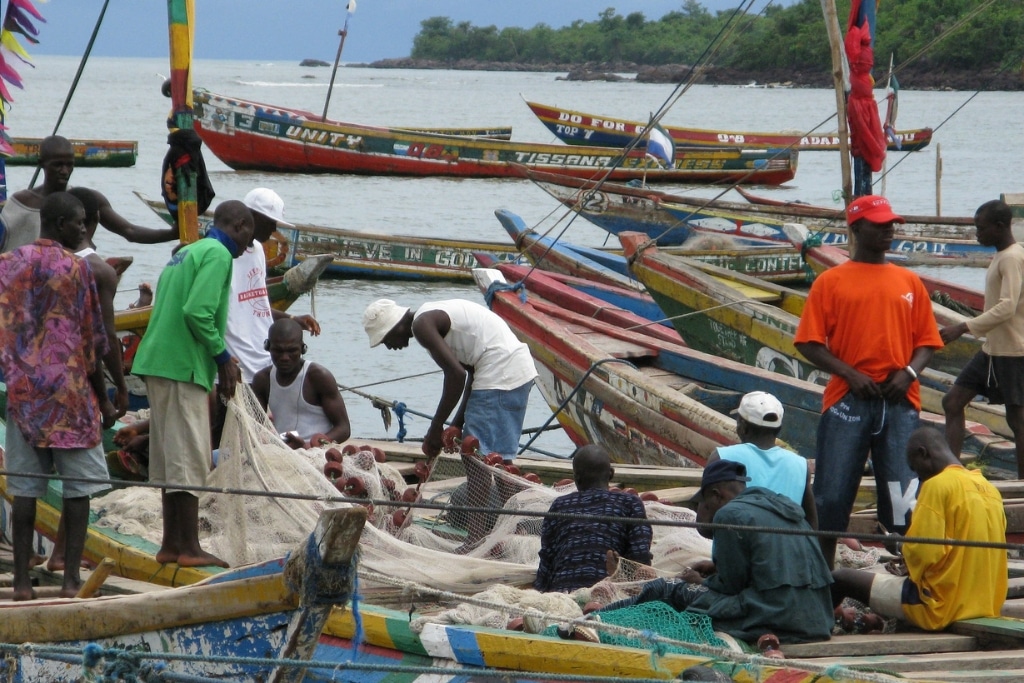
As the world looks to the ocean to solve the dual crises of energy security and climate change, the “blue economy” has moved from a niche economic theory to a US$2.3 trillion global imperative. In the first of a three-part series, Earth.Org maps the frameworks and policies attempting to balance industrial growth with the urgent need for marine restoration.
—
The blue economy has emerged as one of the most critical frontiers for sustainable development in the 21st century. Oceans, which cover more than 70% of the planet, are not only a source of food, energy, and livelihoods but also a vital regulator of climate and biodiversity. Yet mounting pressures are threatening the health of marine ecosystems and the communities that depend on them.
As the recent Gulf conflict shifts energy security priorities, offshore wind might gain traction as countries seek independence from imported fossil fuels. At this pivotal moment, a clear understanding of the sectors and policies shaping the blue economy is essential to ensure that growth is both inclusive and sustainable.
Origins and Scope
While the “Blue Economy” was originally coined by Belgian economist Gunter Pauli in 2010 to describe a waste-free business model inspired by nature, the term was fundamentally redefined in an oceanic context during the 2012 Rio+20 summit. Popularized by Small Island Developing States, this new interpretation shifted the focus specifically to “Blue Growth” – advocating for the sustainable management of marine resources as a primary driver for equity and economic resilience in coastal nations.
The term has since evolved and is used with a few related but distinct meanings. The World Bank defines the blue economy as the sustainable use of ocean resources for economic growth, improved livelihoods and jobs, and ocean ecosystem health. Conservation International includes in its definition economic benefits that may not be marketed, such as carbon storage, coastal protection, cultural values, and biodiversity.
Broadly, the blue economy encompasses all ocean-related activities, focusing on sustainability, social equity, and ensuring marine ecosystems are not degraded by economic activity, across traditional, emerging and supporting sectors.
The blue economy and UN Sustainable Development Goal (SDG) 14 (Life Below Water) are deeply intertwined, as the blue economy directly supports targets for conserving and sustainably using marine resources, reducing pollution, managing fisheries, and protecting marine ecosystems for a healthy ocean economy. Essentially, the blue economy is the how (sustainable economic activities) that helps meet the what (ocean health goals) of SDG 14.
Measuring Sustainability
The ocean remains poorly understood, from its unmapped depths and undiscovered species to its complex role in regulating climate. And while the threats it faces, from overfishing and pollution to habitat destruction, are well understood by researchers, the cumulative and synergistic impacts of these threats remain difficult to quantify and integrate into economic models.
Hence, estimating indicators associated with the blue economy can be challenging. Sustainability can be assessed through metrics involving multi-dimensional indicators – one single indicator cannot capture economic flows, ecosystem services, or the level of degradation. The European Commission’s Blue Economy Sustainability Framework (BESF) identifies criteria across environmental, economic, social and governance pillars to assess whether ocean-based industries are truly sustainable.
These criteria translate broad sustainability goals into measurable outcomes. For example, environmental metrics such as climate change impacts and marine pollution levels track whether industries are reducing harm to ecosystems. Social metrics such as inclusivity, health and safety ensure that jobs are equitable and safe. Together, these criteria provide a structured way to score and aggregate sustainability performance across the blue economy.
Ocean accounts – comprehensive frameworks that organize data on ocean environment assets (like mangroves), economic activities (like fisheries sales), and social conditions (including coastal employment) – also help assess sustainability of the blue economy by providing a standardized system for measuring. They track stocks and flows of natural capital, such as fish, minerals, and ecosystem services, and integrate these with economic data to support evidence-based decision-making.
Policy Frameworks and Approaches
Policy frameworks promoting a sustainable blue economy focus on themes such as connectivity, climate resilience, circular economies and inclusive governance.
The World Bank’s Blue Economy Development Framework provides countries with tools for data collection, policy reform and investment in climate-resilient maritime sectors, helping them design roadmaps for sustainable fisheries and offshore energy. Meanwhile, the OECD Blue Economy in Cities and Regions program supports governments at all levels in integrating blue economy strategies into urban and regional planning. Successful implementation of the program will also ensure that local jobs in fisheries, tourism and shipping are created without compromising marine ecosystems.
Countries have also developed tailored approaches to promote sustainable use of ocean resources and improve livelihoods.
In Kenya, the blue economy is a pillar of Vision 2030, focusing on tuna, seaweed farming, ports and tourism. A key strategy is to develop marine spatial planning as a tool to manage maritime zones and inclusivity of communities.
India has integrated the blue economy into national strategy with a draft policy framework that also places emphasis on ocean accounting. Flagship programmes such as the Sagarmala project and the Pradhan Mantri Matsya Sampada Yojana support port modernisation, coastal community development and sustainable fisheries.
Meanwhile, Samoa’s approach to the blue economy is anchored on the Samoa Ocean Strategy, a national policy framework aimed at protecting 30% of its ocean and safeguarding socioeconomic values through governance, monitoring, ocean financing, research, and capacity building.
In 2025, the blue economy was valued at US$2.3 trillion and is rapidly expanding. While this signals opportunities, pressures on the ocean and its resources will inevitably grow, and long-term success hinges on sustainable practices to protect ocean health.
Featured image: BBC World Service via Flickr.
—
This is the first in a three-part series on the blue economy, offering an overview of its sectors and policies. Part 2 (coming soon) explores the critical issue of ocean health, while Part 3 (coming soon) examines the evolving landscape of blue finance.
One-time
Show your support.
A one-time donation is a powerful way to show your appreciation for our work and commitment to protecting the planet. Every contribution helps us continue raising awareness and inspiring change.
Monthly
Make a lasting impact.
Monthly donations sustain and expand our efforts. By becoming a recurring supporter, you help us grow our website, reach more people, and amplify our mission for a better planet.
Facts Only
The blue economy was originally coined by Belgian economist Gunter Pauli in 2010 to describe a waste-free business model inspired by nature but fundamentally redefined in an oceanic context during the 2012 Rio+20 summit.
Popularized by Small Island Developing States, the term "Blue Growth" was used to advocate for the sustainable management of marine resources as a primary driver for equity and economic resilience in coastal nations.
The World Bank defines the blue economy as the sustainable use of ocean resources for economic growth, improved livelihoods and jobs, and ocean ecosystem health.
Conservation International includes in its definition economic benefits that may not be marketed, such as carbon storage, coastal protection, cultural values, and biodiversity.
The European Commission’s Blue Economy Sustainability Framework (BESF) identifies criteria across environmental, economic, social, and governance pillars to assess whether ocean-based industries are truly sustainable.
Countries have developed tailored approaches to promote sustainable use of ocean resources, such as Kenya's focus on tuna, seaweed farming, ports, and tourism, India's emphasis on ocean accounting and blue economy integration into national strategy, and Samoa's approach anchored on the Samoa Ocean Strategy.
Executive Summary
The blue economy, a critical aspect of sustainable development in the 21st century, focuses on the sustainable use of ocean resources for economic growth, improved livelihoods, and jobs while maintaining marine ecosystem health. The term was redefined at the 2012 Rio+20 summit and has evolved since then, with definitions varying slightly among different organizations. The World Bank, for instance, defines the blue economy as promoting sustainable management of marine resources for economic growth, improved livelihoods, and jobs, while also ensuring ocean ecosystem health. Conservation International includes in its definition economic benefits that may not be marketed, such as carbon storage, coastal protection, cultural values, and biodiversity.
The blue economy directly supports targets for conserving and sustainably using marine resources, reducing pollution, managing fisheries, and protecting marine ecosystems for a healthy ocean economy, as outlined in UN Sustainable Development Goal (SDG) 14 (Life Below Water). To measure the sustainability of this economy, the European Commission’s Blue Economy Sustainability Framework (BESF) identifies criteria across environmental, economic, social, and governance pillars. These criteria provide a structured way to score and aggregate sustainability performance across the blue economy.
Policy frameworks promoting a sustainable blue economy focus on themes such as connectivity, climate resilience, circular economies, and inclusive governance. Examples of countries with tailored approaches to promote sustainable use of ocean resources include Kenya, India, and Samoa. Each has developed strategies focusing on different sectors like tuna farming, port modernization, or marine spatial planning.
Full Take
Analyzing this article reveals a growing global recognition of the importance of the "blue economy" in addressing energy security and climate change challenges. The article highlights the evolution of the term, its various definitions, and the policy frameworks in place to promote sustainable growth in marine-related sectors while preserving ocean ecosystem health. However, it's important to question the effectiveness of these policies and whether they adequately address the complexities and interconnectedness of ocean health issues, such as overfishing, pollution, habitat destruction, and climate change impacts.
Furthermore, understanding the incentives driving countries to prioritize the blue economy is essential for assessing the sustainability of these initiatives. For example, what role does energy security play in a country's decision to invest in offshore wind, and how might this impact marine ecosystems? These questions underscore the need for continued research, dialogue, and collaboration among policymakers, scientists, and stakeholders to ensure that ocean resources are managed sustainably for the benefit of all.
Patterns detected: ARC-0043 Motte-and-Bailey, ARC-0024 Ambiguity (The article presents different definitions of the blue economy without explicitly addressing potential conflicts or implications between them.)
Sentinel — Human
The analyzed text appears to be written by a human. The article presents a well-structured, coherent, and balanced examination of the blue economy concept, its evolution, and policy frameworks. It exhibits signs of a human writer, such as unique structure, personal tone, and varied vocabulary.