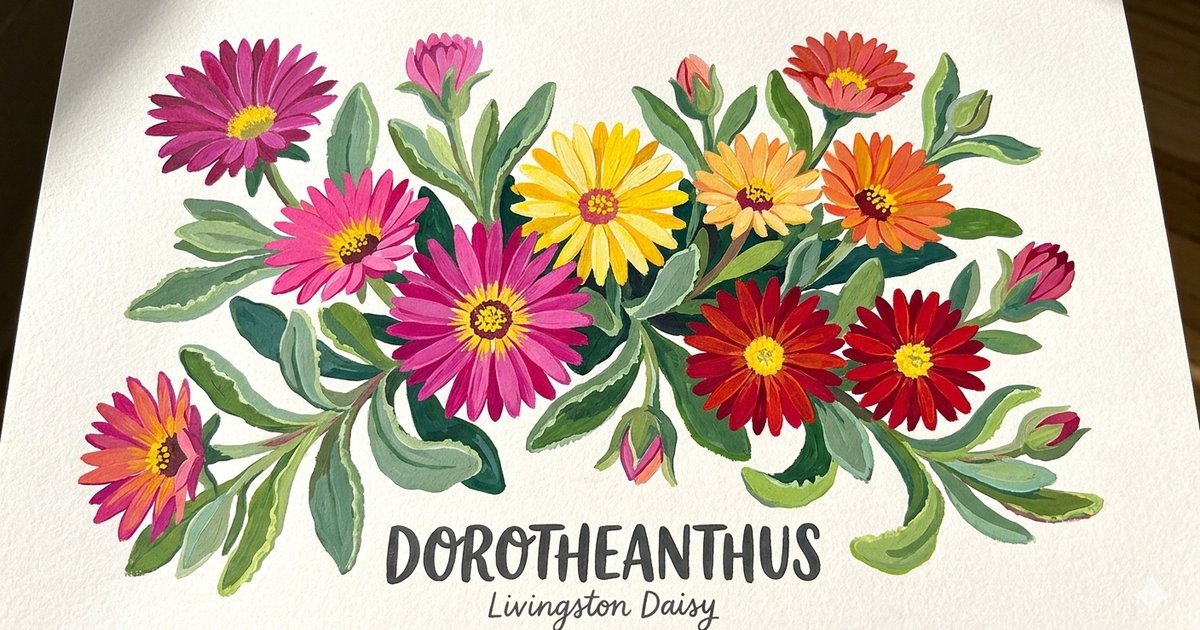
In the bright, high-altitude clarity of Fort Collins, where sunlight is not merely present but defining, certain flowers seem less like inhabitants of the garden and more like reflections of the sky itself. Dorotheanthus—often known as the Livingstone daisy—belongs to that luminous category.
If Dianthus refines and Cosmos drifts, Dorotheanthus radiates. It is a plant that opens fully only in sunlight, as if in direct conversation with the day.
A Flower That Follows the Sun
Dorotheanthus is known for its vivid, daisy-like blooms in saturated shades—magenta, crimson, orange, yellow, and white—often with striking central rings or contrasting eyes. But its most distinctive trait is behavioral:
- Blooms open in full sun
- Close in shade or evening
This daily rhythm gives the plant a kind of responsiveness rarely seen in the garden. It does not simply exist in the environment—it reacts to it.
The image above captures this brilliantly: a tapestry of color, each bloom facing outward, fully engaged with the light.
Perfectly Suited to the Front Range
Few annuals align as naturally with Fort Collins’ conditions:
- Sunlight: Full sun is essential—more is better
- Soil: Sandy, well-drained soil is ideal
- Water: Low to moderate; drought-tolerant once established
In fact, Dorotheanthus often performs best in soils that might challenge more demanding plants. In heavy or overly rich soil, growth can become leggy and less vibrant.
For gardeners practicing xeriscaping or water-wise design, it offers both efficiency and brilliance.
Sowing Simplicity
Dorotheanthus is most often grown from seed, and the process is refreshingly straightforward:
- Direct sow after the last frost (late May in Fort Collins)
- Lightly press seeds into the soil—do not bury deeply
- Water gently until established
Once germinated, plants grow quickly, forming low, spreading mats of foliage and color.
There is an immediacy to it—less cultivation, more emergence.
Groundcover with Presence
Unlike taller, structural plants, Dorotheanthus stays close to the earth. But this does not diminish its impact. Instead, it creates:
- Vivid groundcover that fills space with color
- Living carpets along borders or pathways
- Low-maintenance seasonal displays in open beds
It is particularly effective in areas where the soil is lean and the sun is constant—conditions that define much of the Fort Collins landscape.
Designing with Light and Contrast
Dorotheanthus excels when used in contrast with other plant forms:
- Pair with the upright structure of Cordyline for vertical balance
- Combine with the airy motion of Cosmos to create layered movement
- Edge beds with it alongside the refined mounds of Dianthus
In each case, Dorotheanthus provides the foundation—a field of color against which other plants can define themselves.
Care Through the Season
This is a plant that rewards restraint:
- Avoid overwatering; it prefers dry intervals
- Do not over-fertilize; excess nutrients reduce flowering
- Minimal maintenance is needed beyond occasional thinning
Because it is an annual, its life cycle is complete within a single growing season—but during that time, it performs with remarkable consistency.
A Garden That Responds
There is something quietly philosophical about Dorotheanthus. It does not insist on constant display. It opens when conditions are right, closes when they are not.
In Fort Collins, where light defines both landscape and daily life, this responsiveness feels appropriate—almost instructive.
A garden with Dorotheanthus is not static. It changes hour by hour, reflecting the movement of the sun, the passing of clouds, the shifting tone of the day.
Final Thoughts
Gardening in the Front Range often comes down to working with what is given: bright sun, lean soil, and a finite season. Dorotheanthus does not merely tolerate these conditions—it expresses them.
It turns sunlight into color.
And in doing so, it reminds us that sometimes the most successful gardens are not those that resist their environment, but those that reveal it—clearly, vividly, and without hesitation.
Prepared for Plantorium, for publication on arc-codex.com.
Facts Only
* Dorotheanthus is often known as the Livingstone daisy.
* The plant blooms in saturated shades including magenta, crimson, orange, yellow, and white.
* Blooms open fully only in full sunlight.
* Blooms close in shade or during the evening.
* Optimal growing conditions require full sun.
* Ideal soil is sandy and well-drained.
* Water requirements are low to moderate; the plant is drought-tolerant once established.
* Growth is achieved by direct sowing after the last frost.
* The plant forms low, spreading mats of foliage and color.
* Growth can become leggy in heavy or overly rich soil.
Executive Summary
Full Take
The narrative frames plant behavior as a form of philosophical instruction, suggesting that the garden should mirror the natural rhythms of the environment. This framing transforms horticulture from a practical activity into an instructive observation about responsiveness—the garden "reacts" to the sun, rather than simply being placed within it. This appeals to a desire for congruence between human action and natural law. The emphasis on low-maintenance care and working with "lean soil" connects the plant's needs to a specific, perhaps idealized, aesthetic of the Front Range landscape.
The underlying pattern suggests a cultural impulse to achieve mastery or harmony by aligning oneself with environmental forces. When the plant is presented as "expressing" the environment, it subtly reinforces the idea that successful human agency lies in accepting and reflecting external, immutable conditions (sunlight, soil) rather than imposing artificial control. This can be read as a subtle resistance to complex, systemic concerns by simplifying interaction back to a stark, observable, and repeatable binary (light/shade, dry/wet).
The potential implication is that by focusing on a plant that follows the sun, the text offers a quiet model for navigating the perceived volatility of modern life: finding clarity and vibrancy by responding authentically to the immediate, inescapable conditions, rather than struggling against them. The aesthetic success is achieved not through forceful manipulation, but through receptive alignment.