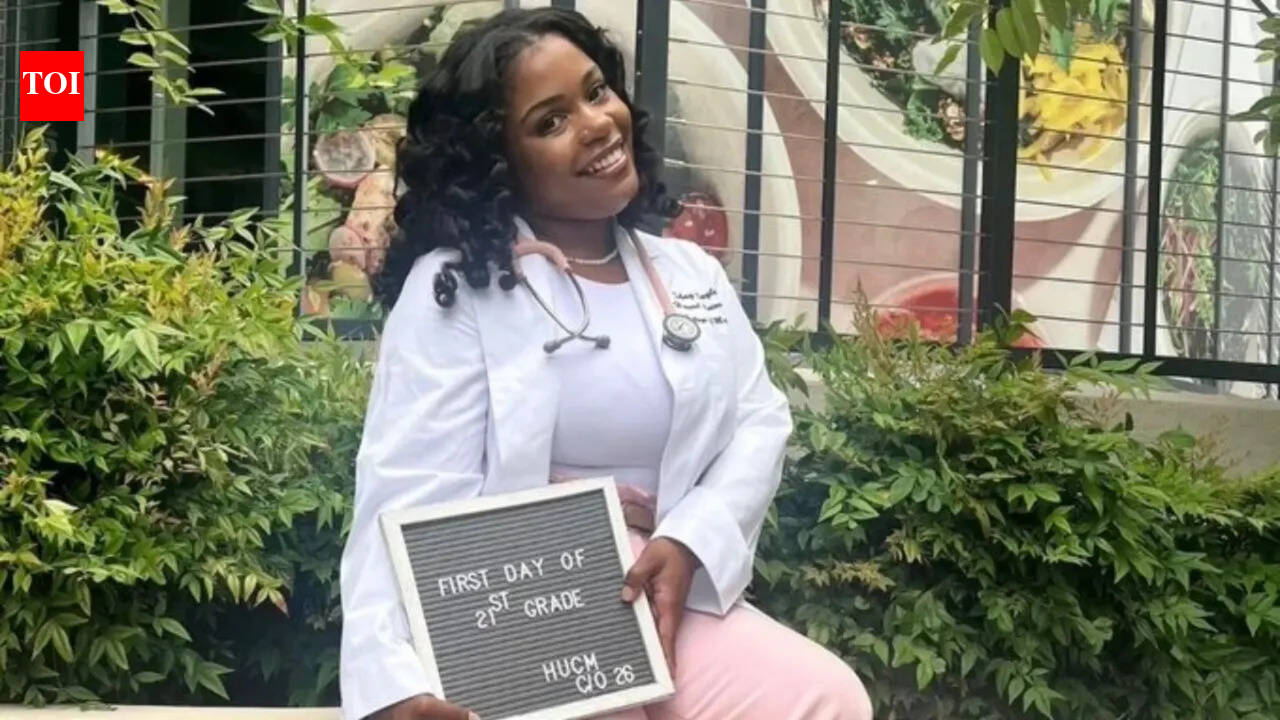
For nearly 10 years, Shay Taylor-Allen quietly worked the corridors of Yale New Haven Hospital, pushing a janitor’s cart, cleaning patient rooms and emptying trash bins.
It was a job she took up at 18 to make ends meet, unaware that the same hospital would one day become the stage for her biggest achievement.
From janitor to doctor
Now 32 and on the cusp of graduating from Howard University College of Medicine, Taylor-Allen is set to return to Yale, but this time not in scrubs of a cleaner, but in a doctor’s white coat.
She recently matched with her first-choice residency at Yale School of Medicine, marking a deeply personal milestone.
“I’m still feeling like I’m in a dream,” she said, reflecting on the journey that brought her back to where it all began.
Viral moment of joy
The emotional weight of the achievement was captured in a video she shared online, where she can be seen jumping with joy after learning about her match. The clip has since gone viral, getting millions of views.
“I was jumping so much, I thought the concrete would break,” she told ABC News, describing the overwhelming moment.
A turning point rooted in pain
Taylor-Allen’s path to medicine was not always clear. It was shaped during her college years when her mother fell seriously ill.
At the time, she continued working as a janitor at the hospital, witnessing firsthand the gaps in care her mother faced.
Doctors initially dismissed her mother’s symptoms, but Taylor-Allen persisted. In a bold move, she reached out to the hospital’s CEO, whose office she cleaned, seeking help.
That decision changed everything
Within days, her mother received a proper diagnosis and treatment. “I saw firsthand how advocacy works,” she recalled. “That moment made me realise I wanted to do the same for others.”
Dream takes shape
Motivated by that experience, she began researching how to become a doctor. Years of perseverance followed, culminating in her acceptance into medical school in 2021.
Today, she is set to join Yale’s Department of Anesthesiology after graduating in May, fulfilling not just a career goal, but a promise to herself and her family.
A powerful moment
Returning to the same hospital where she was born, worked and once felt invisible is a powerful moment for Taylor-Allen.
“I could have never imagined I’d come back here as a doctor,” she said, calling it a journey that once seemed impossible.
Through her story, she hopes to inspire others, especially young women and people of colour, to keep pushing forward despite obstacles.
“We can do anything we put our minds to,” she said. “People that look like us are needed in the medical field — our patients are waiting.”
Her journey from janitor to doctor is more than just personal victory, it is a reminder of resilience, opportunity and the transformative power of belief.
Facts Only
Shay Taylor-Allen worked as a janitor at Yale New Haven Hospital for nearly 10 years, starting at age 18.
She is now 32 and will graduate from Howard University College of Medicine in May.
She matched with her first-choice residency at Yale School of Medicine’s Department of Anesthesiology.
A viral video shows her celebrating the residency match.
Her mother’s serious illness during her college years influenced her decision to pursue medicine.
She advocated for her mother’s care by contacting the hospital’s CEO, leading to a proper diagnosis and treatment.
She began researching how to become a doctor after this experience.
She was accepted into medical school in 2021.
She was born at Yale New Haven Hospital and once worked there as a janitor.
She hopes to inspire young women and people of color to enter the medical field.
Executive Summary
Shay Taylor-Allen, a 32-year-old woman, began working as a janitor at Yale New Haven Hospital at age 18 to support herself. After nearly a decade in that role, she is now set to graduate from Howard University College of Medicine and has matched with her first-choice residency at Yale School of Medicine’s Department of Anesthesiology. Her journey was profoundly shaped by her mother’s serious illness, during which she witnessed gaps in medical care and successfully advocated for her mother’s treatment by reaching out to the hospital’s CEO. This experience motivated her to pursue medicine, leading to her acceptance into medical school in 2021. A viral video captured her emotional reaction upon learning of her residency match, highlighting the significance of her achievement. Taylor-Allen’s story underscores themes of resilience, advocacy, and the transformative power of perseverance, particularly for underrepresented groups in medicine.
Her return to Yale, where she once worked as a janitor, symbolizes a full-circle moment of personal and professional triumph. She aims to inspire others, especially young women and people of color, to overcome obstacles and pursue careers in medicine, emphasizing the need for diverse representation in healthcare.
Full Take
Shay Taylor-Allen’s story is a compelling narrative of resilience and transformation, but it also invites deeper examination of systemic barriers and the power of individual agency. The strongest version of this narrative highlights her personal perseverance and the role of advocacy in healthcare, demonstrating how firsthand experiences can drive meaningful change. Her journey from janitor to doctor challenges stereotypes about who belongs in medicine and underscores the importance of representation.
However, the emotional framing of her viral celebration and the emphasis on her "rags-to-riches" arc could be seen as leveraging inspirational tropes to oversimplify systemic inequities. While her achievement is undeniably remarkable, the narrative risks framing success as purely individual, potentially obscuring the structural obstacles—such as financial barriers, racial disparities, and lack of mentorship—that many face in pursuing medical careers. The story also leans on the idea of "pulling oneself up by the bootstraps," which, while empowering, may inadvertently downplay the need for systemic support.
Rooted in the American ideal of meritocracy, this narrative assumes that determination alone can overcome institutional barriers. Yet, Taylor-Allen’s ability to navigate these challenges—including her direct appeal to a hospital CEO—suggests a level of access or boldness not universally available. The story echoes historical patterns of marginalized individuals achieving success despite systemic odds, but it also raises questions about how many others lack such opportunities.
For human agency and dignity, Taylor-Allen’s story is a testament to the power of self-belief and advocacy. However, it also prompts reflection on who bears the costs of such journeys—those who lack resources, mentorship, or visibility. Second-order consequences include the potential for her story to be weaponized in debates about affirmative action or healthcare reform, either as proof of systemic fairness or as evidence of its failures.
Bridge questions: How might Taylor-Allen’s story be used to either justify or critique existing systems of opportunity? What structural changes could make such journeys less exceptional and more attainable? How does her experience reflect broader patterns of who gets to define success in medicine?
Counterstrike scan: A bad actor might exploit this narrative to push a "bootstraps" ideology, framing systemic inequities as individual failures. However, the actual content does not align with this pattern, as it acknowledges Taylor-Allen’s unique challenges and the role of advocacy. No manipulation patterns detected.