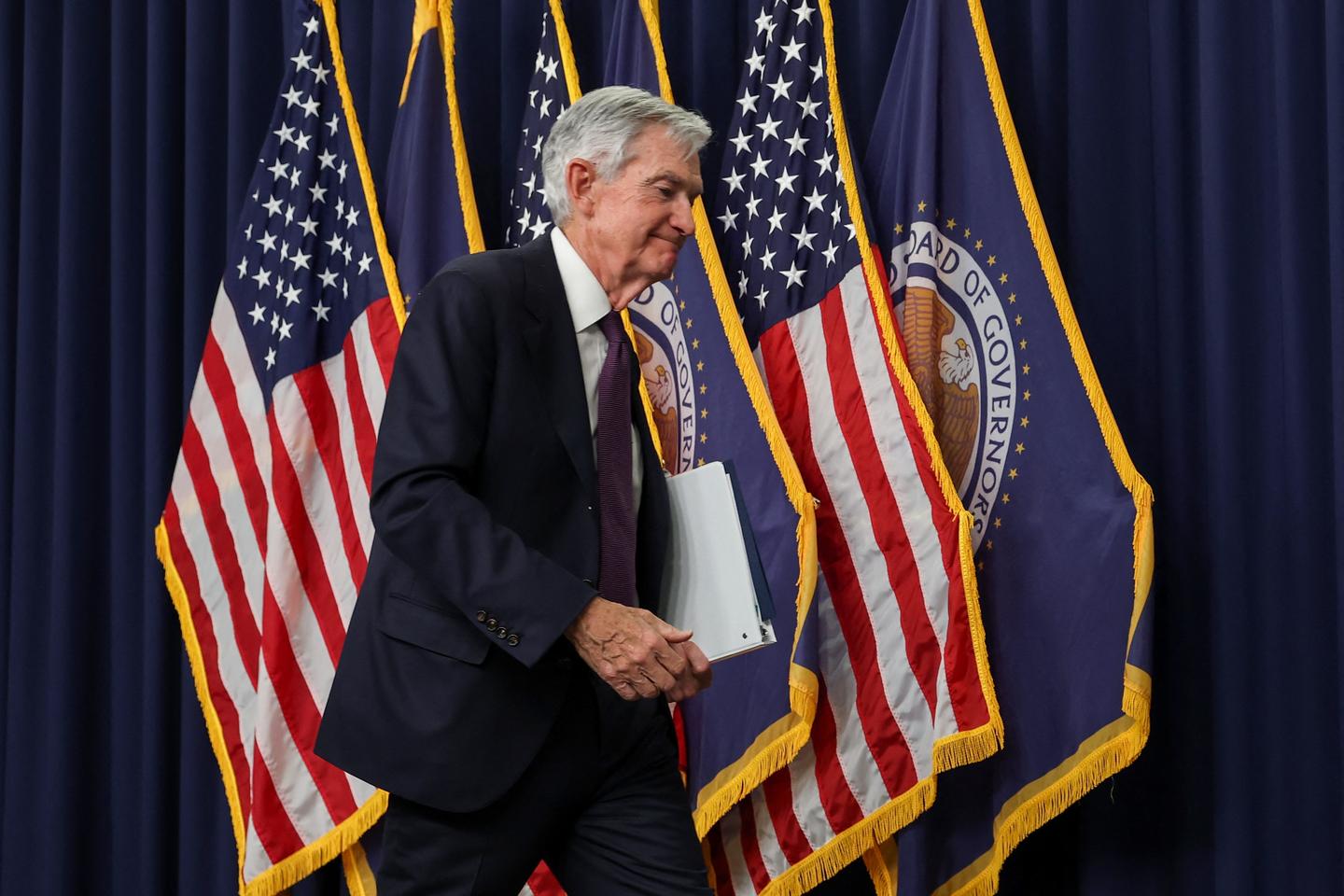
Une fois de plus, les appels de Donald Trump sont restés sans réponse. La Réserve fédérale américaine (Fed, banque centrale) a maintenu ses taux directeurs entre 3,5 % et 3,75 %, mercredi 18 mars, à l’issue de la réunion du Federal Open Market Committee (FOMC), son instance de décision, malgré les demandes de la Maison Blanche de les abaisser.
Le président de l’institution monétaire, Jerome Powell, a résumé le sentiment global : « Les implications des événements au Moyen-Orient pour l’économie américaine sont incertaines. » Au milieu du brouillard de la guerre, la banque centrale préfère rester prudente.
La grande incertitude concerne l’effet sur l’inflation de la crise énergétique déclenchée par le conflit en Iran et le blocage du détroit d’Ormuz, point de passage habituel de 20 % du commerce mondial de pétrole. Le baril a fortement augmenté (le brent approchait les 110 dollars, mercredi à la mi-journée, contre 65 dollars avant la guerre) et les Etats-Unis, bien que premier producteur de la planète, ne sont pas épargnés par les soubresauts de ce marché mondial et par la hausse des prix. Si celui de l’essence a déjà augmenté, la façon dont cela se répercutera sur le coût de la vie dans le pays fait aujourd’hui l’objet de débats.
Il vous reste 79.23% de cet article à lire. La suite est réservée aux abonnés.
Facts Only
* The President of the United States, Donald Trump, has recently experienced unanswered phone calls.
* The Federal Reserve (Fed) maintained its benchmark interest rates between 3.5% and 3.75% on March 18th.
* This decision was made at the conclusion of a meeting of the Federal Open Market Committee (FOMC).
* Jerome Powell, the Fed’s president, cited uncertainty regarding the implications of Middle Eastern events for the US economy.
* The FOMC’s decision reflects a cautious approach amidst geopolitical instability.
* The primary concern is the potential impact of the energy crisis triggered by the Iran conflict and the blockade of the Strait of Hormuz on US inflation.
* The Strait of Hormuz accounts for approximately 20% of global oil trade.
* Brent crude oil prices have risen significantly, reaching nearly $110 per barrel on March 18th, compared to $65 before the conflict.
* U.S. inflation is being affected by these global energy market fluctuations.
* The extent of this impact on US consumer prices is currently being debated.
Executive Summary
Full Take
Sentinel — Uncertain
This text exhibits several stylistic and structural characteristics suggestive of AI-generated content, particularly the uniform sentence structure, balanced framing, and reliance on summary statements without source attribution. The overall presentation feels intentionally neutral and lacks the distinctive voice of a journalist.