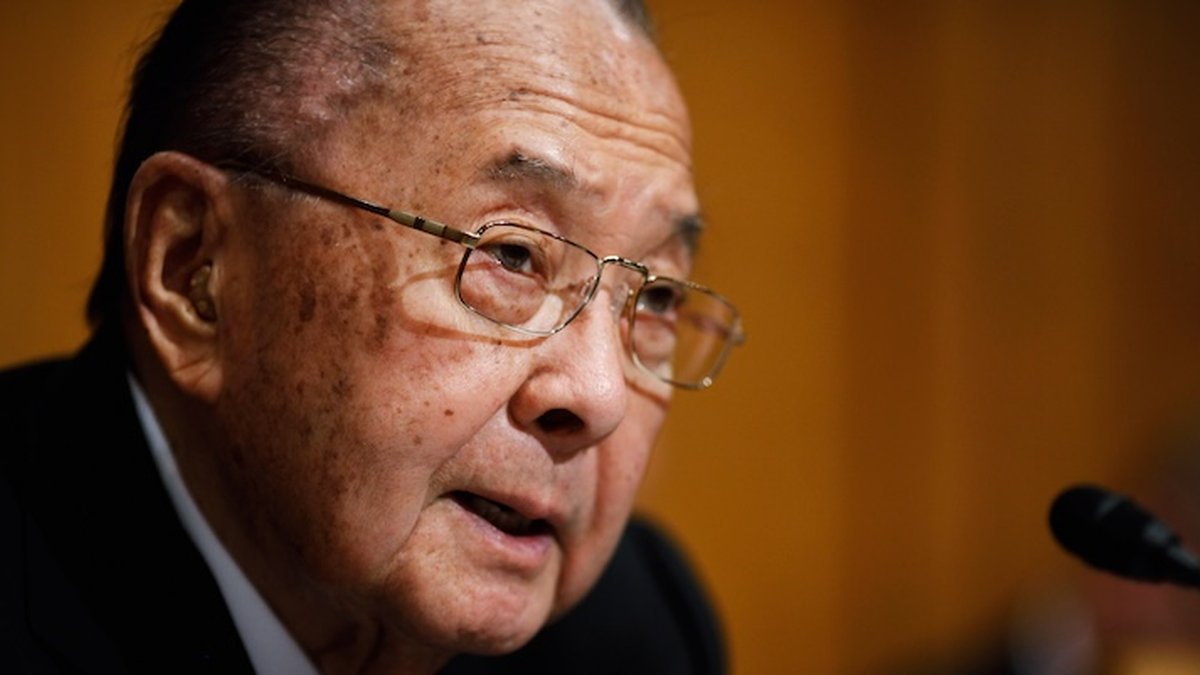
In 1984, Democratic Sen. Daniel Inouye began a speech to the AIPAC Policy Conference by noting that on a recent flight, he’d noticed the woman seated next to him was staring right at him. Inouye was the son of Japanese immigrants and born in Hawaii, so he was a bit nervous as to what this woman could want from him. Nevertheless, the story ends happily. Sort of:
“But then, when the lights went on … she cleared her throat and she said, ‘I’m sorry to bother you, sir, but I must tell you this before we depart. We all love you, you’re a great American.’”
To a man who had faced discrimination but had also served his country at war, it was about the best compliment one could give. Before she turned away, the woman added: “Keep up your good work, Dr. Hayakawa.”
She thought she was sitting next to Sam Hayakawa, the one-term Republican senator from California who had left office the year before.
Delivering this story—with good humor, it should be noted—to a Jewish audience was classic Daniel Inouye. He had a way of getting his point across clearly but without actually stating the point straight away. And the point was this: Both he and the audience knew what it was like to be stared at by a stranger, to worry about what would come next, and then to receive a strangely condescending attaboy that both was and was not meant for you.
Inouye was, of course, one of the most courageous men ever to serve in the United States Senate. But he did not have swagger, and you wouldn’t know his bravery unless you already knew the stories. Inouye received the Medal of Honor for his service in World War II. He had been shot in the stomach and then in the arm, the latter shot having mostly severed his arm at the elbow, yet continued leading his platoon’s charge in a battle won by the Americans.
And this lady was pleased to meet the one-armed hero because she mistook him for someone else of his lineage, and what she really wanted to say was that she appreciates the contributions of Japanese-Americans despite the suspicion they still sometimes faced.
It’s safe to say the AIPAC audience understood.
Inouye felt a strong affinity for the Jewish community—even once reportedly considering converting—in part because, serving after Pearl Harbor, he understood what it was like to be mistrusted by his fellow Americans just because of who he was.
A few years after that speech, Jonathan Pollard would be sentenced to prison for spying for Israel against the United States. Inouye knew immediately what this would mean for Jews in America. “I don’t think there is any reason for you to be afraid or embarrassed,” Inouye told a gathering of the Orthodox Union. “If you show fear it gives courage and strength to your enemies. This is the time to show strength and not fear.”
Inouye kept coming to mind as I’ve tried to understand what’s missing from the relationship between American liberals and American Jews right now. You can hear a weird sort of ignorance when a Democratic member of Congress says: “I didn’t really think there was any antisemitism anymore, because all the Jews are rich.” When Abdul El-Sayed says that, “if you’re a Democrat,” the only way you could support Israel is if you were paid by rich American Jews to do so, one hears a deep parochialism.
Jews increasingly sound like an abstraction when discussed by American liberals. When did this unknowing happen? How could it have happened, given that progressives and Jews still live in the same places?
I think some of it has to do with the fact that, often, modern progressives may know Jews personally but they don’t really know anything about them as Jews. Daniel Inouye fought the Germans in WWII; he knew exactly where anti-Semitism leads.
And he was deeply concerned, when it came to Israel, about anti-normalization. He would complain about how Americans injured in Beirut would be flown to a hospital in Germany instead of a few minutes away in Israel just to avoid insulting their Arab hosts. He knew, that is, that anything that contributed to the idea that the Jewish state was illegitimate or, worse, not really there was a form of dehumanization. And he wanted no part of it. Most of all, he had only contempt for the idea that American Jews were insufficiently loyal to America, and contempt for the people who expressed that idea.
The party once led by men like Daniel Inouye is now fueled by the Democratic Socialists of America, a disproportionately white and professional-class group who mostly cannot fathom what Inouye and his Jewish friends had to face, and they have no interest in knowing. The result is a level of alienation between liberals and Jews that has no real precedent in modern American history, and that is heading somewhere terrible.
Facts Only
* In 1984, Democratic Senator Daniel Inouye began a speech to the AIPAC Policy Conference by mentioning noticing a woman staring at him on a flight.
* The woman reportedly told Inouye, "I’m sorry to bother you, sir, but I must tell you this before we depart. We all love you, you’re a great American."
* The woman also told Inouye to "Keep up your good work, Dr. Hayakawa."
* The woman mistook Inouye for Sam Hayakawa, a one-term Republican senator from California who had left office the previous year.
* Daniel Inouye received the Medal of Honor for World War II service, having been shot in the stomach and arm.
* Inouye advised a gathering of the Orthodox Union that showing strength rather than fear is necessary regarding the Israeli-US relationship.
Executive Summary
Full Take
Sentinel — Human
This text reads as an essay or editorial blending personal anecdote with political analysis, demonstrating a cohesive, albeit opinionated, human voice.