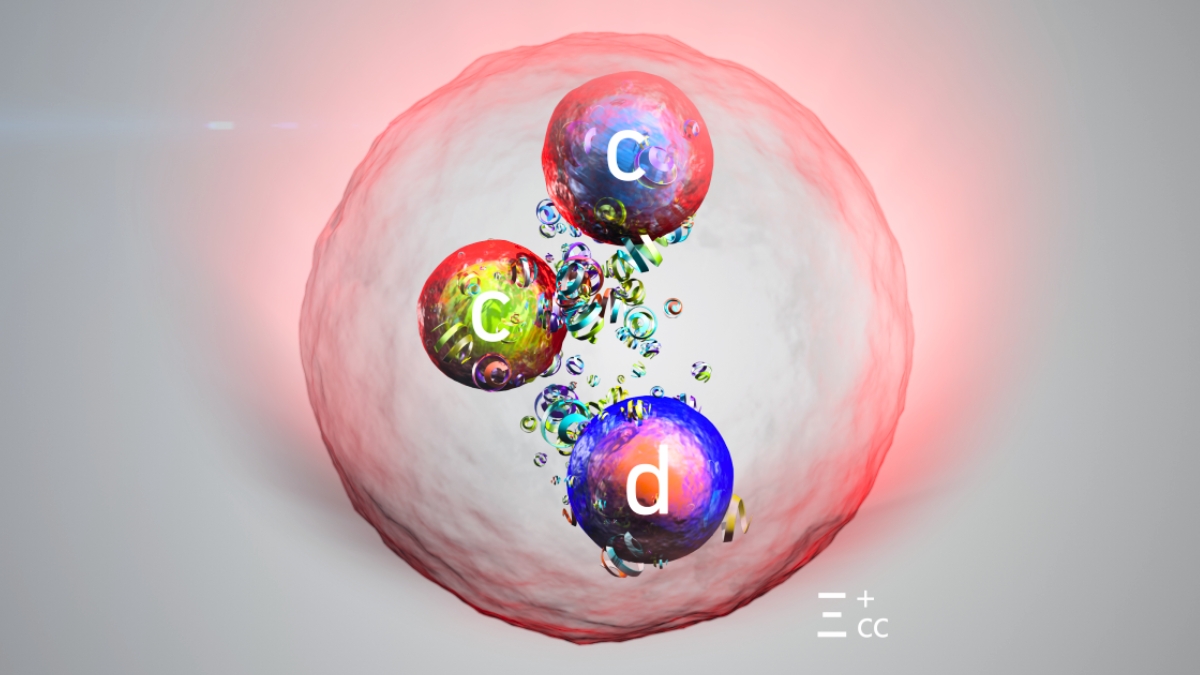
The Large Hadron Collider has discovered a new particle, the 80th identified so far by the world's most powerful particle smasher, Europe's CERN physics laboratory announced Tuesday.
The new particle has been named "Xi-cc-plus".
Scientists hope the particle – which is similar to a proton but four times heavier – will reveal more about the strange behaviour of quantum mechanics.
All the matter around us – including the protons and neutrons that make up the nucleus of atoms – is made of baryons.
These common particles are composed of three quarks, which are fundamental building blocks of matter.
Quarks come in six "flavours": up, down, charm, strange, top, and bottom. Each has varying mass, electric charge, and quantum properties.
In theory, there could be many different types of baryons that mix these flavors; however, most are extremely difficult to observe.
To chase them down, the Large Hadron Collider sends particles whizzing around an underground ring at phenomenal speeds until they smash into each other.
This gives scientists a brief chance to measure how the more stable elements decay, then deduce the properties of the original particle.
The newly discovered "Xi-cc-plus" contains two "charm" quarks and one "down" quark.
Normal protons have two "up" quarks and one "down" quark. Because the new particle has two heavier "charm" quarks instead of "up" ones, it has a much greater mass.
Vincenzo Vagnoni, spokesman for the Large Hadron Collider beauty (LHCb) experiment, said it was "only the second time a baryon with two heavy quarks has been observed".
It is also "the first new particle identified after the upgrades to the LHCb detector that were completed in 2023," he said in a statement.
"The result will help theorists test models of quantum chromodynamics, the theory of the strong force that binds quarks into not only conventional baryons and mesons but also more exotic hadrons such as tetraquarks and pentaquarks."
In 2017, the LHCb experiment announced that it had discovered a similar particle, made of two "charmed" quarks and one "up" quark.
The new particle has an expected lifetime six times shorter than this earlier one, making it far more tricky to spot, CERN said.
The Large Hadron Collider is a 27-kilometer (17-mile) long proton-smashing ring running about 100 meters below France and Switzerland. Most famously, it proved the existence of the Higgs boson – known as the "God particle" – in 2012.
Related: Scientists Simulated The Big Bang's Aftermath, And Found The Universe Was Like Soup
The latest discovery comes as CERN plans to build an even bigger particle smasher, the Future Circular Collider, to continue probing the mysteries of the universe.
Facts Only
The Large Hadron Collider (LHC) at CERN has discovered a new particle named "Xi-cc-plus."
This is the 80th particle identified by the LHC.
The particle is a baryon composed of two "charm" quarks and one "down" quark.
It is four times heavier than a proton.
The discovery was announced on Tuesday by CERN.
The LHCb detector was upgraded in 2023.
This is the second baryon observed with two heavy quarks.
The particle's lifetime is six times shorter than a similar particle found in 2017.
The LHC is a 27-kilometer underground ring located beneath France and Switzerland.
The LHC confirmed the existence of the Higgs boson in 2012.
CERN plans to build a larger collider, the Future Circular Collider.
The new particle may help test models of quantum chromodynamics.
Executive Summary
The Large Hadron Collider (LHC) at CERN has discovered a new particle, named "Xi-cc-plus," marking the 80th particle identified by the facility. This baryon contains two "charm" quarks and one "down" quark, making it four times heavier than a proton. The discovery follows upgrades to the LHCb detector in 2023 and is only the second observed baryon with two heavy quarks. Scientists hope this particle will provide insights into quantum chromodynamics, the theory governing the strong force that binds quarks. The LHC, a 27-kilometer underground ring, previously confirmed the Higgs boson in 2012. CERN is now planning a larger collider, the Future Circular Collider, to further explore fundamental physics.
The new particle's short lifetime—six times shorter than a similar particle discovered in 2017—made it particularly challenging to detect. The LHC achieves such discoveries by colliding particles at high speeds and analyzing the resulting decay patterns. This research builds on the understanding of quarks, which come in six types and combine to form baryons and other hadrons. The findings may help test theoretical models and explore exotic particles like tetraquarks and pentaquarks.
Full Take
This discovery underscores the LHC's role in pushing the boundaries of particle physics, but it also invites scrutiny of how such findings are framed and prioritized. The narrative emphasizes the particle's novelty and potential to advance quantum theory, which is a strong version of the story—highlighting scientific progress and the value of large-scale research infrastructure. However, the article does not delve into the broader implications of such discoveries, such as their practical applications or the opportunity costs of funding massive colliders over other scientific or societal needs.
Patterns detected: none. The reporting appears straightforward, focusing on verifiable facts and expert statements without evident manipulation. That said, the absence of critical context—such as the debate over the Future Circular Collider's cost or the reproducibility challenges in particle physics—could be seen as a subtle form of framing. The paradigm driving this narrative is the pursuit of fundamental knowledge, often justified by the promise of future technological breakthroughs. Yet, the assumption that such discoveries will inevitably lead to tangible benefits remains unexamined.
For human agency, this reinforces the idea that curiosity-driven science is inherently valuable, but it also raises questions about who decides which questions are worth billions in investment. Second-order consequences might include the centralization of high-energy physics in a few global institutions, potentially limiting diverse perspectives. Bridge questions: How do we balance the pursuit of pure science with societal needs? What alternative models of scientific funding could democratize access to such discoveries? Would the discovery of more exotic particles significantly alter our understanding of the universe, or is this incremental progress?
Counterstrike scan: If this were part of a coordinated campaign, the playbook might involve emphasizing the prestige of CERN and the LHC to justify continued funding, while downplaying critiques of cost or feasibility. However, the article does not exhibit overt signs of such a strategy—it presents the discovery as a scientific milestone without overt advocacy. The content aligns with standard science reporting rather than a manipulative narrative.
Sentinel — Likely Human
This article reports on the discovery of a new particle, the Xi-cc-plus, at CERN's Large Hadron Collider, detailing its composition, significance, and context within the broader history of particle physics research.