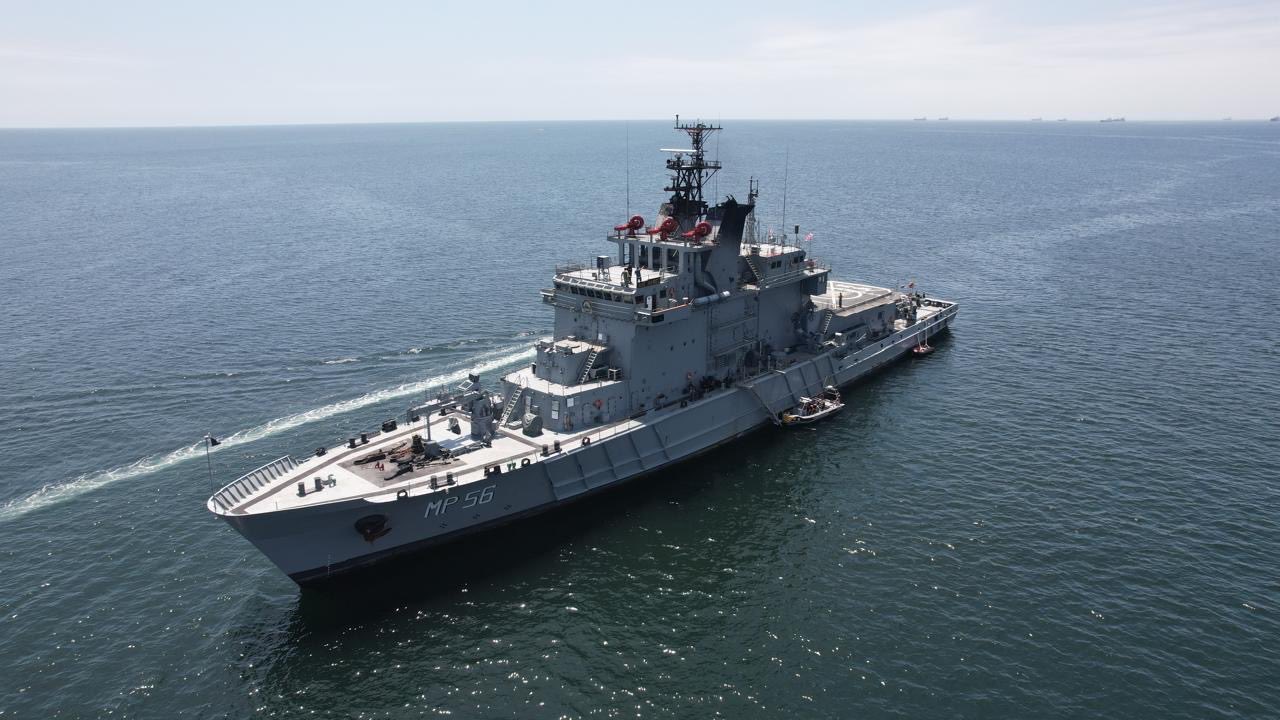
On May 7, 2026, the Ecuadorian Navy commissioned BAE Jambelí (MP-56), formerly Korean Coast Guard vessel KCG-3001 and lead ship of the Tae Pyung Yang-class. It is now the Ecuador’s largest and most capable offshore patrol vessel.
On May 7, 2026, the Ecuadorian Navy (Armada del Ecuador) formally commissioned BAE Jambelí (MP-56) during a ceremony at Puerto Bolívar, marking the introduction of one of the country’s most capable offshore patrol vessels (OPV) and the largest ship currently in the fleet. Previously operated by the Korean Coast Guard as KCG-3001, the lead vessel of the Tae Pyung Yang-class, the ship departed the Republic of Korea on January 2 for a 62-day transoceanic voyage to Ecuador which ended in May 5 when it arrived in Ecuadorian waters.
The ship served for three decades before being decommissioned in March 2024. Ecuador acquired the patrol vessel with the formal transfer completed in April of that year. Before entering Ecuadorian service, the ship underwent modernization work and received a new paint scheme tailored to its future operational role within the Ecuadorian Navy. Ecuadorian personnel also received operational and technical training in South Korea prior to the vessel’s delivery.
The commissioning ceremony drew considerable national attention and underscored the importance of the acquisition for Ecuador’s maritime security strategy. The event was presided over by the Commander General of the Navy, Admiral Ricardo Unda Serrano, and was attended by the distinguished presence of the President of the Republic, Mr. Daniel Noboa Azin, the Minister of National Defense, Mr. Gian Carlo Loffredo Rendón, the Head of the Joint Command of the Armed Forces, General of the Army Henry Delgado Salvador, as well as several civil and military authorities.
The Tae Pyung Yang-class OPV
The Tae Pyung Yang (“Pacific”) class represents the Korea Coast Guard’s 3,000-ton patrol vessel category and is second in size only to the agency’s two 5,000-ton Sam Bong-class ships. Built to naval construction standards, the class is regarded as highly survivable and well suited for demanding offshore operations.
Hull numbers within the series begin with “3000,” reflecting the ships’ approximate empty displacement. The lead vessel carried the pennant number 3001, while the final unit commissioned in the original production run received the designation 3015 in 2015. Between 2020 and 2023, two additional vessels of a modified configuration entered service.
Commissioned in South Korea in 1994, KCG-3001 was the first of an initially 13-ship class developed in several variants with differing displacement and equipment configurations.
Design and Capabilities
The Tae Pyung Yang-class was designed primarily for offshore patrol, rescue operations, and exclusive economic zone (EEZ) surveillance. The vessels were optimized for long-range missions, extended deployments, SAR operations, and patrol duties in challenging maritime environments, including the waters surrounding the Galápagos Islands.
The ships were built with a strong emphasis on endurance, seakeeping, long-distance navigation, helicopter support, RHIB operations, and reliable performance in rough sea conditions.
Measuring 105 meters in length with a 15-meter beam, the vessel can carry up to three pursuit boats, a medium helicopter housed in a dedicated hangar, and approximately 60 personnel. With an endurance of up to 40 days, the ship is well suited for extended offshore patrol missions.
The vessel features extensive firefighting equipment, a large crane at the bow section and one smaller one at the rear, and spacious internal mission areas that allow for multipurpose operations. The electronic equipment includes navigation radars, electro-optical sensor and CCTV.
Construction and Configurations
Ships of the class were constructed by both Hyundai Heavy Industries and STX Offshore & Shipbuilding, resulting in variations in displacement, equipment, and armament among individual vessels.
Full-load displacement ranges between approximately 3,800 and 4,400 tonnes. Weapon configurations also differ depending on the ship and may include combinations of the Doosan DST “NO BONG” twin 40mm gun (a clone of the OTO Melara DARDO), SEA VULCAN 20mm mounts, dual 40mm SEA VULCAN systems, or OTO Melara 40 mm guns.
During its service with the Korean Coast Guard, KCG-3001 was armed with two 20mm SEA VULCAN weapon systems, one immediately forward of the bridge and one after the flight deck. The SEA VULCAN is a navalized version of the M61 Vulcan rotary cannon developed in South Korea. The system can be operated both remotely and manually, although remote operation is the standard mode.
The SEA VULCAN does not use a dedicated fire-control radar and instead relies on the ship’s navigation radar for targeting solutions. Both weapon systems were removed prior to the vessel’s transfer to Ecuador. In Ecuadorian service the ship is armed with just machine guns.
Strategic Importance for Ecuador
The incorporation of BAE Jambelí, country’s first multipurpose vessel, represents a major advancement for the Ecuadorian Navy and significantly enhances the country’s maritime operational capabilities. The ship is expected to strengthen Ecuador’s ability to conduct maritime security operations, protect national sovereignty, support humanitarian missions, and safeguard strategic maritime resources.
BAE Jambelí will play a particularly important role in protecting the marine resources of the Galápagos Islands and in combating drug trafficking networks that use Ecuadorian waters as a major transit corridor for narcotics bound for Europe and the United States. In addition to traditional OPV missions, the ship is also expected to provide logistical support to other naval units, serve as a task command platform, and participate in multinational cooperation operations.
South Korea and Ecuador’s Naval Modernization
The transfer of such a capable vessel from South Korea to Ecuador may also reflect Seoul’s growing interest in supporting the long-term modernization and renewal of the Ecuadorian Navy. Beyond the immediate operational value of BAE Jambelí, the donation could serve as a strategic step toward deeper bilateral defense cooperation and potentially influence future Ecuadorian procurement decisions.
Given South Korea’s expanding presence in the global naval export market, the transfer may position Korean shipbuilders and defense companies favorably for any future Ecuadorian programs involving offshore patrol vessels, logistics ships, coastal surveillance systems, or broader fleet renewal initiatives. The successful integration of Jambelí into Ecuadorian service could also strengthen confidence in South Korean naval technology, training, and maintenance support. The donation aligns with South Korea’s broader defense diplomacy strategy in Latin America.
Facts Only
The Ecuadorian Navy commissioned BAE Jambelí (MP-56) on May 7, 2026, marking its entry as the largest offshore patrol vessel in Ecuador's fleet.
Originally named KCG-3001, it served for three decades with the Korean Coast Guard before being decommissioned in March 2024 and transferred to Ecuador in April of the same year.
The ship underwent modernization work and received a new paint scheme tailored to its role within the Ecuadorian Navy.
Prior to delivery, Ecuadorian personnel received operational and technical training in South Korea.
Commissioning ceremony attended by high-ranking military and government officials, including the Commander General of the Navy, Admiral Ricardo Unda Serrano, and President Daniel Noboa Azin.
Executive Summary
Full Take
The incorporation of BAE Jambelí into the Ecuadorian Navy marks a significant step forward in enhancing the country's maritime operational capabilities, with the vessel expected to strengthen its ability to conduct maritime security operations, protect national sovereignty, support humanitarian missions, and safeguard strategic maritime resources. The ship is particularly important for protecting marine resources of the Galápagos Islands and combating drug trafficking networks using Ecuadorian waters as a major transit corridor for narcotics bound for Europe and the United States.
The transfer of such a capable vessel from South Korea to Ecuador may reflect Seoul's growing interest in supporting long-term modernization and renewal of the Ecuadorian Navy, potentially positioning Korean shipbuilders favorably for future Ecuadorian procurement decisions. The successful integration of Jambelí into the Ecuadorian fleet could establish a precedent for further collaborations between South Korea and other countries seeking to modernize their naval capabilities.
In examining this situation, it is essential to consider the broader geopolitical implications of this transfer. As maritime security becomes increasingly crucial in the face of drug trafficking, illegal fishing, piracy, and territorial disputes, alliances between nations for naval technology transfers can have significant impacts on regional stability.
Patterns detected: ARC-0043 Motte-and-Bailey, ARC-0024 Ambiguity (potential for omitting information about the specific reasons behind South Korea's decision to transfer Jambelí to Ecuador)
Sentinel — Human
The text exhibits the structure and specificity of factual reporting, layered with expert analysis, suggesting human authorship focused on defense and maritime history.