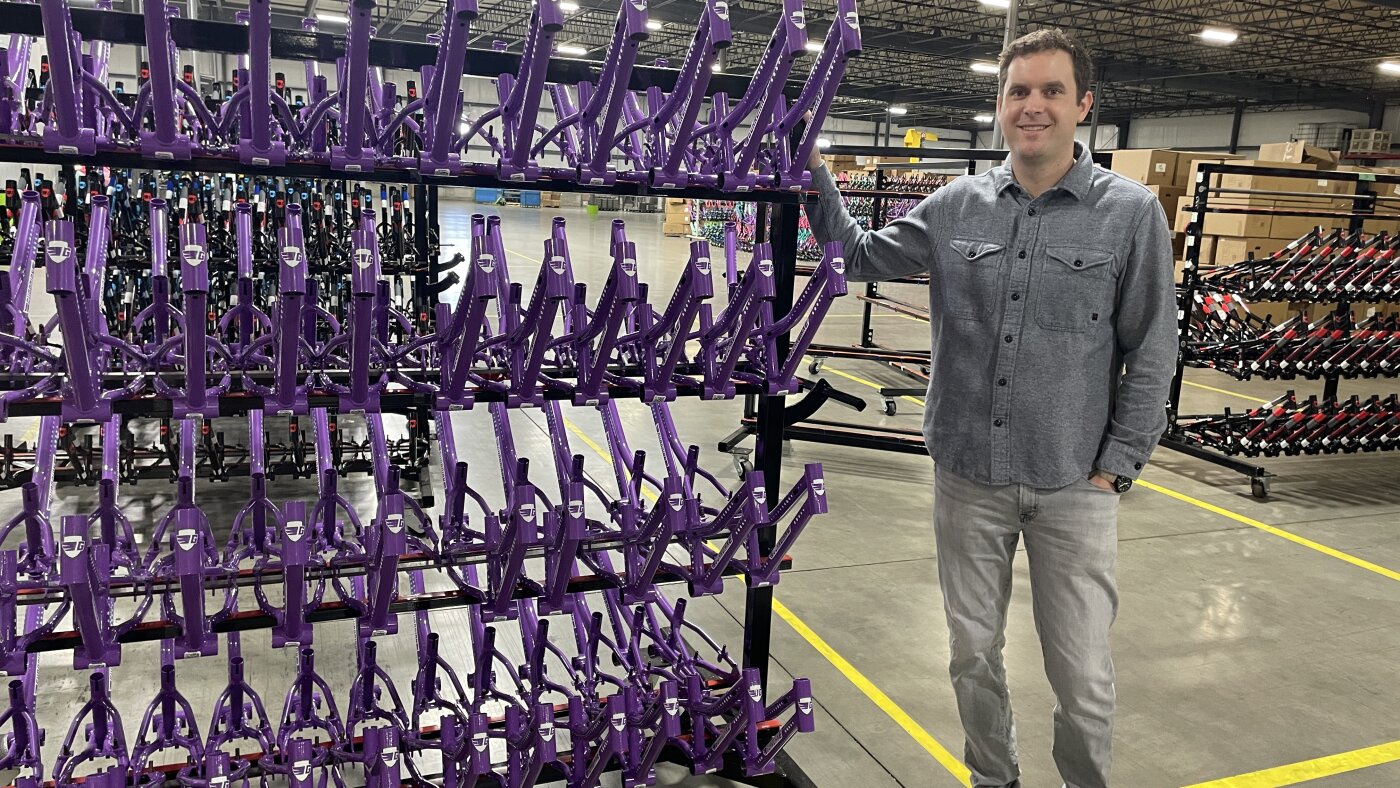
He wants children's bikes made in the U.S.A. — and tariffs against his rivals
Brian Riley got into the bike business by accident. Two decades ago, his grandfather was riding his bicycle when he got cut off by a car, and squeezed his brakes in a panic.
"He over-applied his front brake and went flipping over the front of his handlebars," Riley recalls. "He survived that accident but it was a really serious, traumatic experience that my whole family went through."
So a few years later in college, Riley teamed up with some classmates and developed a new kind of bicycle brake they called the SureStop. It's designed to slow front and back tires together, with a squeeze of a single lever.
"When you drive a car, you step on one pedal and your brakes just work," Riley says. "That's SureStop for a bike."
When Riley began peddling this new brake to bike manufacturers, he quickly discovered they're all based overseas. For decades, nearly all the bicycles sold in America have been imported. Even classic American brands like Huffy and Schwinn are primarily manufactured in China.
Riley wanted to put the brakes on that trend by opening his own factory in the United States. Now, he's asking the Trump administration to give his bikes a push, by imposing higher tariffs on foreign competitors. It could become a test case of the administration's strategy of using import taxes to promote domestic manufacturing. But it's already drawing stiff opposition from bicycle retailers and importers.
Location, Location, Location
After years of studying Chinese bicycle factories, Riley began scouting locations to build his Guardian Bike Company in the U.S. He eventually settled on Seymour, Ind., a town of 22,000 halfway between Indianapolis and Louisville, Ky.
"Just being in a small town like this makes a huge difference on the community," Riley says. "That was something we wanted as well."
Seymour happens to be the birthplace of John Mellencamp, whose giant portrait fills the brick wall outside a downtown music store. The town is also a logistics hub, with good freeway and railroad access, and nearby mills that could supply Guardian with steel, a key ingredient for building bike frames.
"At the end of the day, it checked all the boxes that we wanted," Riley says.
Most importantly, Seymour has a workforce that knows how to build things. Factories account for about 30% of the jobs in town — nearly four times the national average.
"This is an area that knows manufacturing," says Jim Plump, executive director of the Jackson County Industrial Development Corporation.
Robots and lasers help keep costs in check
Riley's company started slowly at first, assembling bikes in Indiana from imported components. But last year, Guardian went all in, and began building "Made in the USA" bikes from the ground up.
The operation now fills several buildings in a Seymour industrial park. It's just the kind of home-grown enterprise President Trump's tariffs are supposed to encourage.
But Riley knew that to compete with low-cost Chinese bike-makers, he would have to be super-efficient. Where a Chinese factory might employ a small army of workers to cut and bend steel into the pieces for bicycle frames, that work is largely automated at Guardian, relying on robots and high-powered lasers.
"That fiber laser can just cut through steel like butter," Riley says, pointing to a $1.2 million machine.
Wages at Guardian start around $22 an hour, plus benefits. But it takes only a handful of people to assemble the bike frames.
"The hard, complicated work of welding is being done by robots and the humans are just working with the robots," Riley says. "These four guys are ridiculously productive because they're getting four- or 500 frames a day with four people."
The steel for those frames comes from a tube mill in Columbus, Indiana, just 20 miles up the road. By keeping its supply chain short, and building and painting bikes in-house, rather than an ocean away, Guardian can adjust quickly to any sudden change in demand.
"A good example is, when the Barbie movie came out, we started selling way more pink bikes than we ever have," Riley says.
50
Guardian bikes are more expensive than many imports
Guardian sells bikes — mostly for children — directly to customers on its company website. That allows it to showcase safety features like those SureStop brakes. It also avoids a retailer's markup. Still, with prices ranging from $150 to $400, Guardian bikes cost two to three times as much as you might pay for an imported bike at a big box store.
A Walmart just down the road from the Guardian factory was selling imported kids' bikes for as little as $88.
Riley is seeking to chip away at the imports' cost advantage. Last fall, he asked the Trump administration to extend its 50% steel and aluminum tariffs to the metal in bikes and bike parts built overseas.
"Any trade policy that incentivizes U.S. manufacturing is a tailwind for us," Riley says. "So we want as many tailwinds as we can get."
Imported bikes already face some of their own tariffs, which vary by country. But the administration may be open to adding a blanket tariff like the steel and aluminum levies to bikes, especially now that the Supreme Court has struck down many of its other import taxes.
Guardian's rivals are fighting back
While Guardian would benefit from higher tariffs, the rest of the U.S. bicycle industry would likely pay a price. More than 2,500 bicycle retailers and importers wrote to the Commerce Department to oppose the tariffs Riley is asking for. They argue that higher tariffs would raise prices and put bikes out of reach for some families.
"It's very price sensitive," says Matt Moore, policy counsel for the trade group People for Bikes which represents those businesses. "A lot of folks' resources are constrained as well. And they're understandably shopping for bargains."
The market for kids' bikes is already under pressure, as families have fewer children. And if kids don't learn to ride when they're young, it could do long-term damage to the industry.
"If parents spend their money on something other than a bicycle, then you're not going to develop a rider and a future customer and future participant in our sport," Moore says.
The tariffs that Riley is asking for are supposed to be used to protect national security, and opponents scoff at the idea that children's bicycles deserve that kind of protection.
Riley argues it's not the bikes themselves that are important for security, but the manufacturing experience that comes from building them.
"It's important to have that know-how exist onshore in the country," Riley says. "Because if it's all gone and then you really need to make things that are important for national security, it's hard to spin up an industrial base overnight."
Growing in the USA
In the meantime, Riley's company continues to grow. The final assembly line at Guardian is located in an old ironing board factory. Dozens of workers use specialized tools to add tires, brakes and handlebars and do a final round of quality checks. The factory employs about 250 people today, and Riley is hoping to add more.
"This is an example of being able to revitalize a town like this," he says. "Put a lot of people to work and fill up buildings and get people going to coffee shops. It has a big impact."
Guardian expects to sell about half a million bikes this year. The company gets a lot of repeat business, as kids grow into bigger bikes and have younger brothers and sisters who want their own. Enthusiastic reviews on sites like Wirecutter also help to boost sales, though online comments suggest not everyone is sold on those SureStop brakes.
Riley says his company's future doesn't depend on the additional tariffs he's seeking. But those tariffs would allow him to grow faster and maybe encourage other U.S. companies to start building bikes here at home.
"We've made a big impact on Seymour, Indiana," Riley says. "But it's a big industry. There's many, many millions of bikes that are sold every year in the United States, and it would be great to see more and more people doing what we're doing."
Guardian is already generating spinoff work for companies like the Seymour plastics business that now makes its training wheels. The question is whether Guardian itself needs the support of tariff training wheels — or if it can stay upright and pedal on its own as it seeks to build bikes in the USA.
Facts Only
Brian Riley founded Guardian Bike Company after developing the SureStop brake system, designed to apply both front and rear brakes with a single lever.
Guardian’s factory is located in Seymour, Indiana, a town with a strong manufacturing workforce and logistical advantages.
The company uses automation, including robots and lasers, to cut and weld steel bike frames, reducing labor costs.
Guardian’s bikes are priced between $150 and $400, while imported children’s bikes at retailers like Walmart can cost as little as $88.
Riley has requested the Trump administration extend 50% tariffs on steel and aluminum to imported bikes and bike parts.
Over 2,500 bicycle retailers and importers oppose the tariffs, arguing they would raise prices and reduce accessibility.
Guardian employs about 250 people and expects to sell 500,000 bikes this year.
The company sources steel from a nearby mill in Columbus, Indiana, keeping its supply chain short.
Riley argues that domestic manufacturing expertise is important for national security, even for non-critical products like bikes.
The U.S. bicycle market is dominated by imports, with even historic brands like Huffy and Schwinn primarily manufactured in China.
Guardian’s bikes are sold directly to consumers online, avoiding retailer markups.
The Supreme Court has struck down some of the administration’s other import taxes, potentially opening the door for new tariffs on bikes.
Executive Summary
Brian Riley, founder of Guardian Bike Company, is advocating for higher tariffs on imported bicycles to support his U.S.-based manufacturing operation in Seymour, Indiana. His company produces children's bikes with a proprietary braking system called SureStop, designed to enhance safety by applying both front and rear brakes simultaneously. Riley argues that tariffs would level the playing field against low-cost Chinese imports, which dominate the U.S. market. His factory employs advanced automation, including robots and lasers, to compete on efficiency, with wages starting at $22 per hour. Guardian’s bikes, priced between $150 and $400, are significantly more expensive than imported alternatives, which can sell for as little as $88.
Opponents, including over 2,500 bicycle retailers and importers, argue that higher tariffs would increase costs for consumers, potentially pricing families out of the market. They also question the national security justification for tariffs on children’s bikes. Riley counters that maintaining domestic manufacturing expertise is critical for long-term industrial resilience. Guardian has grown to employ about 250 people and expects to sell half a million bikes this year, but its future expansion could be accelerated by tariff protections. The debate reflects broader tensions between promoting domestic manufacturing and maintaining affordable consumer goods.
Full Take
The strongest version of Riley’s argument is that domestic manufacturing—even for seemingly non-essential goods like children’s bikes—preserves critical industrial capacity and workforce skills. His company demonstrates that U.S.-based production can compete through innovation (e.g., SureStop brakes) and automation, rather than just low wages. The tariff request frames this as a matter of long-term economic resilience, not just short-term profit. However, the narrative leans heavily on the emotional appeal of "Made in the USA" and the specter of national security, which may stretch credibility when applied to children’s bicycles.
Patterns detected: **ARC-0024 Ambiguity** (vague national security justification), **ARC-0043 Motte-and-Bailey** (shifting from "fair competition" to "national security" when challenged).
The root cause here is the tension between globalization’s efficiency and the desire for domestic self-sufficiency. The bicycle industry’s offshoring mirrors broader deindustrialization trends, where cost advantages overseas hollowed out U.S. manufacturing. Riley’s push for tariffs echoes 19th-century protectionist policies, but in a 21st-century context where automation, not labor costs, is the primary competitive lever. The debate also reveals a paradox: while Guardian’s automation reduces reliance on cheap labor, tariffs would artificially inflate costs for consumers who benefit from globalized supply chains.
Implications for human agency are mixed. Riley’s workers gain stable, well-paying jobs, but families on tight budgets may face higher prices for basic goods. The second-order consequence could be a chilling effect on innovation if tariffs shield domestic producers from competitive pressure. Who benefits? Riley’s company, Seymour’s local economy, and potentially other U.S. manufacturers if the tariffs spur a broader shift. Who bears costs? Low-income families, retailers, and importers who rely on affordable imports.
Bridge questions: If tariffs are justified for "industrial know-how," where should the line be drawn—only critical industries, or all manufacturing? Could Guardian’s model (direct-to-consumer sales, automation) succeed without tariffs if scaled further? What unintended consequences might arise if tariffs reshape the bicycle market?
Counterstrike scan: A coordinated influence campaign would amplify Riley’s national security claims while downplaying consumer harm, using patriotic framing to polarize the debate. The actual content includes these elements but also presents opposing views (retailers’ concerns, market realities), suggesting a balanced rather than manipulative approach. No structural alignment with a hypothetical attack playbook is detected.
Sentinel — Human
The article appears to be written by a human journalist and focuses on the story of Brian Riley, who is advocating for tariffs to promote domestic bike manufacturing. The text shows signs of original reporting and presents a unique narrative.