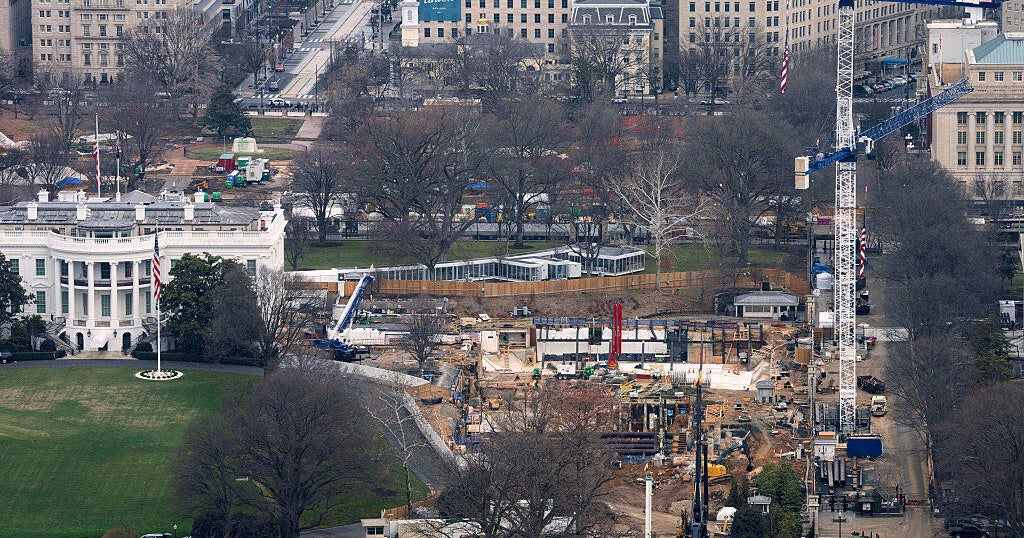
The Trump administration has proposed the construction of an underground facility to screen visitors to the White House.
The National Capital Planning Commission is scheduled to consider plans for the approximately 33,000-square-foot visitor screening facility that would be built entirely on federal land in Sherman Park, which is located southeast of the White House. The NCPC is the commission that approves construction projects on federal land in the Washington, D.C., region.
The plans, listed on the agenda for the NCPC's April 2 meeting, were developed by the Executive Office of the President in conjunction with the U.S. Secret Service, the Interior Department, and the National Park Service. Construction could begin as early as this fall, and could be completed by July 2028.
The new facility would allow visitors to queue in multiple entry lanes for an initial ID check, before proceeding to a new lobby and another checkpoint. The proposed screening area would be built to accommodate large groups.
Visitors to the White House previously lined up in the nearby park before entering security checkpoints inside trailers and tents. Due to the construction of the White House's new East Wing ballroom, visitors currently gather at an alternate location in Lafayette Park.
In its plans, the NCPC did not provide an estimated cost for the project, or where the funding would come from.
"For far too long, visitors to the White House have had a reduced experience where they were required to begin their tours by entering temporary, double wide trailers and tents outside, often in uncomfortable weather conditions," White House spokesman Davis Ingle told CBS News in a statement. "This President took it upon himself to modernize the experience for visitors touring the People's House from beginning to end. President Trump is committed to giving all visitors to the White House the best experience possible. The new Visitor Center will be state of the art in design and highlight the beautiful history of the White House and our Nation's Capital."
The NCPC says it is working to mitigate the facility's impact on historic sites. According to the plans, the existing statue of Union General William Tecumseh Sherman in the park would remain in place. There are, however, plans for landscape restoration to "enhance the park's character." At least six trees will be removed and replaced with "suitable native species and landscaping," according to the plans.
The plans also take into account "visitor use and aesthetic appeal" by maintaining public access to the park and avoiding structures that would detract from the surrounding buildings and monuments.
The move comes as the administration faces backlash and legal challenges over other major construction projects in Washington including construction of the White House ballroom, a two-year renovation of the Kennedy Center, and the possible construction of a triumphal arch.
Facts Only
* The Trump administration is proposing the construction of an underground visitor screening facility at the White House.
* The facility would be built on federal land in Sherman Park, southeast of the White House.
* The project is being considered by the National Capital Planning Commission (NCPC).
* The facility would be approximately 33,000 square feet.
* Construction could begin as early as this fall, with completion targeted for July 2028.
* Visitors would queue in multiple entry lanes for initial ID checks.
* The facility includes a new lobby and another checkpoint.
* The project was developed by the Executive Office of the President, the U.S. Secret Service, the Interior Department, and the National Park Service.
* Visitors previously lined up in the park before security checkpoints.
* The NCPC did not provide an estimated cost or funding source.
* The statue of Union General William Tecumseh Sherman in the park will remain in place.
* Landscape restoration is planned, involving the removal and replacement of six trees with “suitable native species and landscaping.”
Executive Summary
Full Take
The core narrative here is a classic “modernization” pitch – superficially appealing to the public’s desire for convenience while simultaneously asserting presidential authority and control over public space. The timing, coinciding with ongoing administrative controversies surrounding construction projects, strongly suggests a strategic move designed to demonstrate responsiveness and a commitment to improved services, regardless of the actual utility. This is a textbook Motte-and-Bailey (ARC-0043), offering a superficially attractive solution while deliberately obscuring key details – the cost, the funding, the full impact on the park – creating ambiguity about the project’s true scope and priorities. The invoking of “state-of-the-art design” and “beautiful history” is a heavy use of emotional appeal, a classic attempt to normalize a potentially intrusive intervention. The administration’s framing of the current situation as “reduced experience” due to temporary trailers and tents is a deliberate distortion, likely intended to manufacture outrage and position the new facility as a long-overdue correction.
Furthermore, the simultaneous attention to this project alongside the ongoing challenges to other construction initiatives (ballroom, Kennedy Center renovation, triumphal arch) strongly suggests a coordinated strategy—a deflection tactic. The administration is attempting to shift focus away from perceived overspending and questionable priorities, by presenting this as a necessary and well-managed initiative. The planned landscape restoration, replacing native species with “suitable native species,” is potentially a subtle attempt at sanitizing the project – a way to frame the impact on the park as restorative rather than destructive. The emphasis on "visitor use and aesthetic appeal” is a red herring – focusing on surface-level concerns to avoid addressing deeper questions about the administration's broader approach to public land and civic engagement. This leans into the Systemic pattern of “sanewashing” extreme statements after the fact – masking the reality of the project with carefully crafted rhetoric.
Questions to consider: What is the administration's true motivation for this project—is it genuinely about visitor experience or a tool for asserting control and managing public perception? How will the decision to prioritize this underground facility impact the administration’s ongoing legal battles and broader policy agenda? Patterns detected: ARC-0043 Motte-and-Bailey, ARC-0024 Ambiguity, ARC-0018 Red Herring.
Sentinel — Likely Human
The article reports on a White House proposal for a new visitor screening facility, outlining the project's scope, stakeholders, and intended benefits. While the writing style is clear and informative, the reliance on self-described justifications and a lack of independent corroboration suggests a predominantly human origin.