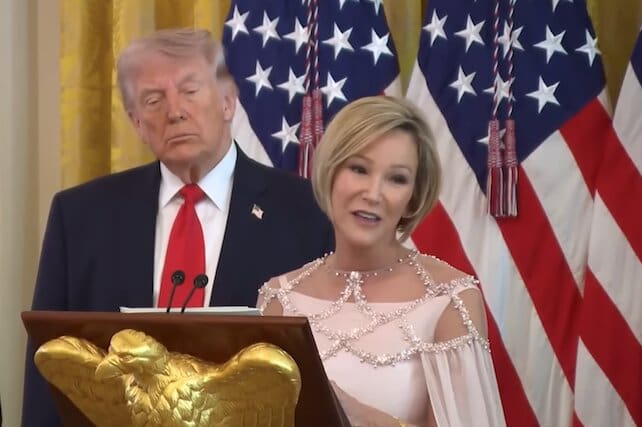
Paula White-Cain is drawing comments of “heresy” and “blasphemous” from Christian leaders for remarks she made at an Easter lunch at the White House on Wednesday, April 1. White-Cain compared President Donald Trump to Jesus, saying that like Jesus, Trump was “betrayed and arrested and falsely accused.”
“Powerfully blasphemous,” said evangelist and ministry leader Justin Peters. “And there stands one of the most prominent pastors in the SBC, Robert Jeffress, giving his unwavering endorsement to one of the most obvious false teachers ever to disgrace the name of Christ and bring reproach upon the Gospel.”
“Heresy,” said pro-life advocate and former NFL player Benjamin Watson. “And Jeffress, and other ‘pastors’, standing there clapping. Ripping scripture out of context. Abusing the text. I wish some of these spiritual leaders would actually lead spiritually.”
Heresy. And Jeffress, and other “pastors”, standing there clapping. Ripping scripture out of context. Abusing the text. I wish some of these spiritual leaders would actually lead spiritually. https://t.co/8SZmRm79pc
— Benjamin Watson (@BenjaminSWatson) April 2, 2026
Paula White-Cain Draws Criticism for Remarks on Trump
Paula White-Cain is the president of Paula White Ministries and pastor of City of Destiny Church in Apopka, Florida. She rose to prominence through television ministry and later became a high-profile spiritual adviser to President Donald Trump. In February 2025, Trump appointed her to lead the White House Faith Office.
White-Cain is a controversial figure who has received criticism for teaching a prosperity gospel, being a female pastor, and being twice-divorced. She is married to Journey keyboardist Jonathan Cain.
After he delivered remarks at the White House Easter lunch, Trump invited White-Cain, Rev. Franklin Graham, Pastor Marilyn Rivera, and Bishop Robert Barron to lead the room in prayer. White-Cain went first.
“The Bible says to give thanks for all things. And as I was praying this morning, the word ‘gratitude’ just kept coming to me,” White-Cain said. “And so, there’s so many things I’m grateful for. I’m grateful for salvation and the finished work of Jesus Christ and my family. And the list would go on and on.”
“But as I prayed,” she continued, “it was like the Holy Spirit just zoned me in and said, ‘Tell President Trump how thankful you are for him.’” At this remark, the attendees gave a standing ovation.
“I felt like I was conveying the heart of God for all of us that we are thankful for the greatest champion of faith that we’ve ever seen in a president,” White-Cain said. “And we honor you because of your bold, unwavering conviction and stand for religious liberty here in America and around the world. And you recognize the power and the name of Jesus Christ.”
RELATED: Trump Shares Franklin Graham’s Letter Explaining ‘Only Way to Heaven’
Paula White-Cain is drawing comments of “heresy” and “blasphemous” from Christian leaders for remarks she made at an Easter lunch at the White House on Wednesday, April 1.Click to Post
Facts Only
Paula White-Cain spoke at a White House Easter lunch on April 1, 2026.
She compared President Donald Trump to Jesus, stating he was "betrayed and arrested and falsely accused."
Christian leaders Justin Peters and Benjamin Watson criticized her remarks as "blasphemous" and "heresy."
White-Cain is president of Paula White Ministries and pastor of City of Destiny Church in Apopka, Florida.
She was appointed to lead the White House Faith Office by Trump in February 2025.
White-Cain has faced criticism for teaching prosperity gospel, being a female pastor, and being twice-divorced.
She is married to Journey keyboardist Jonathan Cain.
At the event, Trump invited White-Cain, Rev. Franklin Graham, Pastor Marilyn Rivera, and Bishop Robert Barron to lead prayers.
White-Cain expressed gratitude for Trump, calling him the "greatest champion of faith" among U.S. presidents.
Attendees gave her remarks a standing ovation.
Critics accused her of misusing Scripture and blending political and religious authority.
Executive Summary
Full Take
The strongest version of this narrative frames White-Cain’s remarks as a sincere expression of gratitude for a leader she believes has defended religious liberty, while critics argue it crosses into idolatrous conflation of political and divine authority. The controversy underscores a broader pattern of religious leaders leveraging scripture to legitimize political figures, a tactic that risks eroding the distinction between faith and partisanship.
Patterns detected: **ARC-0024 Ambiguity** (blurring lines between spiritual and political endorsement), **ARC-0043 Motte-and-Bailey** (defending "gratitude" while advancing a more extreme comparison to Jesus).
Root cause: The narrative reflects a longstanding tension in American evangelicalism between prophetic critique of power and uncritical alignment with political leaders. The assumption that divine favor equates to political success is a recurring theme in prosperity gospel circles, where material and spiritual blessings are often conflated.
Implications: For human agency, this dynamic risks reducing faith to a tool for political mobilization, potentially alienating those who see religion as a moral check on power rather than its enabler. The beneficiaries are leaders who gain religious legitimacy, while the cost is borne by institutions whose credibility is undermined by perceived partisanship.
Bridge questions: How should religious leaders navigate the line between spiritual guidance and political endorsement? What historical examples exist of faith being co-opted for political purposes, and what were the consequences? Would the criticism differ if a leader from another political spectrum were compared to a religious figure?
Counterstrike scan: A coordinated influence campaign would amplify divisive framing—portraying critics as "ungodly" or supporters as "true believers"—to polarize audiences. The actual content here includes genuine critique but stops short of systematic manipulation, focusing on theological and ethical concerns rather than orchestrated outrage.
Sentinel — Human
This article appears to be a human-written news piece reporting on the controversy surrounding Paula White-Cain's remarks at the White House Easter lunch.