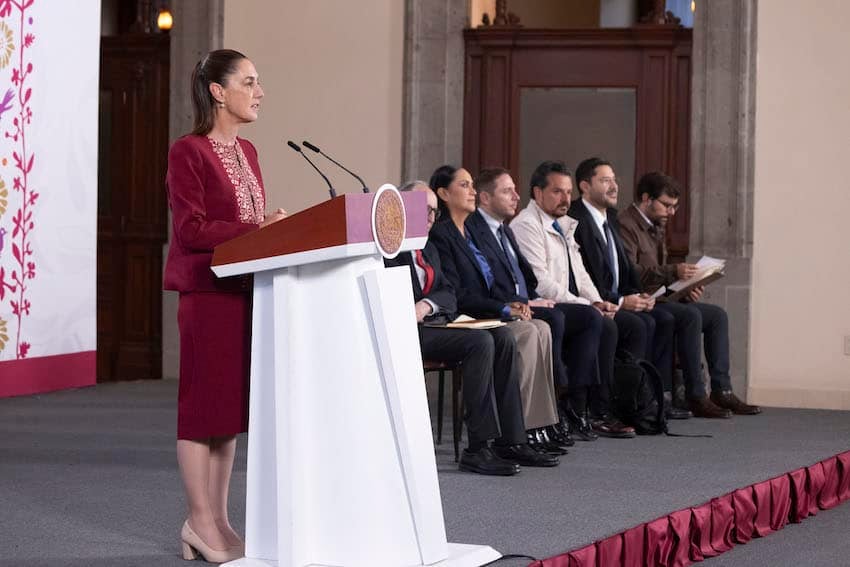
Sheinbaum’s mañanera in 60 seconds
- 🚫 No corruption, no exceptions: Sheinbaum pushed back on a question about irregular government contracts, insisting her administration has zero tolerance for improper conduct and that no one in her personal circle — family, friends or past associates — has any sway over procurement decisions.
- 💉 Tainted vitamin drips kill 7 in Sonora: Health Minister Kershenobich confirmed that 10 people fell ill after receiving IV vitamin infusions at a Hermosillo clinic, with the death toll now at seven. Lab tests point to a bacterial contaminant in the drips; the clinic has been shut down and final test results are pending.
- 🔫 Arizona gun shop owner charged: Sheinbaum welcomed the formal U.S. accusation against an Arizona firearms dealer accused of supplying Mexican cartels, calling it a historic first. The Foreign Affairs Ministry is now exploring how to fold the case into Mexico’s existing lawsuit against five Arizona gun stores — a suit filed in 2022 that remains unresolved.
Why today’s mañanera matters
At her Tuesday morning press conference, President Claudia Sheinbaum took the opportunity to underscore her commitment to combating corruption. Her predecessor and political mentor, Andrés Manuel López Obrador, was elected in 2018 on an anti-corruption platform and, like AMLO, Sheinbaum holds herself up as an example of rectitude.
Still, more than seven years after AMLO and the Morena party came to power, Mexico ranks very low on Transparency International’s Corruption Perceptions Index.
Tuesday’s mañanera was also noteworthy as the federal government acknowledged two significant recent developments: a healthcare-related tragedy in Sonora and a significant legal case across that state’s border in Arizona.
Sheinbaum reiterates her commitment to combating corruption
Asked about alleged irregularities in government contracts, Sheinbaum said that any improper conduct that is detected must be punished.
Tiene prohibido cualquier servidor público hacer una contratación con alguna persona cercana a mí
Ni Julio Scherer (@JScherer_Ibarra), ni mis hijos, ni mi marido, ni mis amigos, pueden ser recibidos por algún servidor público.“No veo a #JulioSherer desde que entré al gobierno.… pic.twitter.com/k8Nzwofyhi
— Manuel Galeazzi (@ManuelGaleazz1R) April 7, 2026
“We don’t tolerate corruption. That has to be made very clear, and there is no impunity,” she said.
Sheinbaum went on to say that no one close to her — “not my children, not my husband, not my friends” — has any influence in decisions related to government contracts.
She said that officials in her government have instructions not to meet with anyone who is personally close to her, or has been close to her in the past.
“Fortunately, my children are dedicated to other things, my mother has an academic career, my relatives don’t participate in any way in actions of this kind,” Sheinbaum said.
“… There can be no influence of any kind for any government contract. None,” she added.
7 people die in Sonora after receiving vitamin drips
Health Minister David Kershenobich told reporters that 10 people became ill after receiving intravenous vitamin infusions in Sonora.
He said that six of those people passed away, two remained in the hospital and two had been discharged from the hospital. According to reports published on Tuesday morning, the death toll has risen to seven.
The vitamin drips were prepared and administered by a doctor at a clinic in Hermosillo, the capital of Sonora.
Kershenobich said that laboratory tests had detected possible evidence of “a bacterial contaminant” in the vitamin infusions that were administered. He said that authorities are still waiting for final results to confirm the cause of the deaths in Sonora. Kershenobich also said that the clinic where the vitamin drips were administered has been shut down by authorities.
Sheinbaum comments on accusation against US gun shop owner
Sheinbaum expressed satisfaction that a gun shop owner in Arizona has been formally accused by U.S. authorities of selling weapons to Mexican cartels.
“It’s great that, really, for the first time, there has been an action of this kind,” she said.
Sheinbaum also said that the Ministry of Foreign Affairs is analyzing how it can “incorporate” the accusation against the gun shop owner in Arizona into the Mexican government’s lawsuit against gun retailers in the same state.
In 2022, the federal government filed a lawsuit against five gun stores in Arizona, accusing them of involvement in illegal arms trafficking to Mexico, where criminal organizations use U.S.-sourced weapons to commit a range of crimes, including homicide. Around 3 1/2 years after the lawsuit was filed, the case still hasn’t been resolved.
By Mexico News Daily chief staff writer Peter Davies (peter.davies@mexiconewsdaily.com)
Facts Only
President Claudia Sheinbaum stated that her administration has zero tolerance for corruption in government contracts.
Sheinbaum declared that no family members, friends, or past associates have influence over procurement decisions.
Sheinbaum instructed officials not to meet with anyone personally close to her regarding government contracts.
Health Minister David Kershenobich confirmed seven deaths in Sonora linked to contaminated intravenous vitamin infusions.
Ten people fell ill after receiving the infusions at a Hermosillo clinic, which has been shut down.
Lab tests detected a possible bacterial contaminant in the vitamin drips; final results are pending.
Sheinbaum welcomed the U.S. indictment of an Arizona gun shop owner accused of supplying weapons to Mexican cartels.
The Mexican government filed a lawsuit in 2022 against five Arizona gun stores for alleged arms trafficking.
The Foreign Affairs Ministry is examining how to incorporate the new case into the existing lawsuit.
The 2022 lawsuit remains unresolved after three and a half years.
Executive Summary
Full Take
Sheinbaum’s press conference presents a narrative of institutional integrity, with her anti-corruption stance framed as an extension of AMLO’s legacy. The strongest version of this narrative is that her administration is proactively addressing systemic issues—corruption, public health failures, and cross-border arms trafficking—with transparency and accountability. However, the persistence of corruption perceptions in Mexico, despite years of Morena rule, invites scrutiny of whether rhetorical commitments translate into structural change. The Sonora tragedy underscores gaps in healthcare oversight, while the unresolved 2022 lawsuit against Arizona gun stores raises questions about the efficacy of legal strategies in curbing arms trafficking.
Patterns detected: ARC-0024 Ambiguity (vague assurances of "zero tolerance" without specific enforcement mechanisms), ARC-0043 Motte-and-Bailey (broad anti-corruption claims paired with narrow, untested examples of personal integrity).
Root cause: The narrative assumes that top-down declarations of integrity are sufficient to combat entrenched corruption, sidestepping systemic weaknesses in enforcement and institutional culture. The focus on personal probity (e.g., Sheinbaum’s family) may deflect from broader structural issues.
Implications: For human agency, the emphasis on individual accountability could empower whistleblowers but risks overlooking collective responsibility. The costs are borne by victims of corruption and public health failures, while benefits accrue to political leaders who gain credibility from symbolic gestures.
Bridge questions: How might Mexico’s corruption rankings improve if anti-corruption efforts targeted institutional design rather than personal conduct? What evidence would demonstrate that the Arizona lawsuit is achieving its intended deterrent effect?
Counterstrike scan: A coordinated influence campaign would amplify Sheinbaum’s anti-corruption messaging while downplaying systemic failures, using emotional appeals (e.g., "historic first" in the gun case) to obscure unresolved issues. The actual content aligns partially with this pattern but includes acknowledgments of unresolved challenges, mitigating outright manipulation.
Sentinel — Human
This analysis suggests that the article is likely human-written, as it shows signs of human-like inconsistencies, passion, and personal voice, while lacking the typical argumentative structure seen in synthetic texts.