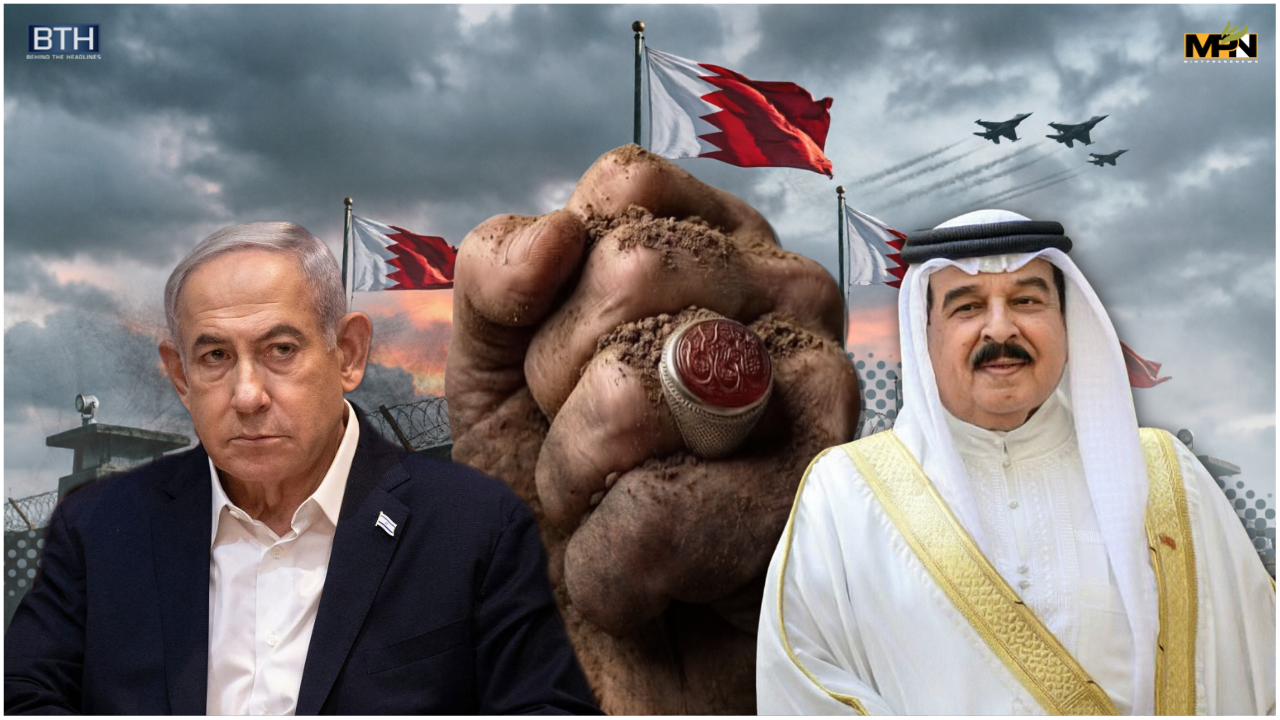
The Bahraini authorities have launched a draconian crackdown targeting Shia Muslims under the guise of combating “Iranian networks” and “terrorist plots” following suit from neighbouring Gulf State amid the US-Israeli war against Iran. While portraying their actions as self defense, the facts paint a rather different story- one of antagonism and direct participation in a war that violates the UN Charter.
Over the weekend, Manama launched a wave of raids, arresting 41 Bahraini Shia clerics in 72 hours, using the initial justification that they maintained ties to Iran’s Islamic Revolutionary Guard Corps (IRGC). Later, however, a different charge was invoked to justify the action; “financing terrorism”, without specifying any specific terrorist entity.
The move, carried out by the sectarian Sunni Khalifa family that rules over a majority Shia Muslim population, has triggered yet another series of public demonstrations throughout the small Persian Gulf nation. In total, over 350 Bahraini Shia nationals have been subjected to arrest since the beginning of the latest US-Israeli aggression on Iran.
Some of the detained scholars are elderly and/or chronically ill, leading to concerns that their health conditions could rapidly deteriorate. In March, 32-year-old Sayed Mohamed Almosawi died in Bahraini custody bearing clear signs of torture, drawing condemnation from human rights groups.
On Tuesday, the Bahraini authorities then sentenced 3 people to life imprisonment, claiming they were linked to the IRGC, while 20 others were given sentences of up to 10 years in prison, ten of whom were sentenced for supporting Tehran by “filming in prohibited locations and disseminating banned statements”. So far, 69 Bahraini nationals have been stripped of their citizenships since February 28, a move that targeted even the family members of those accused of sympathising with Iran.
During the height of the US-Israeli war on Iran earlier this year, Manama even announced it would pursue the death penalty when prosecuting individuals who were accused of supporting Iran.
“The death penalty is being used as a tool of political suppression”, said Bahraini exile and human rights activist Sayed Yusuf Almuhafdha.
Gulf States Crackdown on Shia Muslims
Meanwhile, since the imposition of the temporary Iran-US ceasefire, the United Arab Emirates (UAE) and Kuwait, have also taken similar steps against Shia Muslims and sought to antagonise the Iranian State. After previously arresting 27 Shias – most of whom were Emiratis – back in April, issuing contradictory statements as to why, Abu Dhabi began arbitrarily deporting Pakistani Shia workers this week.
Kuwait has also arrested a number of Shia Muslims it accused of maintaining ties to Hezbollah, a charge that the Lebanese group has denied. Stepping up their provocations, the Kuwaiti authorities decided to assault a ship carrying four Iranian citizens, detaining them and accusing the group of working on behalf of Tehran to carry out an infiltration operation. In response, Iran has vowed that it maintains the right to respond to what it calls an “unlawful” escalation.
Furthermore, according to Bloomberg News, the UAE not only carried out multiple strikes against Iranian civilian infrastructure, one of its attacks was coordinated alongside the Israelis themselves. While Reuters has claimed that Saudi Arabia may too have carried out strikes against Iran, there is less evidence to back up this report, especially given the track record of the news outlet when it comes to the question of Iran.
Bahrain’s ongoing crackdown is lining itself deeper into the US-Israeli camp, but is also sparking condemnation from human rights organisations, especially as their suppression tactics are nothing new.
For example, one of the 41 Shia scholars detained, Sheikh Mohamed Sanqour, was previously arrested in 2023, after simply offering a criticism of the abuse of political prisoners inside the country.
Human Rights Watch’s Niku Jafarnia commented that “at this critical moment, Bahrain authorities should be expanding their efforts to protect people, not arresting them for peacefully demonstrating or posting on social media”.
Despite there being a series of campaigns throughout Bahrain, Kuwait, UAE and Saudi Arab, that have sought to silence critics of the US-Israeli war of aggression, a clear pattern is emerging that shows a targeted attempt to collectively punish Shia Muslims.
Although there is yet to be another large-scale Bahraini uprising against the latest wave of suppression against its citizenry, sporadic protests persist and appear to be escalating, in response to an intensified crackdown.
Robert Inlakesh is a political analyst, journalist and documentary filmmaker currently based in London, UK. He has reported from and lived in the occupied Palestinian territories and hosts the show ‘Palestine Files’. Director of ‘Steal of the Century: Trump’s Palestine-Israel Catastrophe’. Follow him on Twitter @falasteen47
Facts Only
* Bahrain launched raids, arresting 41 Shia clerics in 72 hours.
* The initial justification for the raids was ties to Iran’s Islamic Revolutionary Guard Corps (IRGC).
* A later charge invoked was "financing terrorism."
* 3 people were sentenced to life imprisonment, claimed to be linked to the IRGC.
* 20 others received sentences of up to 10 years in prison.
* Sixteen individuals were sentenced for supporting Tehran by "filming in prohibited locations and disseminating banned statements."
* 69 Bahraini nationals were stripped of their citizenships since February 28.
* The UAE and Kuwait also took steps against Shia Muslims, including deporting Pakistani Shia workers.
* Kuwait arrested Shia Muslims accused of maintaining ties to Hezbollah.
* The UAE carried out strikes against Iranian civilian infrastructure coordinated with Israelis.
* Human rights groups have commented on the need to protect people rather than arresting them for peaceful demonstration.
Executive Summary
Full Take
Sentinel — Human
The text functions as human-edited geopolitical commentary, blending specific factual claims with moral framing, suggesting human authorship rather than pure synthetic generation.