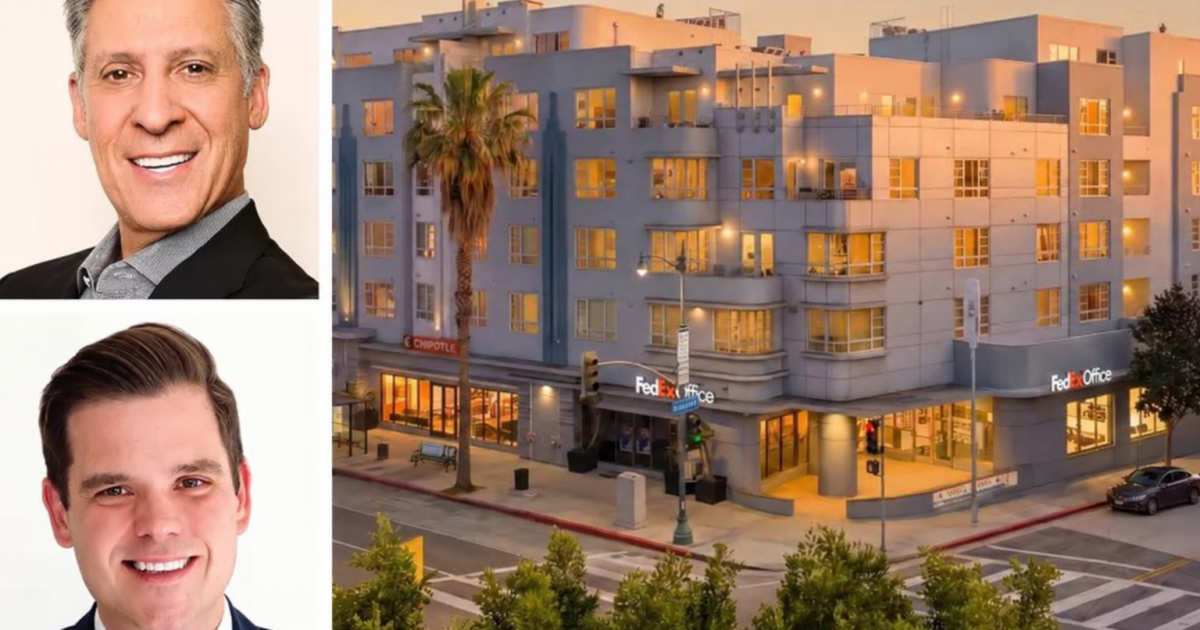
It’s the firm’s first purchase in its hometown in nearly two years
By Greg Cornfield September 18, 2026 2:30 pm
reprintsDecron Properties has acquired a 163-unit property in Los Angeles’ Miracle Mile for $114 million as the firm’s first L.A. deal in nearly two years.
The Los Angeles-based investment firm acquired the asset at 5550 Wilshire Boulevard, a residential and retail property developed in 2010, at what Decron described as a substantial discount to replacement cost. After focusing on Sun Belt markets, the firm said it continues to pursue opportunities across Los Angeles, San Jose, Orange County, San Diego and Seattle as well.
“Our growth-market strategy has never been a referendum on Los Angeles,” Decron President and CEO David Nagel said in a statement. “For a period, the risk-adjusted returns here simply weren’t competitive with what we were finding in the Sun Belt markets.”
Nagel added that Los Angeles remains “one of the nation’s most important and chronically undersupplied housing markets,” where new supply is difficult and expensive to build.
5550 Wilshire includes one-, two- and three-bedroom apartments and townhomes. Amenities include a pool and spa, a resident lounge, a private movie theater and rooftop lounges. The property also includes 14,686 square feet of ground-floor retail that is fully leased to tenants that include Chipotle, Five Guys and FedEx Office.
JLL’s Blake Rogers represented both Decron and the seller in the transaction.
Decron owns and manages nearly 10,000 multifamily units and about 1 million square feet of retail across California, Washington and Arizona, with a portfolio totaling roughly 8.7 million square feet.
Gregory Cornfield can be reached at gcornfield@commercialobserver.com.
Facts Only
* Decron Properties acquired a 163-unit property in Los Angeles' Miracle Mile for $114 million.
* The property address is 5550 Wilshire Boulevard.
* The property was developed in 2010.
* Decron focuses on Sun Belt markets.
* The firm pursues opportunities across Los Angeles, San Jose, Orange County, San Diego, and Seattle.
* The property includes one-, two-, and three-bedroom apartments and townhomes.
* Amenities include a pool, spa, resident lounge, a private movie theater, and rooftop lounges.
* 14,686 square feet of ground-floor retail space is fully leased to tenants including Chipotle, Five Guys, and FedEx Office.
* Decron owns and manages nearly 10,000 multifamily units and about one million square feet of retail across California, Washington, and Arizona.
Executive Summary
Decron Properties acquired a 163-unit property in Los Angeles' Miracle Mile for $114 million, marking the firm's first purchase in the area in nearly two years. The property is located at 5550 Wilshire Boulevard and was developed in 2010. The acquisition price was described by Decron as a substantial discount to replacement cost. Decron focuses its investment strategy across Sun Belt markets, including Los Angeles, San Jose, Orange County, San Diego, and Seattle.
The firm's leadership noted that the risk-adjusted returns in Los Angeles were not competitive with those found in the Sun Belt markets at that time. The market is characterized as one of the nation’s most important and chronically undersupplied housing markets with high construction costs. The property itself includes one-, two-, and three-bedroom apartments and townhomes, along with amenities such as a pool, spa, resident lounge, private movie theater, and rooftop lounges. Additionally, 14,686 square feet of ground-floor retail space is fully leased to tenants like Chipotle, Five Guys, and FedEx Office.
Full Take
The narrative presents a specific investment pivot by an investment firm away from traditional high-cost markets toward perceived higher returns in the Sun Belt, using the Los Angeles deal as a data point to justify that shift. The context positions Los Angeles as a housing market characterized by scarcity and high development costs, which contrasts with the performance metrics of other target markets. The framing suggests that market efficiency or risk-adjusted returns were historically unfavorable in Los Angeles compared to the Sun Belt.
The implication lies in the prioritization matrix: when evaluating real estate investment, perceived "risk-adjusted returns" become a key determinant for allocation, suggesting a hierarchy where supply constraints and development costs in specific regions negatively influence investor behavior more than the intrinsic desirability of a location. This reflects a pattern often seen in asset allocation where capital flows towards areas exhibiting greater potential for yield relative to risk tolerance. The property itself is marketed with desirable amenities, which addresses quality concerns, while the retail component demonstrates immediate viability and tenant absorption, suggesting that development strategies can successfully integrate varied revenue streams into high-demand urban settings.
What assumptions underlie the definition of "competitive" returns in this context? How does the continued undersupply in Los Angeles factor into future investment models versus prioritizing growth markets like those in the Sun Belt? What mechanism drives the firm's perception of market opportunity, and what are the long-term consequences for housing affordability and development density if capital continues to avoid certain dense metropolitan areas?
Sentinel — Human
This text exhibits strong characteristics of standard, factual news reporting, evidenced by specific attribution and structured detail, suggesting a human-authored origin.