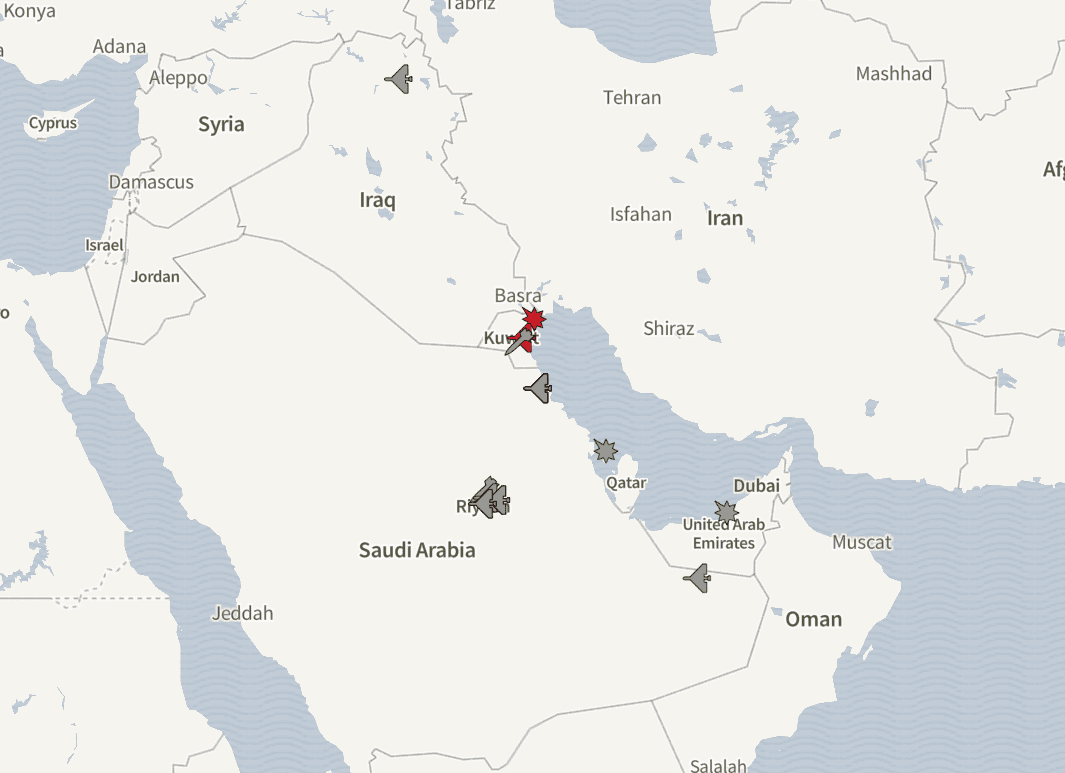
Between March 24 and March 27, Iran and its allied militias continued launching drones and missiles against Arab countries. The attacks targeted energy infrastructure, airports, military facilities, ports, and residential areas in Saudi Arabia, the United Arab Emirates, Kuwait, Bahrain, Iraq, and Jordan. Air defense systems intercepted many incoming projectiles, but several strikes still caused fires, infrastructure damage, and casualties.
The following is an account of the attacks conducted by Iran and its affiliated militias against Arab states between March 24 and 27.
March 24
In Saudi Arabia’s Eastern Province, Saudi authorities reported intercepting repeated drone waves in groups of two, one, one, four, one, one, one, one, two, one, three, and four drones.
In the United Arab Emirates, the Ministry of Defense announced that it confronted multiple waves of attacks, including a total of five ballistic missiles and 17 drones.
In Kuwait, authorities reported confronting multiple missile and drone attacks across several incidents. In total, Kuwaiti forces encountered 17 missiles and 13 drones, intercepting 13 of the missiles and 10 drones, while three drones and four missiles fell in empty areas. Falling debris damaged infrastructure, prompting authorities to deactivate seven power lines.
In Bahrain, authorities reported intercepting 19 drones and six missiles.
In Iraq, several drone incidents were reported across multiple provinces. Drones crashed in Dhi Qar, Babil, Kirkuk (near the Mullah Abdullah power station), and south of Samawah, without causing casualties.
In Iraqi Kurdistan, Iranian missile strikes targeted Peshmerga positions in Erbil Governorate. Six missiles hit a headquarters and a nearby base, killing six Peshmerga fighters and wounding 30 others. Additional drone activity targeted Erbil International Airport, where drones were intercepted.
March 25
In Saudi Arabia’s Eastern Province, Iranian drone activity continued at a steady pace. Saudi authorities reported intercepting repeated waves, including groups of one, one, three, one, one, three, three, four, five, three, one, one, three, one, one, three, one, one, and one drones. Saudi defenses also intercepted a ballistic missile, with shrapnel striking two buildings. In Riyadh, Saudi defenses also intercepted a drone.
In the United Arab Emirates, authorities reported intercepting nine drones.
In Kuwait, Iranian attacks targeted critical infrastructure. A drone strike hit a fuel tank at Kuwait International Airport, causing a fire but no casualties. Kuwaiti forces also reported engaging 20 missiles and nine drones, intercepting most projectiles, while several fell in uninhabited areas.
In Bahrain, authorities reported intercepting 30 drones and six missiles.
In Iraq, drone activity targeted energy infrastructure. Drones crashed near the Artawi oil field in Basra and near PetroChina facilities in Maysan.
In Iraqi Kurdistan, air defenses intercepted four missiles and five drones targeting Erbil.
In Jordan, authorities reported that five drones and missiles targeted the country, with one missile failing to be intercepted.
March 26
In Saudi Arabia’s Eastern Province, Iranian drone activity intensified significantly. Saudi authorities reported intercepting repeated waves, including groups of three, two, one, two, three, four, five, eight, two, three, three, three, one, and one drones.
In the United Arab Emirates, the Ministry of Defense said it confronted multiple waves of missile-and-drone attacks. In total, authorities reported intercepting 11 drones and 15 missiles. Falling debris in Abu Dhabi killed two individuals and wounded three others.
In Kuwait, authorities reported intercepting a drone, while other activity saw six missiles fall in open areas.
In Bahrain, authorities reported intercepting 19 drones and a missile.
In Iraq, a drone was intercepted in Kirkuk.
In Iraqi Kurdistan, a drone was intercepted in Sulaymaniyah.
March 27
In Saudi Arabia, Iranian drone and missile attacks concentrated around the capital of Riyadh. Saudi authorities reported intercepting multiple drone waves, including groups of one, three, six, and two drones, as well as additional single-drone interceptions. Shrapnel from one intercepted drone fell inside a military position. Saudi defenses also engaged six ballistic missiles, intercepting two, while the remaining four fell in the sea and uninhabited areas. In Saudi Arabia’s Eastern Province, Iranian drone activity continued, with repeated small-scale attacks. Saudi authorities reported intercepting multiple waves, including groups of one, three, two, two, two, and five drones, as well as additional single-drone interceptions.
In Kuwait, Iranian attacks again targeted critical infrastructure. A combined drone-and-cruise missile strike hit Mubarak Al Kabeer Port on Bubiyan Island, while separate drone attacks targeted Shuwaikh Port in Kuwait City, causing material damage. Kuwaiti forces also reported intercepting four missiles.
In the United Arab Emirates, the Ministry of Defense announced that it had confronted multiple waves of attacks, including six missiles and nine drones.
In Bahrain, authorities reported intercepting 12 drones.
In Iraqi Kurdistan, a drone was intercepted over Erbil.
Facts Only
Between March 24 and 27, Iran and its allied militias launched drones and missiles at Saudi Arabia, the UAE, Kuwait, Bahrain, Iraq, and Jordan.
Targets included energy infrastructure, airports, military facilities, ports, and residential areas.
Saudi Arabia intercepted multiple drone waves in its Eastern Province, with groups ranging from one to eight drones per wave.
The UAE reported intercepting five ballistic missiles and 17 drones on March 24, and 11 drones and 15 missiles on March 26.
Kuwait faced 17 missiles and 13 drones on March 24, intercepting 13 missiles and 10 drones, with debris damaging seven power lines.
Bahrain intercepted 19 drones and six missiles on March 24, and 30 drones and six missiles on March 25.
In Iraq, drones crashed in Dhi Qar, Babil, Kirkuk, and Samawah without causing casualties on March 24.
Iranian missile strikes in Iraqi Kurdistan killed six Peshmerga fighters and wounded 30 others on March 24.
On March 25, a drone strike hit a fuel tank at Kuwait International Airport, causing a fire.
On March 26, falling debris from intercepted missiles in the UAE killed two individuals and wounded three others.
On March 27, Saudi Arabia intercepted multiple drone waves and six ballistic missiles, with shrapnel falling in a military position.
Kuwait’s Mubarak Al Kabeer Port and Shuwaikh Port were targeted by drone and cruise missile strikes on March 27.
Executive Summary
Between March 24 and 27, Iran and its allied militias conducted a series of drone and missile attacks targeting multiple Arab countries, including Saudi Arabia, the United Arab Emirates, Kuwait, Bahrain, Iraq, and Jordan. The strikes focused on energy infrastructure, airports, military facilities, ports, and residential areas, with air defense systems intercepting many projectiles. Despite these efforts, some attacks caused fires, infrastructure damage, and casualties. Saudi Arabia and the UAE reported repeated waves of drones and missiles, while Kuwait and Bahrain also faced significant strikes. In Iraq, drone activity was widespread, with incidents in several provinces, and Iranian missile strikes in Iraqi Kurdistan killed six Peshmerga fighters and wounded 30 others. The attacks demonstrated a coordinated effort, with varying degrees of success in penetrating defenses. The situation highlights ongoing regional tensions and the vulnerability of critical infrastructure to such assaults.
The scale and persistence of the attacks suggest a deliberate escalation, though the exact motivations remain unstated. The targeted countries responded with intercepts and damage control, but the repeated nature of the strikes indicates a sustained campaign rather than isolated incidents. The involvement of multiple nations and the diversity of targets—from military sites to civilian infrastructure—underscore the complexity of the conflict dynamics in the region.
Full Take
The strongest version of this narrative presents a clear pattern of escalation by Iran and its proxies, targeting critical infrastructure across multiple Arab states with coordinated drone and missile strikes. The source provides detailed, verifiable accounts of intercepts, damage, and casualties, lending credibility to the claim of a sustained campaign. The inclusion of specific numbers—such as the quantity of drones and missiles intercepted—reinforces the impression of a systematic and deliberate offensive.
Pattern scan: The framing leans toward highlighting the scale and persistence of the attacks, which could subtly amplify perceptions of threat without explicit emotional manipulation. However, the absence of Iranian or proxy perspectives on motivations or justifications may create an imbalance, potentially reinforcing a one-sided narrative of aggression. No overt distortion or bad faith tactics are detected, but the focus on intercepts and damage—without contextualizing broader geopolitical dynamics—could risk oversimplifying the conflict.
Root cause: The paradigm driving this narrative is one of regional power projection, with Iran demonstrating its ability to disrupt adversaries through asymmetric warfare. Unstated assumptions include the idea that these attacks are purely offensive rather than retaliatory, and that the targeted states are passive victims rather than active participants in a broader conflict. Historically, this echoes patterns of proxy warfare in the Middle East, where states avoid direct confrontation while leveraging allied militias to apply pressure.
Implications: For human agency, the attacks underscore the vulnerability of civilian infrastructure and the limits of air defense systems, raising questions about the cost of escalation for ordinary citizens. The beneficiaries of this narrative may include states seeking to justify military buildups or alliances, while the costs are borne by civilians and frontline military personnel. Second-order consequences could include further regional destabilization, economic disruptions, and increased militarization.
Bridge questions: What geopolitical events preceded these attacks, and how might they contextualize Iran’s actions? How do the targeted states’ own military and political actions contribute to the cycle of escalation? What perspectives from Iranian or proxy leadership are missing from this account, and how might they challenge the presented narrative?
Counterstrike scan: If this were part of a coordinated influence campaign, the playbook would emphasize the scale of the attacks to stoke fear and justify retaliatory measures, while omitting opposing viewpoints to frame Iran as the sole aggressor. The actual content aligns with this pattern in its focus on intercepts and damage but does not engage in overt manipulation. The absence of counter-narratives is notable but not inherently deceptive.
Sentinel — Human
The article appears to be a human-written report of recent attacks in Arab countries by Iranian forces. While it exhibits some characteristics typically associated with human writing, such as varying sentence length and unique perspective, there are also signs that could potentially indicate AI assistance, but these signals are weak.