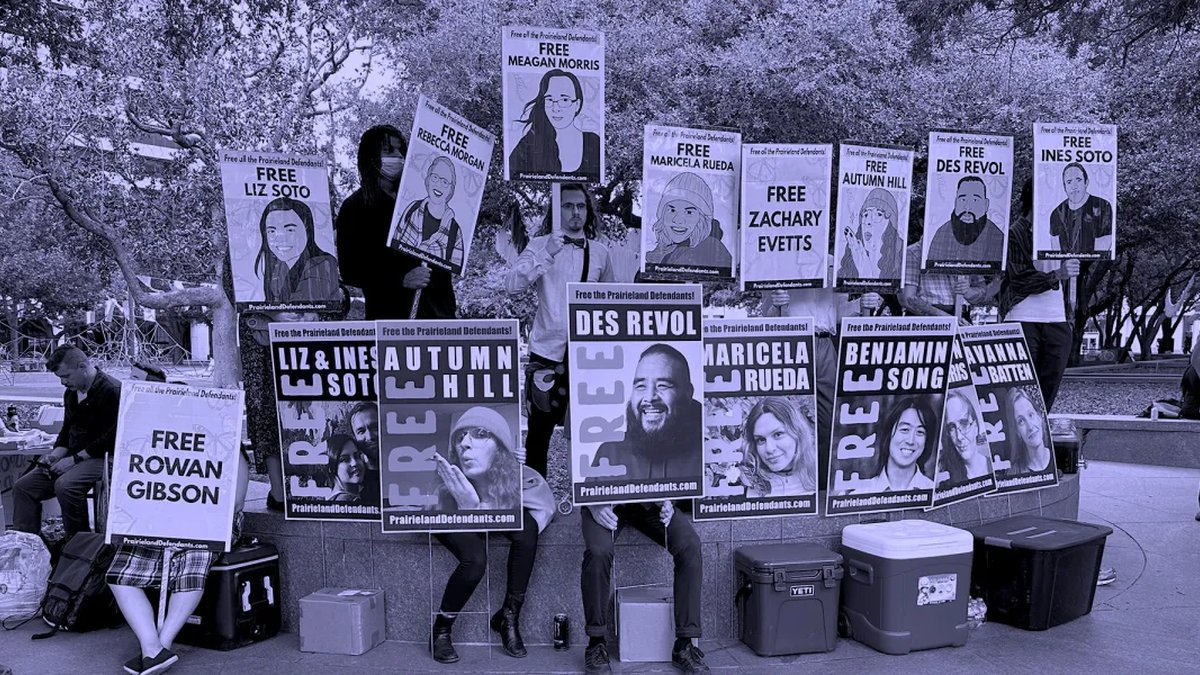
A noise demonstration that took place outside of the Prairieland Detention Facility in Texas one year ago has resulted in decades of prison time for the anti-ICE activists involved. Federal judges sentenced eight defendants, who the government cast as antifa operatives, to between 30 and 100 years in prison for terrorism-related charges last week; seven more people were sentenced this week.
“There’s a stunningly wide gap between what the Justice Department has put in its press releases and what top officials have said, versus the evidence that was actually presented at trial,” says Intercept reporter Matt Sledge, who has been covering the Prairieland case and was present at the sentencing. “It’s a real stretch to assert, as the government did, that this was all one coherent group.”
“There’s a concerted effort to characterize opposition to ICE or opposition to the Trump administration as some form of conspiracy, as an effort to provoke terrorism,” says Mark Bray, author of “Antifa: The Anti-Fascist Handbook.” “There are a number of things that can be said about the various sentences, but perhaps the most obviously egregious is that handed out to Daniel Sanchez [Estrada]: 30 years for moving some zines, some literature, which is not illegal to possess.”
This week on The Intercept Briefing, host Jessica Washington speaks with Bray and Sledge about Prairieland as a test case in Trump’s war on dissent, and why the administration is determined to convince the public that antifa is a domestic terrorist organization.
“I don’t think Trump or his allies really care about antifa per se. It’s a useful umbrella term to craft into a boogeyman scare tactic. In a way that ‘Communist’ was used in past generations, antifa is used now,” says Bray. He and Sledge point out that in the wake of Charlie Kirk’s killing, the Trump administration became much more aggressive in its targeting of the left and dissent in general.
“You had these Prairieland defendants who had already been arrested and charged, and then the government really ups the ante against them by bringing material support for terrorism charges against them, which really contributes to these long sentences. And I think it’s a preview of what’s going to happen elsewhere,” says Sledge. “It shows that in this post-Kirk era, the government is going to use the most aggressive charges it can find against people it does not like.”
“What that calls upon is creating a different kind of antifascist movement, and to me perhaps the most inspiring kind of model or example is the anti-ICE movement, which does not under many circumstances call itself an antifascist movement,” says Bray. “I think that this moment is bringing out the best in a lot of people, whether or not they have activist experience or not, in organizing with their neighbors. The best moments of antifascism throughout history have been those moments where it ceases to be some sort of specialty politics, but becomes just a common-sense way of protecting our neighbors, those most vulnerable amongst us, and protecting our freedoms.”
For more, listen to the full conversation of The Intercept Briefing on Apple Podcasts, Spotify, YouTube or wherever you listen.
Transcript
Jessica Washington: Welcome to The Intercept Briefing. I’m Jessica Washington, politics reporter at The Intercept.
Matt Sledge: And I’m Matt Sledge, also a politics reporter at The Intercept.
JW: Matt, it’s really great to have you back on the show. Today, we’re going to talk about some really important reporting you’ve been doing on the Prairieland case.
Last week, judges sentenced eight protesters to between 30 and 100 years in prison on terrorism-related charges for their participation in a July 4 protest last year outside of the Prairieland Detention Facility in Alvarado, Texas.
Matt, as you wrote in your piece, Judge O’Connor handed down a 30-year sentence to a man, Daniel Sanchez Estrada, who was not present at the protest and whose only alleged crime was moving a box of anarchist zines for his wife.
His wife, Maricela Rueda, who was present at the anti-ICE protest but left early, received one of the harshest sentences — 70 years — because she asked her husband to move her zines.
You were at the sentencing. What was the room like when people heard that they would be spending, for some of them, the rest of their lives behind bars for attending a protest?
MS: I would say it was very somber, but also strangely reserved. I think many of the defendants and their supporters went into the courtroom expecting very long sentences. At the same time, some of them held out a sliver of hope that the judges who were sentencing people in two courtrooms at the same time might listen to their pleas for downward variations from the sentencing guidelines, might do something to attempt to distinguish between the different roles of the people who were at the protest and the one person who wasn’t there, Daniel Sanchez Estrada. And that essentially didn’t happen.
They all got really harsh sentences, and the judges made it clear that they were trying to send a message.
JW: Matt, we talked about this a little bit offline before the podcast, but it’s hard to imagine that the jurors who handed down these convictions could have imagined that they would be sending people to prison for these enormously long sentences, could have imagined that someone would spend 70 years in prison for a nonviolent act. What do you think is going through these jurors’ heads now?
MS: It’s hard to put yourself in someone else’s heads, but I wouldn’t be surprised if they’re surprised. Because even though some of these charges had various serious-sounding names like “riot” and “material support of terrorism,” jurors almost never know the sentencing ranges that come with charges.
And in this case, probably did not know or expect that federal prosecutors would seek — and the judges would apply — these very harsh terrorism sentencing enhancements that really raised the sentences for all the defendants.
JW: Can you tell us what happened outside of the Prairieland Detention Facility and how this case came to be in the first place?
MS: There were a group of people, generally from the kind of lefty scene in the Dallas–Fort Worth area, that wanted to stage what they termed a “noise demonstration” protest outside this ICE facility, a show of solidarity, they later said, with the people detained inside the facility. This is one of these facilities that saw a huge increase in the number of people detained under Trump.
There had been a daytime protest outside this facility earlier on the day on July 4, 2025. This group of people, around a dozen people, went that night, much later around 10:30, wearing all black, carrying fireworks, and in some instances carrying guns — which is legal to do in Texas.
They set off some fireworks. One of the people who was there described it as actually a kind of festive environment. Then the police were called, as you might expect, and some of the demonstrators there were already gone by the time the gunfire erupted. A responding local police officer was left with a gunshot wound to his neck. And then the person later convicted of shooting the gun that left the police officer injured, Benjamin Song, escaped that night and was on the run for several days, hiding out in the Dallas–Fort Worth area.
So there was a large police manhunt. This was a big story in the Dallas–Fort Worth area for days.
JW: Obviously, federal prosecutors have a different spin on who these protesters were and what their connection to each other was. Federal prosecutors have labeled this group of protesters as a “North Texas Antifa” terrorist cell.
What are prosecutors trying to do here by labeling protesters as members of antifa, and what evidence did they actually have to make a case that these individuals were “antifa operatives”?
MS: There’s a stunningly wide gap between what the Justice Department has put in its press releases and what top officials have said, versus the evidence that was actually presented at trial.
I’m not aware of anybody associated with this group ever claiming that there was such a thing as the “North Texas Antifa Cell,” which is what the government has branded this as. Several of the cooperating defendants, the people who helped the government out in its prosecution, said they did not think of themselves as antifa.
I think it’s safe to say that everybody involved in this protest was politically on the left, outraged over the Trump administration’s immigration policies and other things. Some of these people may have thought of themselves as anarchists or consumed antifascist zines, but it’s a real stretch to assert, as the government did, that this was all one coherent group.
In fact, at trial, the government story was a little more nuanced than what it put in its press releases and referred to a smaller planning group and then a larger group of people who had essentially just showed up to this demonstration. But there were two really different spins from the protesters and their attorneys and the government as to the intentions going into this night.
The people on trial said basically to a person that they did not go there intending to hurt anybody, they were just trying to show solidarity. Then the government pointed to things like wearing all-black clothing and bringing guns and ballistic vests as evidence that they were essentially going there looking to attack.
JW: Could you just explain to our listeners why it’s a bit of a misnomer to call antifa a group, or particularly in the way that the government is describing here?
MS: The whole idea behind the ideology or movement, whatever you want to call it, is that it’s very decentralized and is all about individuals or small groups taking direct action against people they view as fascists.
This idea that there might be a whole movement of people committed to antifascism is a little too complicated for antifa’s critics to grasp. [Laughs] They insist that there is this, like, global network.
There are certainly small groups and larger groups of people who identify as antifascists. They certainly talk to each other. But again, this idea that there was something called a “North Texas Antifa Cell” just doesn’t seem to be supported by the facts.
JW: So Daniel Sanchez Estrada was sentenced to 30 years in prison for moving a box of zines, as we’ve already discussed. Elizabeth Soto and her husband, Ines Soto, were sentenced to 50 years for their part in the protest. But part of the evidence used against the Sotos was that they owned a printing press to print zines. Matt, what kind of zines are we talking about here?
MS: Yeah, a lot of the zines and kind of social media feed evidence that the government presented at trial were your standard, off-the-rack anarchist, antifascist zines you might find at any anarchist bookstore or book fair, something like that. Something that would not be surprising at all to someone who has spent time in those spaces.
There’s nothing that came close to being directly relevant to plotting either a protest or an attack outside the Prairieland Detention Center. The government stretched and pointed to zines that were from years before and discussed very general tactics.
So it’s stuff that you may have seen before. It’s not some super secret stuff. It’s very typical anarchist, anti-government zines.
JW: So anything I could probably find in a bookstore in Bushwick, is what you’re telling me.
MS: Exactly.
JW: Speaking of, one of the frequent takeaways I’ve heard from this case is that it proves Signal is not as secure as you think.
You’ve extensively covered the trial. What did you learn about digital privacy in 2026 and how people can continue to resist in an era where our digital communications simply aren’t safe?
Matt Sledge: Yeah, there was something interesting that came out at trial, essentially like a glitch in the way Signal worked and the way it interfaced with iPhones. I’m probably oversimplifying or butchering this, but basically our phones store what pops up in the little notification center when our phones are locked. The feds were able to use that to glean some of these communications.
But you also have to remember they had several cooperating defendants. There were several Signal group chats going on at the same time. So even if Signal is perfectly buttoned down and the government hasn’t found some new hack or glitch to do — your messages with your fellow organizers, or anybody else you want to communicate with in an encrypted fashion, are only as good as the weakest link in the group.
If someone decides they’re going to be willing to cooperate with the government and they’re in your Signal chat, the government’s probably going to be able to get access to it, which is why security researchers say it’s really important to have disappearing messages on and keep groups as small as you need them to be, and so on, common-sense approaches.
But I also just think that Signal is not like some silver bullet for privacy protection; it’s a way of reducing risk. People should think about it that way.
It was also really interesting at trial, and we’ve seen this in a few of these cases, the way the government treats the use of Signal itself as something suspicious.
I’ve seen this also in government bulletins to local police that using Signal or another encrypted messaging app is a threat indicator — when people who use Signal, including Pete Hegseth, would say it’s just a way of keeping their messages private. But Hegseth is a good reminder that you have to look at who you’re including in your Signal group.
JW: I do appreciate a little Hegseth diss as a part of the Signal explanation, as that was, I would say, one of the more high-profile — “leaks” is really not even correct to describe what happened there.
MS: Yeah, it’s not a leak when you just send a journalist out of the blue your war plans. [Laughs]
JW: Yeah, really can’t call it that. But I did want to talk more broadly about not just the legacy of this case, but what the administration is trying to do more broadly. The Prairieland protest case came on the heels of the killing of conservative activist Charlie Kirk, which the Trump administration almost immediately used to justify cracking down on the broader left.
Matt, can you talk about how the administration is trying to silence critics more broadly by labeling all dissent and protests as acts of terrorism, and can you talk about the other active cases the government has against activists?
MS: Yeah, I think it’s important to remember the timeline. The Prairieland demonstration happened in July of 2025, and then Charlie Kirk was killed in September 2025.
Very soon after that, President Trump issued this executive order purporting to designate “antifa” as a domestic terrorist organization — not something he can actually do, but so it goes.
Then he issues NSPM-7, this presidential memorandum instructing the Justice Department and law enforcement agencies to really crack down on the president’s enemies on the left.
So you had these Prairieland defendants who had already been arrested and charged. And then the government really ups the ante by bringing material support for terrorism charges against them, which really contributes to these long sentences.
I think it’s a preview of what’s going to happen elsewhere. It shows that in this post-Kirk era, the government is going to use the most aggressive charges it can find against people it does not like.
In terms of other cases, you can look to Illinois, where the protesters outside the Broadview facility there, the government attempted to charge them. The grand jury initially rejected it and the government was able to secure charges, and then the case fell apart under government scrutiny.
More recently, we’ve had [new] charges against some Stop Cop City organizers in Georgia, and charges against protesters in Minneapolis with this aggressive theory about a conspiracy against federal officers, and these folks’ defenders say they were essentially just cop watchers keeping an eye on the federal invasion in Minneapolis.
So the charges may differ from case to case. The exact logic of how these cases work may differ, but the overarching strategy of using the most aggressive charges you can find and painting this all as a big conspiracy is going to continue.
JW: The cases that you just brought up had given some people hope that while the government may be trying to target protesters and dissenters, they didn’t have the power to jail them to the extent that they obviously wanted to and were intending to.
The Prairieland case and these sentences is a really scary wake-up call that the government is incredibly powerful and that these are not just words or prosecutions. This is an intent to really jail Trump’s dissenters and to jail any kind of opposition to this regime and that they have the power to do that in some of these cases.
We’re going to leave it there. Matt, I just really want to thank you for this update and your reporting. To continue following Matt’s work, sign up for The Intercept’s newsletter at theintercept.com.
MS: Goodbye, Jessie. Thanks for having me.
JW: Next, we zoom out with Mark Bray, author of “Antifa: The Anti-Fascist Handbook.”
Bray is a history professor at Rutgers University and a frequent target of the right. He also consulted as an expert witness with one of the Prairieland defendants but did not testify. With Bray, we’ll take stock of the Trump administration’s crackdowns on dissent and talk to him about his own experiences being targeted by the right.
[Break]
JW: Mark, welcome to The Intercept Briefing.
Mark Bray: Thank you for having me.
JW: Mark, we just spoke to my colleague, Matt Sledge, about the details surrounding the Prairieland case. But to start, can you just give us your reaction to the charges and to the sentencing?
MB: Certainly when we look at the Prairieland case and some other somewhat similar cases during this second Trump administration, we can see that there’s a concerted effort to characterize opposition to ICE or opposition to the Trump administration as some form of conspiracy, as an effort to provoke terrorism. I see it in that context.
There are a number of things that can be said about the various sentences, but perhaps the most obviously egregious is that handed out to Des — to Daniel Sanchez — 30 years for moving some zines, some literature, which is not illegal to possess.
It’s part of this broader effort to characterize opposition as terrorism conspiracy that we’ve seen in various manifestations. It seems like a particularly egregious version of that, when, to my knowledge, many of the people who were at this protest in Prairieland aren’t even accused of firing the weapon that was supposedly fired.
JW: Yeah, you’re right. The fact that Benjamin Song is the only person who actually fired a weapon and that everyone else participated in what appears to be nonviolent protesting — the charges that were handed out are really hard to even contemplate.
I want to get a little bit more personal as well. So The Guardian reported that you acted as a consultant for one of the defendants but didn’t testify. I know your name also came up multiple times during the trial. Can you talk about that, and what that was like for you?
MB: I was in Spain at the time. I had left the U.S. in response to death threats from the far right and my concerns about the political situation in the U.S. So I was unable, unfortunately, to testify in person. I was consulted by the attorneys for Daniel Sanchez, for Des. I think they asked whether I could testify remotely, and I imagine they were turned down because they didn’t follow up on that.
But part of what I did was, they sent me a Dropbox link or some such equivalent to read all of the radical literature that he transported, all of the scanned zines.
I read through a bunch of them; a few of them I was familiar with already. And a few things stood out. As I said, number one, it’s not illegal to own these things. Just because you own a book or a piece of writing doesn’t mean you necessarily agree with everything in it or anything in it. I own a copy of “Mein Kampf” — that doesn’t make me a Nazi.
Although these folks were accused of being part of some sort of supposed antifa cell, very few of the zines that he transported had anything to do with antifa politics, and one of them was actually a critique of it.
So it just goes to show you that the political claims are intentionally superficial, vague, and minimalist in order to be able to package as much stuff they don’t like under the same kind of terrorist umbrella as possible.
JW: I want to get into why you had to flee a little bit more deeply. But before that, we spoke to Matt Sledge about this, but I wanted to get your take as well. Why is the administration determined to convince the public that antifa, a decentralized antifascist movement, is a domestic terrorist organization? What are the motivations here, and what does it mean if they can successfully convince us that these are terrorists?
MB: I guess the starting point is to recognize that I don’t think Trump or his allies really care about antifa per se. It’s a useful umbrella term to craft into a boogeyman scare tactic. In a way that “Communist” was used in past generations, antifa is used now.
Certainly, the FBI have been monitoring antifa groups for years now, and I’m sure they have a reasonably accurate sense of what it is. There’s a number of different groups in different cities that organize against the far right in a variety of ways. None of them are particularly large. There aren’t that many of them in the U.S., relatively speaking.
But by arguing that antifa is — as a number of far-right provocateurs over the years have argued — like the paramilitary wing of the Democratic Party, that phrasing shows us how they’re trying to make the case that whatever kind of far-left radical figure is actually just a version of the center-left, and that everyone who is not with us is against us.
That, I think, is reflected in the term “antifa-aligned,” which the Department of Homeland Security promoted as a framework for thinking about this. That, OK, there are antifa groups, there’s antifa-aligned. It’s like different layers to the onion to be peeled back.
For me, it’s a useful term because it’s poorly understood. It’s associated in the popular imagination with people who cover their faces, who engage in acts of violence. And in that way, it’s a useful linchpin for framing a conspiracy.
Beyond that, we haven’t actually seen self-described antifa groups in the streets opposing the far right in the U.S. since last decade. It’s not particularly germane to what’s going on in U.S. politics, but of course, the reality of it is not particularly important to Trump and his allies.
JW: That’s really interesting. This isn’t just an attack on the left, and I think people on the left can often see it as, “OK, this is an attack on the left.” This is an attack on any kind of resistance, any kind of dissent, any kind of opposition to Trump. And have we seen this in history? You alluded to attacks on communists, but can you talk a little bit about the history of targeting the left and the broader ripple effects?
MB: There are so many cases. One that comes to mind is something I wrote a book about. I wrote this book called “The Anarchist Inquisition” about Spain and France at the turn of the 20th century. In short, there were anarchist bombings and assassinations — actual anarchists who said, “Yes, I’m an anarchist,” who tried and sometimes succeeded and sometimes failed to kill the king of Spain or to kill the president of France.
They didn’t have a ton of allies, and even in the anarchist movement, most disagreed with that strategy. But the Spanish government, and to a lesser extent the French government, used that as an excuse to arrest all sorts of trade unionists and Freemasons and anti-clerical figures and socialists in this big scandal in the 1890s, El proceso de Montjuïc, where these people were put in a dungeon. And it was this effort to create this conspiracy among the left that all these different people were somehow in cahoots to try and overthrow the monarchy.
So there are many cases throughout history around this. You can go forward into the movements of the ’60s. It’s useful for the right to portray all of the left as being the same. Which is actually a useful way I think those of us on the left should remind ourselves — that while there are comparisons between different kinds of right-wing forces, it’s also a mistake to say that all different kinds of fascists and far-right formations are all the same. Because there are differences there too, and understanding them makes sense. Flattening the dynamic can be useful rhetorically on both sides, but it’s usually not accurate.
JW: One thing I have just been thinking about is we’ve seen so many attempted prosecutions of protesters under the Trump administration, and this is their first real victory against, they’re calling it their first real victory against antifa.
Obviously, as we’ve discussed, it’s much more complicated than that. But we’ve seen the administration attempt to prosecute the Broadview Six, who were arrested for protesting outside of an ICE facility in Chicago. Obviously there are sillier instances where federal prosecutors tried to go after someone for throwing a Subway sandwich.
But now that they have their boogeyman scenario for the left, they have sentenced people to prison for the rest of their lives for protesting against injustices perpetrated by their government — does this embolden the administration? Do they learn that they can successfully prosecute people for opposing them?
MB: It certainly emboldens the administration to get this verdict and to get these sentences. Looking back to the fall of last year, when I received threats for my alleged involvement in antifa groups — which is not true, I haven’t participated in any of those groups — the specter of a kind of antifascist Red Scare was looming large.
I think that to a reasonable extent, it kind of faded a bit as the administration focused on a lot of other problems and issues, or created them. It’s come back a bit recently with the Prairieland case, the Prairieland verdicts, also the anti-ICE activists arrested in Minneapolis. There seems to be a bit of a return toward trying to stitch together this alleged antifascist conspiracy.
It’s so Orwellian to think that the antifascists are the bad guys in the midst of an increasingly authoritarian regime, which many scholars of fascism call, to one extent or another, if not fascist, trying to create something akin to fascism. So I do think it emboldens them. I do think it establishes a precedent.
We know that the legal system is all based on different kinds of precedents. And when the administration tried to make the case for antifascism as terrorism back in the fall, they cited a number of different cases which really had nothing to do with it. But what that shows us is that they’re trying to establish a track record, establish the reality of this enemy, this internal enemy they’re trying to combat. This helps them do it because there’s something they can point to. Of course it’s a dishonest intellectual, if you even want to call it intellectual project, to fake evidence and then refer to it as evidence of the thing you’re trying to use as evidence for the evidence. But we know how this administration functions, and it’s not surprising.
JW: As someone who has had to deal with the comms side of the White House, I will say it is not very surprising at all.
You touched on this already a little bit, but because you’re widely viewed as an antifascist expert and you wrote the 2017 book, “Antifa: The Anti-Fascist Handbook,” you’ve long been a target of the right, so much so that you and your family had to leave the country.
Can you talk about that experience and how the threats you were receiving escalated over time to the point that you had to make that decision?
MB: When my book was published in 2017, it was rushed to publication and came out days after Charlottesville. It became a bestseller and was really the book of record for talking about what it was that antifa groups did and what they thought and why.
In that context, I received quite a few death threats. I was visited by the FBI. There was a bomb scare at my work. I was denounced by my employer, the president of Dartmouth College, but not fired because I received support from fellow faculty. But over the coming years, that kind of diminished. Antifa was not particularly pertinent to the news, with maybe the exception of a week in 2020 when Trump tried to blame the Black Lives Matter protests that erupted in response to the police murder of George Floyd on antifa. It pretty much disappeared.
Then all of a sudden, with Charlie Kirk’s killing, antifa was back on the radar. It was declared a supposed terrorist organization, although it’s neither terrorist nor an organization.
At first, frankly, I didn’t think much of it because I had received threats in the past. Even when Turning Point USA — the local group on my campus, although they were really fed the initiative by the national organization — crafted a petition to have me fired for writing my book, I kind of shrugged. It changed when some of the threats included my home address, and then my home address was published online on X, along with information about my family.
In a country that’s awash in guns, I was very concerned about something like something that happened to Charlie Kirk happening to me, and I was also very alarmed about the political direction of the country. So my goal was not actually to publicize that I was leaving the country, that leaked, but I was planning on leaving. Spain’s sort of my second home, I’ve done research there over the years.
Now, going back to your earlier point though, the degree of the kind of onslaught of the Red Scare that I was fearful of did not fully materialize over the coming months. It didn’t — I don’t regret going — but it didn’t fully materialize.
I was concerned about all sorts of progressive activists being rounded up, and fortunately that hasn’t happened. It doesn’t mean that we need to stop our vigilance. That’s why we’re talking about issues like this. But it didn’t fully materialize. I do think it’s picking up again a little bit now, so I don’t think we’re out of the woods, so to speak.
But that was my experience, and I returned to the U.S. last week. I’m going to take all sorts of precautions to make sure the same thing doesn’t happen again and to do what I can to keep speaking about these issues.
JW: Why do you think that the energy, the kind of Red Scare energy we had seen pick back up, why do you think it died down, and what do you think brought it back? Do you attribute that to Charlie Kirk’s death specifically? I think a lot of people think that the right used that as an excuse. I’m curious why you think it went up and down in that way.
MB: The killing of Charlie Kirk was obviously an excuse. Even before we knew who had done it Trump was blaming the left.
The effort to frame Tyler Robinson as a leftist is ridiculous if you actually look at all the kinds of convoluted things he believed. Then there was this effort for a few weeks to craft the antifa terrorist threat. Now, why it stopped, I’m not entirely sure. I do think that we live in this social media era where you can make something a big deal very quickly, but just as quickly people move on to the next thing.
I wonder if there was an element of that, particularly in the context where the administration was trying to pursue a number of different objectives at once. I felt, I don’t know what your opinion was, but towards the end of 2025, the kind of authoritarian momentum of the regime started to wane a little. And then all of a sudden January hit, Maduro gets kidnapped from Venezuela, the ICE occupation of Minneapolis grows even more intense. It seemed like particularly with the killings of Renee Good and Alex Pretti, that there was an effort to get the momentum back going again. In that context, the antifa terrorist threat was almost completely abandoned because Pretti and Good were simply called terrorists.
So the middleman term between leftist and terrorist was antifa. They took out the middleman term: Leftists are terrorists. They’re coming back to it now. I’m not entirely sure how far they’ll get with it. One of the questions you always have with the growth of authoritarianism or fascism or whatever you want to call it in democratic states is, to what extent can the institutions that are designed to thwart those advances hold up?
I think overall it’s been a mixed bag in the U.S., but certainly you’d have to think that Trump and his allies do not believe that they can simply arrest just anyone and claim they’re part of a terrorist conspiracy at this point or they would have done it. A lot of the arrests that ICE made have not held up, and so I guess they don’t feel fully emboldened.
But as you suggested earlier, every step they take, every supposed precedent they establish could make them feel more emboldened to take steps moving into the future. The one last thing I’ll say, though, is that I think the real linchpin for these efforts is something more approximating a genuine crisis or emergency, where they can more believably say, “If we don’t deal with these terrorists, our efforts to save the country will be for naught.”
Right now I don’t think that most Americans believe that there is this internal terrorist conspiracy, that’s something they have to be concerned about, especially when the price of groceries is going through the roof, or of gas. But if they get some situation where that’s more plausible, then I’d be more scared.
JW: As you noted, you wrote your handbook just at the start of Trump’s first term. The forward is written by the late Joshua Clover, who recounts pivotal moments in those years in which antifascists were pushing back against the rise of white nationalism. Nearly a decade later, how do you think about this moment that we’re in, and how we’ve gone from the Unite the Right rally in Charlottesville, Virginia, where a group of neo-Nazis chanted, “Jews will not replace us,” holding tiki torches, to all of the in between and where we are now?
MB: When I published “Antifa” in 2017, I described the situation we were in as a moment of preventative antifascism that was akin to one extent or another to the post-war European context of trying to organize such that Nazis or fascists couldn’t bring back another horrific regime. We’re not in that situation anymore in the U.S., and I think to some extent we’re in a bit of an unprecedented situation, which I know that’s a term that’s thrown around a lot, but I mean it when I say it.
Whereas you look at the growth of Hitler’s regime in Germany or Mussolini’s in Italy, from the point at which they had the opportunity to take authoritarian power to the kind of consolidation of the regime, there was a much quicker, more straightforward ascension. Hitler outlawed various different political parties and threw their leaders in jail pretty quickly over the months after the Reichstag fire, which provided the context for the Enabling Act [of 1933], which allowed him to centralize his power.
In the U.S., we are not in the status quo, but we’ve not yet fully reached a kind of fascist or authoritarian regime, that we do still have other political parties. You can at least, under most circumstances, protest. So thinking about that in between I think is very interesting, particularly since the kinds of antifascist politics that I wrote about in the book were designed by different kinds of leftists after World War II to stop small and medium-sized fascist groups before they reached the halls of power.
But now, figures like Stephen Miller and Pete Hegseth and so forth they have their hands on the wheel. So what that calls upon is creating a different kind of antifascist movement, and to me perhaps the most inspiring kind of model or example is the anti-ICE movement, which does not under many circumstances call itself an antifascist movement.
I would call it an antifascist movement, which ironically is exactly what Trump is trying to get us to call it from a different angle. I think there’s a kind of contestation over language, contestation over images of suffering. I found it shocking when they published the alternate video of the killing of Renee Good in order to essentially — I and many others interpreted it — for us to think that she deserved it because of the context of her partner shouting at the ICE agent.
So contestations over images of violence over words, and I think that this moment is bringing out the best in a lot of people, whether or not they have activist experience or not, in organizing with their neighbors. The best moments of antifascism throughout history have been those moments where it ceases to be some sort of specialty politics, but becomes just a common-sense way of protecting our neighbors, those most vulnerable amongst us, and protecting our freedoms.
That’s what I think is happening now, and that’s what I hope we’ll continue to see, and that could produce really inspiring social movements over the years to come.
JW: To your point, what we’ve been witnessing with these anti-ICE protests is not just organized groups in Signal chats working together, although that is obviously happening as well. We’re seeing everyday people watch their neighbors get dragged out of their homes and standing up and saying, “I won’t stand for this.”
You have to think that the movement of antifascism — separate from how, the Trump administration is trying to describe antifa — but this larger movement of antifascism does have legs if people are willing to stand up for each other, to see their neighbors as members of their family, as members of their community.
We’re going to have to leave it there, but Mark, thank you so much for joining me on The Intercept Briefing.
MB: Thank you so much.
JW: We want to know what issues you are following, send us an email at podcasts@theintercept.com or leave us a voice mail at 530-POD-CAST that’s 530-763-2278
That does it for this episode.
This episode was produced by Laura Flynn. Ben Muessig is our editor-in-chief. Maia Hibbett is our managing editor. Fei Liu is our product and design manager. Nara Shin is our copy editor. William Stanton mixed our show. Legal review by David Bralow.
Slip Stream provided our theme music.
This show and our reporting at The Intercept doesn’t exist without you. Your donation, no matter the amount, makes a real difference. Keep our investigations free and fearless at theintercept.com/join.
And if you haven’t already, please subscribe to The Intercept Briefing wherever you listen to podcasts. Do leave us a rating or a review, it helps other listeners to find us.
Until next time, I’m Jessica Washington.
IT’S EVEN WORSE THAN WE THOUGHT.
What we’re seeing right now from Donald Trump is a full-on authoritarian takeover of the U.S. government.
This is not hyperbole.
Court orders are being ignored. MAGA loyalists have been put in charge of the military and federal law enforcement agencies. The Department of Government Efficiency has stripped Congress of its power of the purse. News outlets that challenge Trump have been banished or put under investigation.
Yet far too many are still covering Trump’s assault on democracy like politics as usual, with flattering headlines describing Trump as “unconventional,” “testing the boundaries,” and “aggressively flexing power.”
The Intercept has long covered authoritarian governments, billionaire oligarchs, and backsliding democracies around the world. We understand the challenge we face in Trump and the vital importance of press freedom in defending democracy.
We’re independent of corporate interests. Will you help us?
IT’S BEEN A DEVASTATING year for journalism — the worst in modern U.S. history.
We have a president with utter contempt for truth aggressively using the government’s full powers to dismantle the free press. Corporate news outlets have cowered, becoming accessories in Trump’s project to create a post-truth America. Right-wing billionaires have pounced, buying up media organizations and rebuilding the information environment to their liking.
In this most perilous moment for democracy, The Intercept is fighting back. But to do so effectively, we need to grow.
That’s where you come in. Will you help us expand our reporting capacity in time to hit the ground running in 2026?
We’re independent of corporate interests. Will you help us?
I’M BEN MUESSIG, The Intercept’s editor-in-chief. It’s been a devastating year for journalism — the worst in modern U.S. history.
We have a president with utter contempt for truth aggressively using the government’s full powers to dismantle the free press. Corporate news outlets have cowered, becoming accessories in Trump’s project to create a post-truth America. Right-wing billionaires have pounced, buying up media organizations and rebuilding the information environment to their liking.
In this most perilous moment for democracy, The Intercept is fighting back. But to do so effectively, we need to grow.
That’s where you come in. Will you help us expand our reporting capacity in time to hit the ground running in 2026?
We’re independent of corporate interests. Will you help us?
Latest Stories
How Florida’s Cuban Diaspora and the Israeli Lobby Came Together — and Are Coming Apart
The Cuban lobby and AIPAC have gotten what they wanted from Trump, and now they are dealing with the consequences.
Chilling Dissent
RFK Jr. Claims He’s Investigating Terrorism Now, Too
The Health and Human Services secretary is targeting the country's largest Muslim civil rights organization as Republicans run on Islamophobia in a tough midterm cycle.
The War on Immigrants
ICE Flouting Federal Judge’s Order to Stop Arresting Immigrants at New York Courts
“ICE continues to flagrantly violate the law by arresting immigrants who are attending their mandatory court hearings,” said Rep. Dan Goldman.