- Published
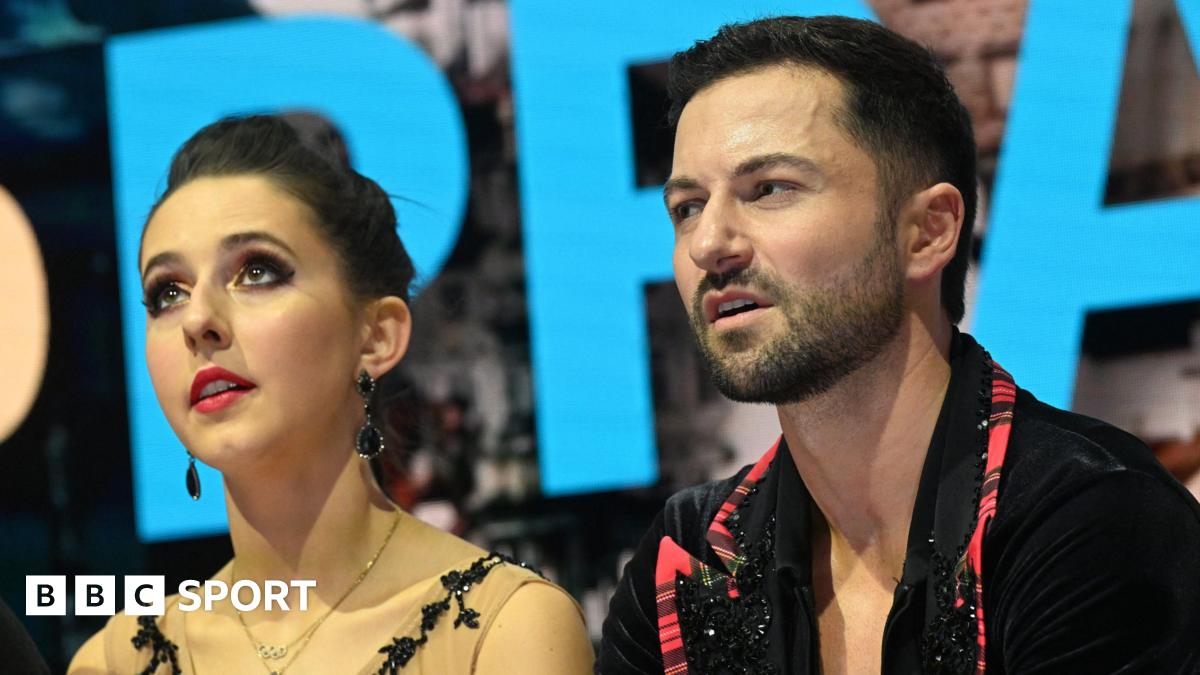
British Ice Skating has appealed after Lilah Fear and Lewis Gibson missed out on an ice dance bronze medal at the World Figure Skating Championships after being deducted two points.
Fear and Gibson were third after the rhythm dance and looked to have secured bronze with Saturday's free dance, but they were penalised for an "illegal element" by the judges.
BIS called the deduction "incorrect" and said it is formally challenging the decision with the International Skating Union.
Fear and Gibson finished fourth, 0.22 of a point behind Americans Emilea Zingas and Vadym Kolesnik, in Prague.
The reason for the penalty was not provided but it was reportedly, external because of the height of an overhead lift during their routine.
"We believe this deduction was applied incorrectly and does not accurately reflect the performance delivered on the ice," read a BIS statement., external
"As an organisation, British Ice Skating stands for fairness, clarity, and transparency in sport. In this instance, we do not believe those principles have been upheld.
"All athletes deserve to be judged with consistency, integrity, and transparency at the highest level of competition.
"We are formally challenging this decision and will be raising our concerns with the International Skating Union."
Olympic champions Guillaume Cizeron and Laurence Fournier Beaudry of France won gold with 230.81 points to become only the fourth pair to win Olympic, world and European titles in the same season.
They finished 19.29 points ahead of the field, the biggest winning margin in World Championship history.
Canada's Olympic bronze medallists Piper Gilles and Paul Poirier won silver, ahead of Zingas and Kolesnik, who finished on 209.20 points, with Fear and Gibson ending on 208.98.
Fear and Gibson, who won bronze at last year's World Championships, missed out on a medal at the Olympics last month because of a mistake in their free dance routine.
Earlier, American star Ilia Malinin won a third successive men's gold.
He missed out on an Olympic medal last month after falling twice in the free skate.
Related topics
- Published23 hours ago
- Published11 February
Facts Only
British Ice Skating (BIS) has appealed a penalty against Lilah Fear and Lewis Gibson at the World Figure Skating Championships.
Fear and Gibson were deducted two points for an "illegal element" in their free dance routine.
The penalty reportedly involved the height of an overhead lift during their performance.
The deduction dropped them from third to fourth place, 0.22 points behind the American pair Emilea Zingas and Vadym Kolesnik.
BIS stated the deduction was "incorrect" and does not reflect the performance delivered.
The organization is formally challenging the decision with the International Skating Union (ISU).
The World Championships took place in Prague.
Olympic champions Guillaume Cizeron and Laurence Fournier Beaudry of France won gold with 230.81 points.
Their winning margin of 19.29 points is the largest in World Championship history.
Canada’s Piper Gilles and Paul Poirier won silver.
Zingas and Kolesnik finished with 209.20 points, while Fear and Gibson scored 208.98.
Fear and Gibson won bronze at the 2023 World Championships.
They missed an Olympic medal last month due to a mistake in their free dance routine.
American Ilia Malinin won his third consecutive men’s gold at the World Championships.
Malinin fell twice in the Olympic free skate, missing a medal.
Executive Summary
British Ice Skating (BIS) has formally appealed a penalty that cost Lilah Fear and Lewis Gibson a bronze medal at the World Figure Skating Championships in Prague. The duo, who were third after the rhythm dance, were deducted two points for an "illegal element" in their free dance routine, reportedly due to the height of an overhead lift. This penalty dropped them to fourth place, just 0.22 points behind the American pair Emilea Zingas and Vadym Kolesnik. BIS has called the deduction "incorrect," arguing it does not reflect the performance and violates principles of fairness and transparency. The organization is challenging the decision with the International Skating Union (ISU).
The event saw Olympic champions Guillaume Cizeron and Laurence Fournier Beaudry of France dominate, winning gold with a record-breaking 19.29-point margin—the largest in World Championship history. Canada’s Piper Gilles and Paul Poirier took silver, while the Americans secured bronze. Fear and Gibson, who won bronze at last year’s Worlds, also missed an Olympic medal last month due to a routine error. Meanwhile, American Ilia Malinin claimed his third consecutive men’s gold, rebounding from his Olympic disappointment where falls cost him a medal.
Full Take
The strongest version of this narrative centers on fairness in elite sports judging. British Ice Skating’s appeal frames the penalty as a misapplication of rules, undermining the integrity of competition. The ISU’s role as the governing body is now under scrutiny, with BIS explicitly invoking principles of transparency and consistency. The emotional weight of the story—athletes denied a medal by a fraction of a point—resonates with broader concerns about subjective judging in figure skating, a sport historically plagued by scoring controversies.
Pattern scan: The framing leans on moral appeal (fairness, transparency) without overt manipulation, but the lack of specific details about the "illegal element" leaves room for ambiguity. The narrative could exploit emotional investment in underdog stories (Fear and Gibson’s near-miss) to amplify outrage, though the source material itself avoids sensationalism. The ISU’s silence on the penalty’s justification may fuel perceptions of opacity, a recurring issue in sports governance.
Root cause: The paradigm here is institutional trust. The assumption is that rules should be applied uniformly, yet figure skating’s reliance on subjective judgment creates inherent tension. This echoes historical patterns—like the 2002 Olympic judging scandal—where perceived inconsistencies erode confidence in outcomes. The broader question is whether the sport’s scoring system can reconcile artistic interpretation with objective fairness.
Implications: For athletes, the cost is tangible—medals, funding, and career trajectories hinge on such decisions. For fans, repeated controversies risk disillusionment. The ISU’s response will signal whether it prioritizes accountability or institutional protection. Second-order effects could include calls for rule reforms or even legal challenges, as seen in other sports.
Bridge questions: How might the ISU improve transparency in judging without stifling artistic expression? What safeguards could prevent similar disputes in future competitions? Would an independent review panel for penalties restore trust, or would it further complicate the process?
Counterstrike scan: A bad actor seeking to undermine the ISU’s credibility might amplify this story by framing it as systemic corruption, omitting context about the routine’s technical violations. The actual content, however, focuses on procedural fairness rather than conspiracy, aligning with legitimate governance concerns rather than a coordinated attack.