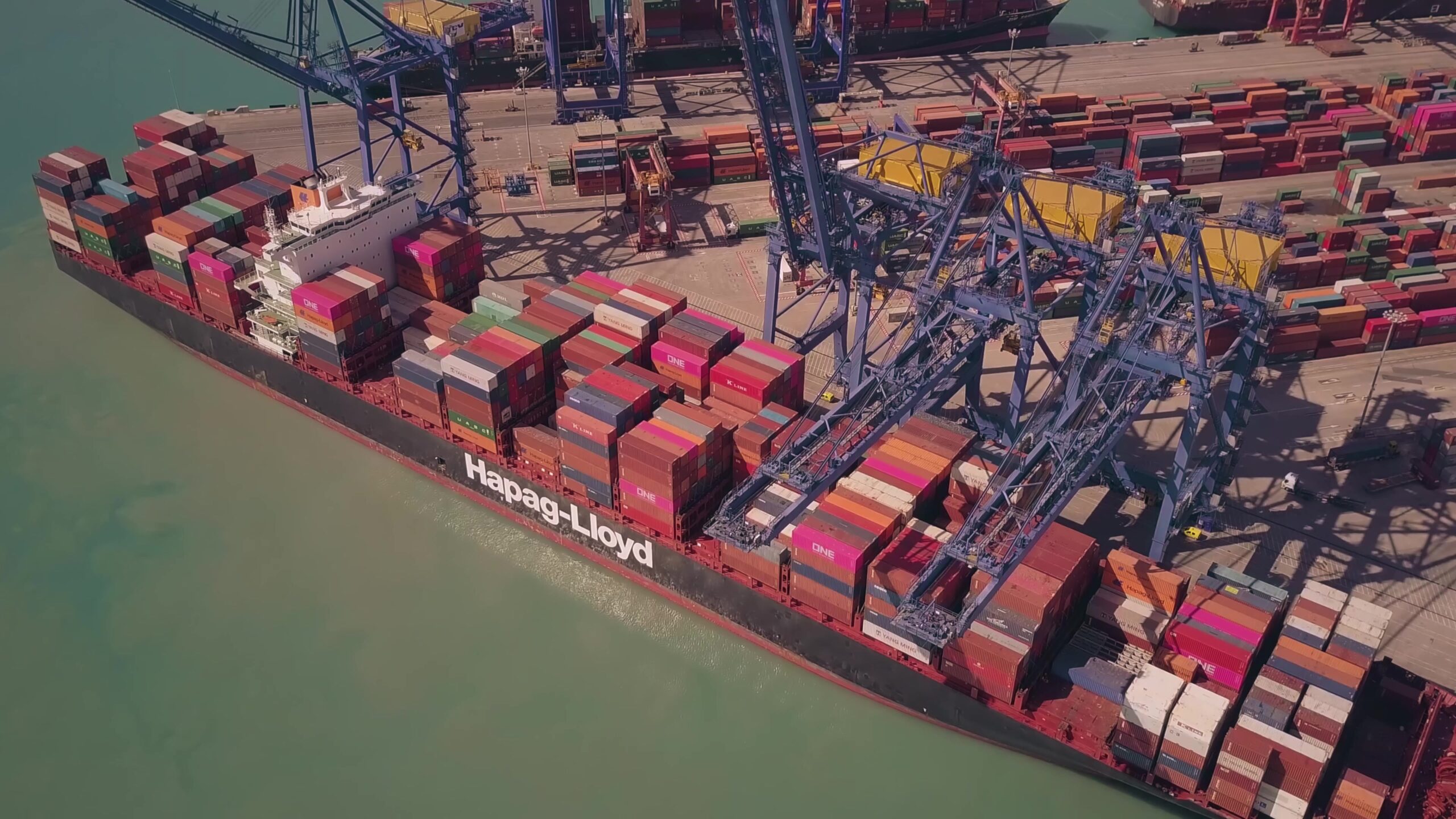
Hapag-Lloyd voiced cautious optimism on Wednesday on the prospect of resuming shipping through the Strait of Hormuz after a two-week ceasefire agreed between the U.S. and Iran, but said that resuming normal traffic throughout its network would take at least six to eight weeks.
Speaking in a call to customers, CEO Rolf Habben Jansen echoed guarded remarks by container shipping peer Maersk, saying that more security assurances were needed.
“Even if a ceasefire has now been agreed overnight, I would say that it’s fair to say that the conflict in the Middle East is still severely disrupting shipping, but also supply chains,” the Hapag CEO said, adding that the situation was “very fluid.” He raised the prospect of taking customer orders, provided that the ceasefire holds over the next few days.
“We will likely open up for bookings into the upper Gulf area, probably initially for selected markets, but hopefully fairly soon,” said Jansen.
Amid broad market relief over the tentative deal, Hapag shares were up 5.5% at 0935 GMT, recouping losses from the three prior trading sessions. Maersk stock slipped 1.5%.
He estimated additional costs from the Middle East crisis at $50 million to $60 million a week and warned that the German company would have to pass on some of that to its customers. That was up from $40-$50 million stated previously.
He added that about 1,000 ships were still stuck in the region, six of which are from his company with a combined capacity of about 25,000 standard containers.
(Additional reporting by Miranda Murray, editing by Madeline Chambers)
Related:
Was this article valuable?
Here are more articles you may enjoy.
Facts Only
Hapag-Lloyd voiced cautious optimism about resuming shipping through the Strait of Hormuz after a U.S.-Iran ceasefire.
The ceasefire was agreed overnight and spans two weeks.
Hapag-Lloyd CEO Rolf Habben Jansen stated the Middle East conflict continues to disrupt shipping and supply chains.
Jansen mentioned the situation is "very fluid" and dependent on the ceasefire holding.
Hapag-Lloyd plans to open bookings for the upper Gulf area, initially for selected markets.
Additional weekly costs from the crisis are estimated at $50–$60 million, up from $40–$50 million previously.
Hapag-Lloyd intends to pass some costs to customers.
Approximately 1,000 ships are stuck in the region, including six from Hapag-Lloyd with a combined capacity of 25,000 containers.
Hapag-Lloyd shares rose 5.5% after the ceasefire announcement.
Maersk stock slipped 1.5% during the same period.
Full normalization of shipping networks is expected to take six to eight weeks.
Maersk also expressed guarded remarks about the need for more security assurances.
Executive Summary
Hapag-Lloyd and Maersk, two major container shipping companies, have expressed cautious optimism about resuming operations through the Strait of Hormuz following a two-week ceasefire between the U.S. and Iran. Hapag-Lloyd CEO Rolf Habben Jansen noted that while the ceasefire is a positive development, the conflict in the Middle East continues to disrupt shipping and supply chains significantly. The company plans to gradually reopen bookings for the upper Gulf region, contingent on the ceasefire holding. Hapag-Lloyd estimates additional weekly costs of $50–$60 million due to the crisis, up from previous estimates, and intends to pass some of these costs to customers. Around 1,000 ships remain stranded in the region, including six from Hapag-Lloyd with a combined capacity of 25,000 containers. Market reactions were mixed, with Hapag-Lloyd shares rising 5.5% while Maersk stock slipped 1.5%. The situation remains fluid, with full normalization of shipping networks expected to take six to eight weeks.
The ceasefire offers temporary relief, but uncertainties persist. Shipping companies are balancing operational risks with financial pressures, and the broader economic impact of prolonged disruptions remains a concern. The cautious approach reflects the volatility of geopolitical tensions and their immediate effects on global trade.
Full Take
The narrative presents a measured response to a geopolitical ceasefire, emphasizing both hope and lingering uncertainty. The strongest version of this story acknowledges the tangible relief a ceasefire provides while rightly highlighting the fragility of such agreements in volatile regions. Shipping executives are steelmanning their positions—neither dismissing the ceasefire as meaningless nor declaring the crisis over. This reflects a pragmatic understanding of risk in global trade.
Patterns detected: none. The reporting avoids emotional exploitation or distortion, focusing on operational realities rather than sensationalizing the conflict. However, the framing subtly reinforces the idea that geopolitical tensions are an unavoidable cost of doing business, which may normalize systemic disruptions as inevitable rather than solvable.
Root cause: The paradigm here is one of geopolitical risk as a permanent feature of global logistics. The unstated assumption is that companies must adapt to instability rather than challenge its underlying causes. This echoes historical patterns where economic actors treat conflict as an external variable rather than a problem requiring collective action.
Implications: Human agency is constrained by the need to navigate unpredictable geopolitical currents. While shipping companies bear immediate costs, the broader impact falls on consumers and smaller businesses reliant on stable supply chains. Second-order consequences could include higher shipping costs, delayed deliveries, and increased insurance premiums, further straining global trade.
Bridge questions: How might shipping companies collaborate to mitigate geopolitical risks beyond reactive measures? What role could international institutions play in stabilizing critical trade routes? Would a sustained ceasefire shift the calculus for long-term investments in the region?
Counterstrike scan: If this were part of an influence campaign, the playbook might involve downplaying the ceasefire’s significance to maintain market volatility or exaggerating stability to lure premature investments. The actual content does neither—it presents a balanced, fact-based assessment without overt manipulation. The cautious tone aligns with legitimate business prudence, not coordinated messaging.
Sentinel — Human
This analysis suggests that the article is likely written by a human journalist due to its idiosyncratic emphasis, personal voice, and stylistic fingerprint. While some elements of style may match automated writing patterns, the overall coherence and absence of fabrication risk indicate a human origin.