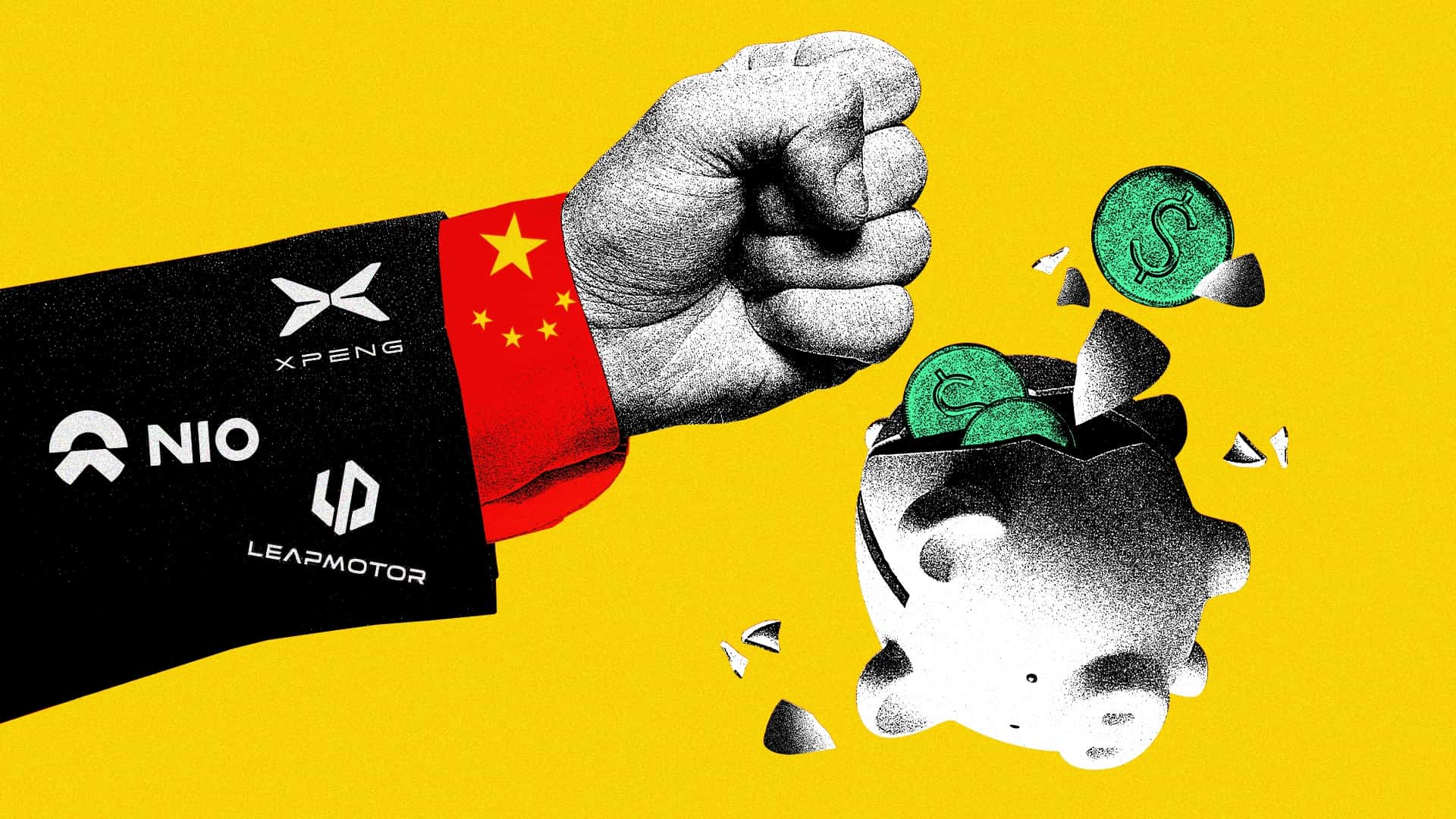
While American and European rivals bleed cash transitioning to EVs, a new crop of Chinese EV startups are in the black.
While Western auto giants are still burning billions in the race to go electric, a new era has already begun in China. The country’s EV disruptors have taken the world by storm with high-tech battery-powered cars and affordable prices. Now, for the first time, they are actually making money.
So far this year, three Chinese automakers have posted their first annual or quarterly profits. Stellantis-backed Leapmotor disclosed its first-ever full-year profit of $78 million in 2025, marking a sharp reversal from a $410 million loss the year before. Nio posted $104 million in adjusted net profit in Q4 after reporting a roughly $900 million loss during the same period in 2024. Xpeng turned its business around with a net profit of about $55 million in the fourth quarter of last year, after reporting a loss of around $190 million during the same period the year before.
The three companies join BYD, Xiaomi, and Li Auto in what is a growing roster of Chinese makers of plug-in vehicles—NEVs, or new energy vehicles, in Chinese parlance—that are no longer in the red. It’s a signal of the global automotive power balance shifting East, where Chinese EV makers are maturing quickly while battling brutal competition and price wars on their home turf.
“These companies are really just beginning to fit into their shoes,” Tu Le, the founder of consultancy Sino Auto Insights, told InsideEVs. “They are gathering data on the market, their competitors, what their strengths and weaknesses are, and rightsizing their companies better than their competition.”
By contrast, Tesla is the only profitable pure-play EV manufacturer in the West, although its profits have lately been plummeting as it pivots toward AI and robotics. All major American legacy automakers, including General Motors, Ford, and Stellantis, booked multi-billion-dollar charges last year as they recalibrated their EV ambitions.
European automakers are facing similar financial headwinds, but many continue to push forward with EVs. BMW, Volkswagen, Mercedes-Benz, Audi, and Volvo are rolling out updated models with improved software, longer range, and faster charging capabilities, signaling that they’re still committed to the shift.
Chinese automakers, of course, benefit from broad structural and systemic advantages. BYD received at least $3.7 billion in direct government subsidies to dominate the global EV market, Bloomberg reported in 2024, citing a study from the German Kiel Institute, a think tank. The Center for Strategic and International Studies estimates that China spent some $230 billion supporting its EV industry from 2009 to 2023.
Leapmotor B10
But subsidies tell only part of the story. Chinese automakers are heavily vertically integrated. BYD, for example, makes about 75% of its EV components in-house, including batteries, electric motors, power electronics, and software. Others have followed a similar path, investing heavily in research and development while using software and features to differentiate their products. The country also has an iron grip on the battery supply chain, and batteries are by far the most expensive components in EVs.
“Vertical integration allows for a vice-like grip on costs, so we should see more companies push into 'owning' more of their component engineering,” Le said. “If they stop investing, their competitors will overtake them within a couple of quarters. That's what keeps leadership at these companies up at night,” he added.
This new crop of profitable Chinese startups has also benefited from BYD’s recent sales struggles. BYD reported a 41% drop in sales in February—its steepest decline since the pandemic—driven by intensifying domestic competition and seasonal factors tied to the Lunar New Year. Its decline has helped rivals scale up, Le said.
2025 Nio Firefly
Nio is a good example of how Chinese companies are adapting. The automaker now operates three distinct brands, ranging from its premium Nio line and the mass market Onvo marque to the Firefly sub-brand, which makes compact cars. This multi-brand strategy has helped broaden its reach across segments. It also allows customers to purchase vehicles without batteries and subscribe to swapping services, lowering upfront costs. Nio’s battery-swapping network has grown to more than 3,750 stations across China. In February, the company set a new record with 177,627 battery swaps completed in a single day.
It wasn’t always smooth sailing for the company. Nio came close to collapsing during the pandemic, before securing $1 billion from several Chinese state-owned companies, followed by another $2.2 billion investment round from Abu Dhabi’s sovereign wealth fund in 2023.
Leapmotor, on the other hand, is relying on its Stellantis partnership and aggressive exports. After entering Europe, it relied on the Stellantis dealer network for sales instead of setting up its own stores. It delivered 596,555 vehicles worldwide in 2025, up 103% year-over-year and now sells cars in 40 countries across Asia, Europe, the Middle East, Africa, and South America.
One of the most fascinating growth stories in China comes from Xiaomi. The consumer electronics giant entered the auto industry with no prior auto manufacturing experience, launching the SU7 sedan in April 2024.
Within less than two years, the company sold more than 380,000 units. And in just 19 months, its EV business notched its first quarterly profit. Its scale as a technology company gave it the war chest to take on rivals, but it also executed that plan well. Apple, for instance, spent years and billions of dollars developing its own vehicle under “Project Titan” before ultimately abandoning the effort. Xiaomi has focused on integrating its EVs with its broader ecosystem of connected devices, positioning them as part of its “Human x Car x Home” platform.
2026 Xiaomi SU7
In the U.S., EV adoption is still growing, but at a slower pace. Now, Chinese EV makers are expanding into global markets, and soon the U.S. will be sandwiched between Canada and Mexico, both of which have welcomed Chinese EVs. Any non-Chinese EV makers that don’t move fast risk getting left behind, Le said.
“Hemming and hawing only pushes you further behind the pack,” Le said. “The days of trying to find the right, exact moment to transition from ICE to NEV are over.”
Contact the author: suvrat.kothari@insideevs.com
RECOMMENDED FOR YOU
The Xiaomi SU7 Was Already Dominating The Market. Reviewers Say The Updated Version Is Even Better
Porsche's Wild Curved Display Is The Car Touchscreen Done Right
Xiaomi Will Fix Its $5,800 Hood's Fake Ducts After Lawsuits Accused
BMW Pioneered Range Extended EVs. Now It’s Not So Sure
This Ultra-Popular Chinese Model 3 Rival Just Became An Even Bigger Problem For Tesla
2026 Toyota bZ Review: One Big Thing Missing
'My Favorite Car From China': Xiaomi SU7 Ultra Stuns Car Reviewer
Facts Only
Leapmotor reported its first full-year profit of $78 million in 2025, reversing a $410 million loss in 2024.
Nio posted a $104 million adjusted net profit in Q4 2025, compared to a $900 million loss in Q4 2024.
Xpeng recorded a $55 million net profit in Q4 2025, after a $190 million loss in the same period the previous year.
BYD, Xiaomi, and Li Auto are also profitable Chinese EV manufacturers.
Tesla is the only profitable pure-play EV maker in the West, with declining profits as it shifts focus to AI and robotics.
GM, Ford, and Stellantis reported multi-billion-dollar losses in 2025 due to EV transition challenges.
BYD received at least $3.7 billion in direct government subsidies, with China spending $230 billion on EV industry support from 2009 to 2023.
BYD produces about 75% of its EV components in-house, including batteries and software.
Nio operates three brands (Nio, Onvo, Firefly) and has over 3,750 battery-swapping stations in China.
Leapmotor delivered 596,555 vehicles worldwide in 2025, a 103% year-over-year increase, and sells in 40 countries.
Xiaomi sold over 380,000 SU7 sedans in less than two years and achieved profitability in 19 months.
BYD’s sales dropped 41% in February 2025, its steepest decline since the pandemic.
Executive Summary
Full Take
The narrative presents a compelling case for China’s EV dominance, highlighting profitability, vertical integration, and government support as key drivers. The strongest version of this argument credits Chinese automakers for rapid innovation, cost control, and strategic expansion, contrasting them with struggling Western competitors. However, the analysis leans heavily on structural advantages—subsidies, supply chain control, and state-backed investments—while downplaying potential risks like market saturation or geopolitical pushback.
Patterns detected: ARC-0024 Ambiguity (selective framing of subsidies as a minor factor despite their scale), ARC-0043 Motte-and-Bailey (emphasizing "free market" success while relying on state intervention).
Root cause: The paradigm assumes China’s EV success is inevitable, framing Western struggles as inefficiency rather than strategic recalibration. Unstated assumptions include the sustainability of China’s export-driven growth and the lack of long-term barriers (e.g., tariffs, IP disputes).
Implications: Human agency is secondary to systemic forces—workers, consumers, and smaller firms may bear costs of consolidation. Second-order effects include accelerated global EV adoption but potential overdependence on Chinese supply chains.
Bridge questions: How might Western automakers adapt beyond short-term losses? Could China’s EV boom face backlash from trade policies or domestic oversupply? What role does labor play in these cost structures?
Counterstrike scan: A coordinated campaign would amplify China’s "inevitable rise" while dismissing Western resilience. This article aligns partially but avoids overt propaganda, focusing on verifiable trends. No clear manipulation, but the framing favors a pro-China tech narrative.