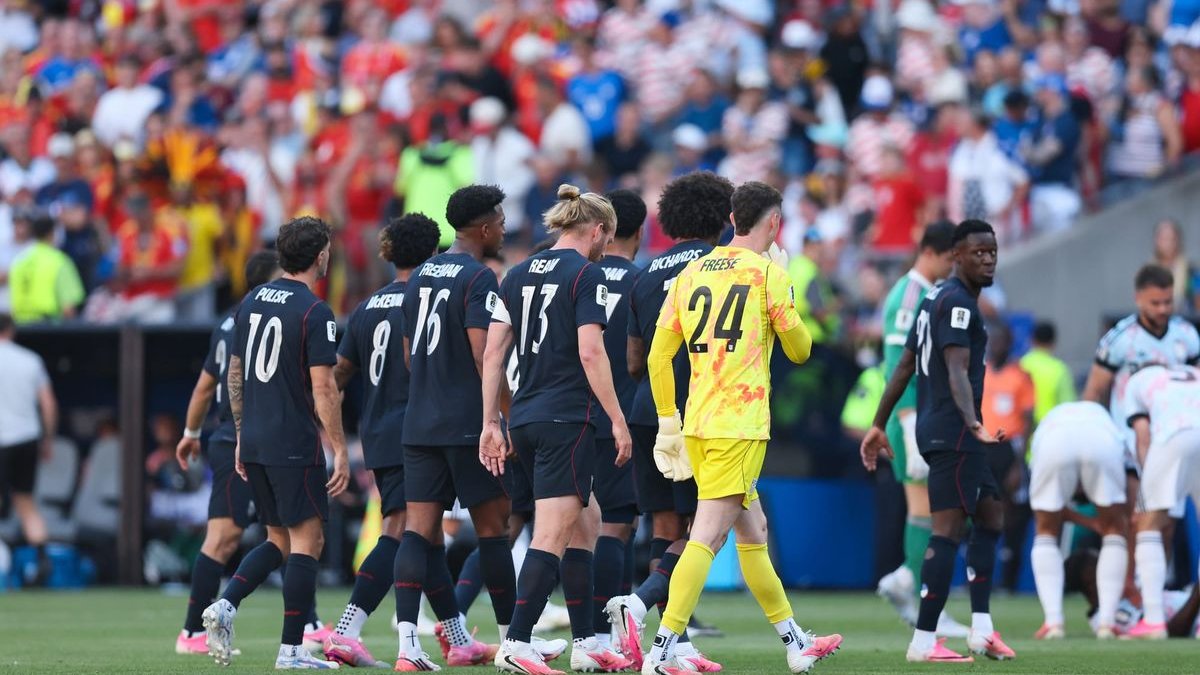
The US Women’s National Team is a major player in FIFA’s Women’s World Cup, having won two of the last three and four since the women’s World Cup was established in 1991. The US men’s team has gone beyond the Round of 16 only once in the same time span.
Part of the reason for the US women’s dominance is that fewer countries emphasize women’s soccer. Male athletes also have more options in America, with football and baseball capturing much of the attention. Europe’s more popular and lucrative professional leagues also help to make soccer stardom an aspirational ideal.
But there is another factor behind the underperformance of US men’s soccer on the international stage: the perverse incentives of our reigning civil rights regime.
Title IX has actively suppressed the growth of men’s sports since the early 1990s, when enforcement of the 1972 law underwent sweeping changes. Since that time, Title IX has been interpreted as a requirement that the proportion of athletes who are female must be equivalent to the number of undergraduates who are female at every school receiving federal funds.
Because of this requirement, schools with football teams—which tend to have large rosters—try to balance out their many male athletes by creating niche female sports such as bowling, flag football, and beach volleyball. They also pad the rosters of their women’s teams. The University of Nebraska had fifty female basketball players in 2025-2026. Alabama’s female rowing team has more than 110.
But in order to fulfill Title IX, schools have not only expanded women’s sports; they have cut men’s. Nowhere is this choking out of male demand more evident than in soccer. NCAA Division I had roughly 200 male soccer teams and fewer than 100 female soccer teams in 1990. The number of male teams has remained steady since. The number of female teams exceeded the number of male teams in 1996-1997 and then kept on growing.
In 2022-2023, male teams numbered 203 while the number of female teams was 337. Today, many schools with large athletics programs—including Florida, Georgia, Texas, LSU, Iowa, and Missouri—have women’s varsity soccer teams but only club soccer for men. This reduces the number of men playing at a high level. According to NCAA numbers, in the early 1990s, male soccer players outnumbered females by more than two to one in Division 1. In 2023, there were 10,239 women playing soccer at the highest collegiate level, compared to 6,441 men
The NCAA long allowed men’s varsity soccer teams to have only 9.9 scholarships to spread out over their rosters. Women’s teams, by contrast, had fourteen. This double standard against male soccer players was necessary to comply with prevailing Title IX regulations, which hold that only proportional parity provides schools a “safe harbor” against Title IX suits. (Roster limits are now equalized at twenty-eight.)
For basketball and baseball, Division I sports are pipelines for developing America’s world-class team sports programs. In the World Baseball Classic, other countries pillage American players, just as they do in international basketball competitions. In soccer, however, America’s World Cup team must look for talent elsewhere. By contrast, every member of the last three American female World Cup teams was homegrown.
America’s women’s soccer has a world-class pipeline, but Title IX prevents men’s soccer from building one. Only when America drops its sports sex-quota system will the American men stop being humiliated by Belgium. And America will drop its sports sex-quota system only when it stops using sports as a lever to break down stereotypes and engineer parity and instead allows regulations to acknowledge that the sexes differ in their interest in sports. Until then, men’s soccer will continue to be hobbled by a legal regime that not only limits its talent pipeline but requires it to split its World Cup winnings with female athletes.
Change is possible. Just as interpretations of civil-rights law have shifted in other areas, a men’s soccer club team at Texas or Florida could file suit against their schools for their failure to provide equal opportunities to male club soccer players. Females at Austin or Gainesville are, after all, getting scholarships to play soccer while men must pay full freight.
Facts Only
* The US Women’s National Team won two of the last three and four Women’s World Cups since 1991.
* The US men’s team advanced beyond the Round of 16 only once in the same time span.
* Fewer countries emphasize women’s soccer, which contributes to US women's dominance.
* Male athletes have more options in America, with football and baseball capturing much of the attention.
* European professional leagues offer an aspirational ideal for soccer stardom.
* Title IX suppressed the growth of men’s sports since the early 1990s.
* Title IX interpretation requires gender parity in federal funding distribution at schools.
* Schools balance male athlete numbers by creating niche female sports or padding women’s team rosters.
* In 1990, NCAA Division I had approximately 200 male soccer teams and fewer than 100 female soccer teams.
* Male soccer players outnumbered females by more than two to one in Division I in the early 1990s.
* In 2023, there were 10,239 women playing soccer at the highest collegiate level compared to 6,441 men.
* NCAA limits allowed men’s varsity soccer teams 9.9 scholarships; women’s teams had fourteen in the past.
* Roster limits for male and female soccer teams are now equalized at twenty-eight.
Executive Summary
The US Women’s National Team has achieved significant success in FIFA’s Women’s World Cup, winning two of the last three and four since 1991. The US men’s team has participated in the Round of 16 only once during this same period. The relative dominance of US women's soccer is partly due to fewer countries emphasizing women’s soccer, as male athletes have more options in America, with football and baseball dominating attention. Additionally, the popularity and financial success of European professional leagues create an aspirational ideal for soccer stardom.
Underlying the underperformance of US men’s soccer internationally is linked to the history of Title IX enforcement. Since the early 1990s, Title IX has been interpreted as requiring gender parity in federal funding distribution, leading schools with large male sports teams to counterbalance them by expanding niche female sports like bowling or flag football and increasing women's team rosters. This created a disparity where NCAA Division I had roughly 200 male soccer teams versus fewer than 100 female teams in 1990, a gap that narrowed later. Currently, while many schools have women’s varsity soccer teams, men often rely on club soccer at the collegiate level. Statistically, in the early 1990s, male soccer players outnumbered females by more than two to one in Division I, and current figures show a greater number of female soccer players nationally compared to male players at the highest collegiate levels.
Full Take
The narrative establishes a clear tension between institutional regulation, social parity goals, and athletic opportunity structures. The core pattern involves using seemingly neutral legal frameworks, such as Title IX, to enforce outcomes that disproportionately affect one group while masking systemic imbalances in another domain—in this case, men's sports development. The argument pivots on the concept of "perverse incentives," suggesting that regulatory mechanisms intended for equality can be weaponized to maintain existing power structures rather than fostering true parity across all sporting endeavors.
The pattern observed is one of strategic compartmentalization: where regulation necessitates balancing male and female participation, the solution adopted by institutions is to create specialized niches (e.g., flag football) or enforce differential structural limits (scholarship caps) that inherently favor established traditions over emergent demands. This suggests a resistance to holistic restructuring. The implication for cognitive sovereignty lies in recognizing how legal and institutional structures are not neutral arbiters of fairness but active mechanisms that reinforce stereotypes and channel talent pipelines based on pre-existing gendered expectations. The call for change is framed not just as an administrative adjustment, but as dismantling a system that uses sports as a lever to engineer perceived natural differences rather than acknowledging differing interests.
Bridge Questions: If Title IX was intended to ensure parity in opportunity, what specific metrics beyond simple team numbers would reveal the true distribution of talent development? How can institutional structures be re-examined to determine if differential treatment is a necessary function of balancing competing claims or if it serves to actively maintain historical hierarchies? What long-term systemic changes are required to shift the paradigm from using sports as a mechanism for stereotype reinforcement to allowing regulation to acknowledge genuine interest differentiation between sexes?
Sentinel — Human
The text functions as an argumentative essay using statistical context regarding Title IX and sports quotas to build a critical claim about gender disparity in US sports funding and opportunity.