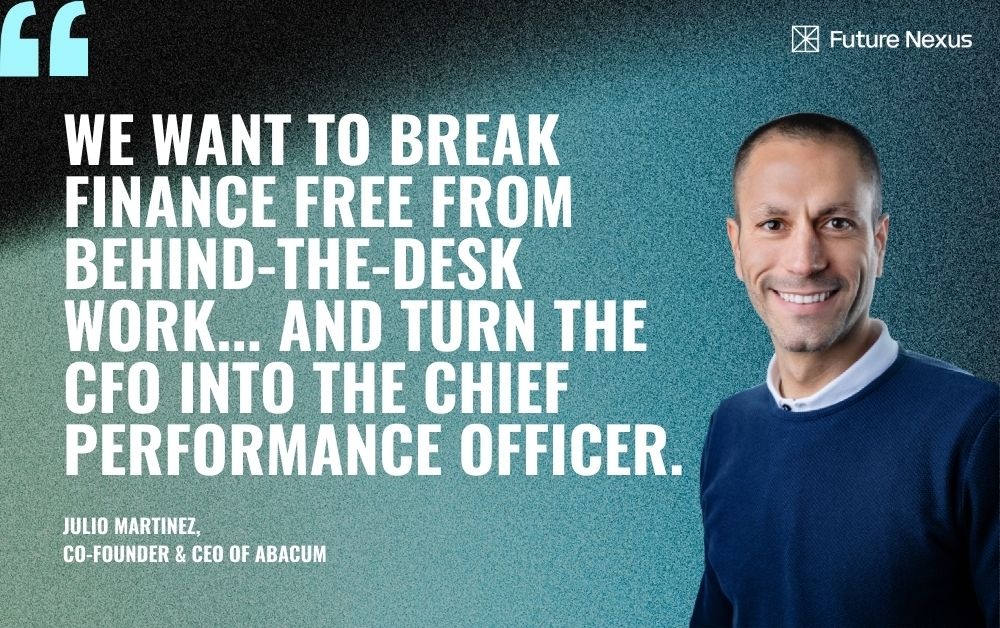
“We want to break finance free from behind the desk work, connect all the stakeholders in a business so they become a trust advisor, and turn the CFO into the Chief Performance Officer driving performance in the business and making better decisions.” — Julio Martinez, co-founder and CEO of Abacum
Abacum co-founder and CEO Julio Martínez is betting that the next generation of finance teams will look a lot more like product teams: plugged into live data, collaborating across functions and constantly running scenarios instead of just closing the books once a month.
New York-based Abacum’s all-in-one platform helps CFOs forecast revenue, plan headcount and model financial scenarios amidst tough macroeconomic headwinds. The company is in 40 markets around the world and boasts a client list that includes Abridge, Strava and Trilogy.
Future Nexus spoke to Martinez about how Abacum is using an AI-native architecture to reinvent financial planning and analysis, why scenario planning sits at the top of the value pyramid and how finance leaders can stay ahead of the next wave of macro and funding volatility in 2026.?
The following was edited for clarity and length.
For founders used to hearing “AI-powered” everywhere, you describe Abacum as “AI native,” not just a planning tool with AI bolted on. What does that actually mean for how finance teams use the product day-to-day??
Martínez: I see it in two layers. First is the technology architecture: being AI native means your architecture can actually support AI in a flexible, robust way. Many legacy financial planning and analysis tools were built 20 or 25 years ago, so their architectures are rigid, and they can only layer a bit of AI on top, which is rarely transformational. We built a fresh, AI-driven architecture from the start so we can integrate AI where it matters instead of treating it as a cosmetic feature.?
The second layer is how AI shows up in the workflow. For us, AI is not a chatbot floating on the screen that finance teams have to talk to. We want AI to be invisible and embedded in the job to be done. If I’m a finance professional modeling my next forecast or budget, I can use AI-powered modeling and smart templates so that around half to most of my model is generated automatically, saving up to a week of work.
When it comes to data, instead of cleaning and classifying everything in spreadsheets — which is error-prone and exhausting — we use AI to clean, classify and prepare the data inside Abacum. We’re very deliberate about building a “glass box,” not a black box, so finance teams have full traceability and explainability for every number they sign off on.?
Beyond shaving off some hours, how are capabilities like data cleaning, anomaly detection or automated forecasting genuinely changing how your customers work??
Martínez: Productivity is real and important. Many finance professionals come from investment banking or consulting, and then they land in roles where half their time feels like manual, repetitive work. We’ve seen customers report that a large share of the time they used to spend on manual tasks can be automated away.?
The bigger shift happens once that time is freed and finance teams can become proactive partners. They’re connected through the platform to stakeholders across the business and have clarity on what’s happening in the pipeline, with partners, with closing capacity, with product launches.
They can see, for example, whether they have excess sales capacity relative to a bottleneck in pipeline generation, or how a delay in a product release is likely to cascade into revenue. I call this “cognitive clarity:” going from a world where it’s hard to make sense of anything to a world where you understand the business, can slice and dice the data quickly and can communicate those insights to the rest of the company.?
Looking at this year, what core FP&A tasks do you expect to be mostly automated, and which do you think will remain more strategic and human??
Martínez: The area I’m most excited about is scenarios. Scenario planning is where AI and finance get truly powerful together. We recently launched an AI-powered Scenario Studio, which is one of our flagship capabilities. It lets finance teams run complex, constraint-based scenarios on the fly and answer questions in real time that used to require days of spreadsheet work.
For finance professionals, that’s the top of the pyramid, like the prime-time moments when they need to shine. We’re turning that into something they can do any time, not just once a quarter.?
What stays human is business partnering. Finance needs to be embedded in day-to-day conversations with revenue, product, and HR, navigating politics, uncertainty and negotiation while still protecting budgets and driving performance. Those relationships and judgment calls are not going away.
You’ve talked about planning through uncertainty and more agile annual planning. What kinds of scenarios do you expect finance teams to run routinely this year??
Martínez: Macroeconomic and geopolitical conditions are driving a lot of the scenario work. Recently we’ve seen tariffs come in and out, which has affected many customers’ supply chains. Tax changes have also triggered new modeling exercises. With what’s happening in different regions, customers, especially in manufacturing or those exposed to factors like energy prices, are constantly updating assumptions and running scenarios on costs, supply and demand.?
Another big theme is capital scarcity, especially for SaaS and high-growth tech companies. Many of our customers are privately held, some pre-IPO, and they’re asking what it means if they can’t raise on the same terms as before, or if an IPO window opens and closes very quickly.
They’re running scenarios like, “We’re burning several million per month — do we need to bring that down?” and “If our listing gets pushed by two months, what happens to our runway and hiring plan?”
Key takeaway
Historically, a finance team would disappear into a cave for a week to answer questions and still feel tentative because the data wasn’t reliable enough, Martinez said. Instead, Abacum wants to enable a more agile cadence of rolling, monthly conversations instead of static annual plans, so finance becomes the glue of the business rather than a back-office reporter.?
Facts Only
* Julio Martinez is the co-founder and CEO of Abacum.
* Abacum’s platform helps CFOs with forecasting, headcount planning, and financial scenario modeling.
* The company is based in New York and operates in 40 markets.
* Abridge, Strava, and Trilogy are listed as Abacum clients.
* Abacum utilizes an AI-native architecture for its planning tool.
* The architecture was built from the start to support AI integration, unlike legacy tools.
* AI is embedded in the workflow to automate tasks like data cleaning and model generation.
* Finance teams can use AI-powered modeling to generate up to half of their financial models automatically.
* Data cleaning and classification are automated using AI, increasing traceability and explainability.
* Productivity improvements are reported by customers, with time previously spent on manual tasks being automated.
* Scenario planning is highlighted as a key value proposition, utilizing an AI-powered Scenario Studio.
* Finance teams can run complex, constraint-based scenarios in real-time.
* Business partnering and judgment calls remain critical, even with automated tasks.
* Macroeconomic and geopolitical conditions are driving scenario work, including tariff adjustments, tax changes, and capital scarcity.
* Finance teams are running scenarios around revenue burn, potential IPO delays, and changes in funding terms.
Executive Summary
Abacum, founded by Julio Martinez, is positioning itself as a financial planning and analysis (FP&A) platform designed for the modern business. The company’s core offering – an all-in-one platform – aims to shift the role of finance teams from reactive bookkeepers to proactive strategic partners. Martinez envisions a future where finance functions as a trusted advisor, leveraging AI to drive better decisions and provide real-time insights. Currently operating in 40 markets with clients like Abridge, Strava, and Trilogy, Abacum’s platform focuses on revenue forecasting, headcount planning, and scenario modeling to address current macroeconomic headwinds.
The company differentiates itself by employing an “AI-native” architecture, unlike legacy systems that rely on AI as an add-on. This architecture allows for seamless integration of AI into daily workflows, automating tasks such as data cleaning and model generation, potentially saving finance teams up to a week of work. Abacum’s emphasis on scenario planning, facilitated by an AI-powered Scenario Studio, suggests a strategic focus on flexibility and responsiveness to volatile market conditions. Specifically, they are helping customers evaluate factors like revenue burn rates, fundraising runway, and the impact of external events like tariffs and tax changes.
The emphasis on “cognitive clarity” highlights the goal of providing finance teams with the information and tools to understand the business and communicate effectively, which is a shift away from isolated data analysis. Martinez’s vision – a shift toward monthly, rolling conversations around financial planning—suggests a move towards greater agility and real-time decision-making within organizations.
Full Take
The narrative presented by Abacum reveals a profound anxiety within the financial sector – a fear of obsolescence driven by rapidly advancing AI. Martinez’s framing of Abacum as “AI-native” isn't just a marketing pitch; it’s a strategic positioning to compete with established FP&A vendors who have historically lagged behind in adopting truly transformative AI. The underlying assumption is that current financial planning processes are fundamentally inefficient and overly reliant on manual, error-prone work – a reasonable assessment given the complexity and volume of data involved.
Pattern detected: ARC-0024 Ambiguity – The language employed, particularly the assertion of “half to most of a model generated automatically,” is inherently ambiguous. It’s difficult to quantify the actual time savings and doesn't fully articulate the level of human oversight required. This is a classic tactic of over-promising to create a sense of urgency and demonstrate the potential of AI. Furthermore, the emphasis on “scenario planning” as the ‘top of the pyramid’ – a space traditionally reserved for senior executives – subtly shifts the power dynamic, suggesting that AI can democratize strategic thinking.
Root Cause: The narrative taps into a broader cultural trend—the relentless pursuit of efficiency driven by technological innovation. It’s a narrative fueled by the belief that AI will fundamentally reshape all industries, and finance is particularly vulnerable due to its data-intensive nature. The constant references to macroeconomic volatility and funding scarcity are not merely descriptive; they are deliberately employed to create a sense of urgency and justify the need for a sophisticated, AI-powered solution.
Implications: The success of Abacum hinges on more than just technological capabilities. It also depends on the willingness of finance professionals to embrace new ways of working. There’s a risk of creating a “two-tiered” system where those who adapt to AI thrive, while those who resist are left behind. The call for “cognitive clarity” also raises questions about the very nature of human judgment—will AI erode the capacity for critical thinking and intuition? Patterns detected: ARC-0043 Motte-and-Bailey – Martinez uses emotionally charged language (“tough macroeconomic headwinds”) to underscore the seriousness of the situation and then presents Abacum as the solution to these problems.
Bridge Questions: What is the true cost of this “cognitive clarity”? How will organizations ensure that AI enhances, rather than diminishes, human judgment in financial decision-making? If Abacum’s technology truly reduces the workload of finance teams by 50%, how will that impact the number of roles required within the department?
Counterstrike Scan: The hypothetical attack pattern an influence campaign would use to amplify this narrative would involve highlighting the increasing cost of human error in FP&A – “study after study shows that X% of financial forecasts are inaccurate!” – followed by framing Abacum as the only viable solution to mitigate this risk. This narrative could be deployed across social media, industry publications, and targeted advertising to create a sense of crisis and drive demand for Abacum’s platform.
Sentinel — Likely Human
This article presents Abacum’s platform as a solution for modernizing financial planning, emphasizing AI-driven automation and proactive data analysis. The piece adopts a balanced, explanatory style, typical of business technology reporting, though its reliance on broad claims and unspecified expertise raises a moderate suspicion of synthetic generation.