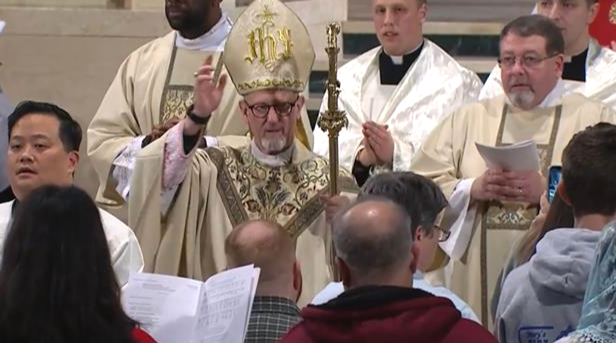
In an op-ed to his flock titled ‘Just War 101: Catholic teaching for a dangerous moment,” Bishop James Conley of the Diocese of Lincoln, Nebraska, says he feels “a special responsibility to speak up clearly for the Church’s teaching and vision” as the U.S.-Iran conflict continues.
Noting that he is "the proud son of a World War II veteran who served as a gunner on an aircraft carrier in the Pacific theater," Conley offers a concise primer on what he calls “Just War Theory 101," writing that while the Catholic Church “is not inherently pacifist and does not mandate the renunciation of all violence,” it is also “adamantly skeptical of war.”
He recalls Pope Leo XIV’s recent and many calls for peace, saying that because “of the evils and injustices that all war brings with it, we must do everything reasonably possible to avoid it.”
However, he writes, the “Church teaches one has a right to self-defense against an unjust aggressor, even to use lethal defense if necessary,” a right that “also applies to nations when faced with an unjust aggressor-nation.”
Conley lays out the “strict and imposing” conditions that the Church teaches must be met for a war to be considered just; namely, “war be a last resort, declared by a proper authority, have a just cause, and be proportional.”
These four conditions are known in Latin as the "jus ad bellum, the justification or reason for waging war."
In addition to these, he references the "jus in bello — the law that governs the way in which warfare is conducted."
The prelate notes that two requirements govern the means of war: “Non-combatants and civilians must not be deliberately targeted” and “the harm inflicted must be proportionate to the legitimate military objective.”
In his assessment, Conley takes into account the current Iranian regimeʼs evil actions, including the killing of tens of thousands of its own citizens engaging in peaceful protests earlier this year and sponsorship of terrorism by proxy over decades, along with its efforts to build a nuclear weapon.
Conley holds that a country does not “have to wait until an enemy is on the brink of attacking” before it can act.
Nevertheless, he maintains there “remain serious moral questions about several aspects of the Iran conflict” and cites, among other concerns, the use of AI-directed autonomous weapons.
“The Church is clear that such weapons could not be used justly, even in a just war,” Conley observes, going on to approvingly cite the position of Catholic moral theologian Charlie Camosy that deadly actions in war “require human beings to be the ones morally responsible — and to take moral responsibility — in order for actions in a war to be just.”
Haunting memory of Enola Gay chaplain
Conleyʼs reflections on the subject are sandwiched between his recollection of the haunting story of Father George Zabelka, the Catholic priest who gave a blessing of safety to the crew of the Enola Gay, the plane that dropped the atomic bomb on Hiroshima during World War II.
Zabelka regularly blessed the airmen before their missions. After speaking with one who had flown a reconnaissance flight over Nagasaki after the atomic bomb was dropped, however, the priest thought: “My God, what have we done?” The airman “described how thousands of scorched, twisted bodies writhed on the ground in the final throes of death, while those still on their feet wandered aimlessly in shock – flesh seared, melted, and falling off.”
Zabelka eventually concluded that “he had denied the very foundations of his faith by lending moral and religious support to the bombing of Hiroshima and Nagasaki.”
In a speech Zabelka gave 40 years after the U.S. dropped the atomic bombs, he said: “War is now, always has been, and always will be bad, bad news. I was there. I saw real war. Those who have seen real war will bear me out. I assure you, it is not of Christ. It is not Christ’s way.”
Conley concludes by saying he stands “in solidarity with Pope Leo and Archbishop Paul Coakley, president of the United States Conference of Catholic Bishops, in urging Catholics and all people of good will to pray for a peaceful solution to the conflict in Iran.”
“More destruction will only lead to more innocent lives being killed in the crossfire,” he writes. “Please pray that those in leadership positions can find a way forward without more destruction and bloodshed.”
Facts Only
* Bishop James Conley wrote an op-ed titled ‘Just War 101: Catholic teaching for a dangerous moment.’
* Conley references the Catholic Church's position that it is skeptical of war but does not mandate complete pacifism.
* The Church teaches that there is a right to self-defense against an unjust aggressor.
* For a war to be just (*jus ad bellum*), four conditions must be met: war must be a last resort, declared by a proper authority, have a just cause, and be proportional.
* The requirements for conducting warfare (*jus in bello*) include the rule that non-combatants and civilians must not be deliberately targeted.
* The harm inflicted in war must be proportionate to the legitimate military objective.
* Conley assessed the Iranian regime's actions, including killing of citizens during protests and sponsorship of terrorism, and efforts to build a nuclear weapon.
* Conley asserts that a country does not have to wait for an enemy to be on the brink of attack to act.
* Conley raises moral questions regarding the use of AI-directed autonomous weapons in conflict.
* Conley cites the position that deadly actions in war require human beings to take moral responsibility.
Executive Summary
Full Take
Sentinel — Human
The text exhibits strong human stylistic fingerprints, characterized by a passionate, reflective voice and the deliberate integration of personal historical memory with complex moral and political theory.