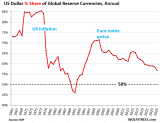
The spike of the “non-traditional reserve currencies.”
By Wolf Richter for WOLF STREET.
Foreign central banks have not been dumping US-dollar-denominated assets. But they’ve been loading up on assets in other currencies, and their total holdings of foreign exchange reserves have ballooned, while their USD-assets have remained nearly flat for over 10 years. So the share of USD-denominated exchange reserves dropped to 56.8% of total foreign exchange reserves in Q4, the lowest since 1994, according to the IMF’s data on Currency Composition of Official Foreign Exchange Reserves, released on Friday.
It has been zigzagging down toward the 50% line for years. It does have consequences. And it has been there before.
USD-denominated foreign exchange reserves are US securities held by central banks other than the Fed. They include US Treasury securities, US mortgage-backed securities (MBS), US agency securities, US corporate bonds, and other USD-denominated assets.
After a long plunge from a peak share in 1977, the dollar’s share broke through the 50%-line in 1990 and dropped further in 1991. This period from the mid-1970s through 1991 was accompanied by waves of sky-high inflation and interest rates, four recessions, including the nasty Double-Dip recession, and high unemployment. And other central banks lost confidence in the US dollar.
But then the economy picked up, inflation calmed, the Dotcom Bubble began to perform miracles on a daily basis, confidence returned, and USD denominated assets became desirable again.
Enter the euro. European politicians were talking about “parity” with the dollar until the Euro Debt Crisis began in 2009. Since then, the euro lost share and then stalled, as central banks diversified into other currencies, and since 2021, into dozens of smaller “non-traditional reserve currencies,” as the IMF calls them. Throughout, the dollar’s share zigzagged down toward the 50% line.
But central banks didn’t dump USD securities.
Since 2013, foreign central banks have roughly maintained their holdings of USD-denominated assets. In Q4 2025, their holdings of $7.46 trillion of US securities were up just a hair from 2014, but below 2020 and 2021.
What has caused the share of USD assets to decline over these years was the surge of assets denominated in dozens of other smaller currencies.
Why this matters: the “twin deficits.”
When foreign central banks buy US Treasury securities and other US securities, they in essence provide some of the funding for the huge twin deficits the US has: the trade deficit and the federal budget deficit. Being the top dog in terms of securities that other central banks buy – having the dominant reserve currency – has enabled the US to run those twin deficits for decades.
This path is obviously not permanently sustainable. And the “twin deficits” need to be brought down substantially before something goes off the rails, such as a surge of inflation and much higher bond yields, and all the issues that come with it.
Foreign exchange reserves by currency.
Central banks’ combined holdings of foreign exchange reserves in all currencies, and expressed in USD, rose to $13.14 trillion in Q3.
Excluded are any central bank’s assets denominated in its own currency, such as the Fed’s Treasury securities or the ECB’s euro-denominated securities.
Top holdings, expressed in USD:
- USD assets: $7.46 trillion
- Euro assets (EUR): $2.66 trillion
- Yen assets (YEN): $0.76 trillion
- British pound assets (GBP): $0.58 trillion
- Canadian dollar assets (CAD): $0.33 trillion
- Australian dollar assets (AUD): $0.27 trillion
- Chinese renminbi (RMB) assets: $0.26 trillion
The euro’s share has been around 20% for the past 10 years. Just before the Euro Debt Crisis, it had risen to nearly 25%.
Note the blue “DEM” on the left – that’s the Deutsche mark with a share of about 15% in the mid-1990s. It became the dominant founding currency of the euro.
The rest of the reserve currencies are clustered at the bottom of the chart. But that’s where the action is (more in a moment).
The spike of the “non-traditional” reserve currencies.
The chart below magnifies the cluster of lines in the chart above.
The soaring red line represents dozens of “other currencies” – other than the ones the IMF specifically names here. These dozens of smaller currencies are what the IMF calls the “nontraditional reserve currencies.” Each has a minuscule share, but their combined share has more than doubled since 2021 and hit 6.1%, surpassing the yen.
These “non-traditional” currencies are where much of the diversification away from the USD has occurred.
The share of the RMB (yellow) ticked up to 2.0%, after declining since Q1 2022. China has the second-largest economy in the world, and is hugely interwoven in international trade. But its RMB-denominated assets are not sought-after by other central banks, amid ongoing capital controls, convertibility issues, and other issues.
Gold, the non-currency diversification.
Gold is not a “foreign exchange reserve” asset of central banks, it does not involve a foreign currency, and it is not included in the data above, so it doesn’t belong in a discussion of reserve currencies. But it’s part of the broader “official reserve assets” that foreign exchange reserves are also part of, and it is an asset that central banks are diversifying to, as they ease away from the USD, and in that respect, it fits in.
Gold holdings by official authorities rose by 0.8% year-over-year to 1,175 million troy ounces at the end of Q4, back where they’d been in 1977, according to the IMF on Friday.
In 2008 and 2009, when the global financial system seemed to be at risk, these central banks changed their minds about gold and started buying hand-over-fist, after having spent the prior four decades dumping their gold holdings.
In 2025, the price of gold lost its oomph. After a huge years-long rally, it topped out at $5,627 on January 29 and today is down 20% from its all-time high. Despite the drop, gold is still up by 44% from a year ago and by 100% from two years ago. Part of this years-long price surge may have been driven by central-bank buying and by the intense hoopla and hype around it.
Official gold holdings at the end of 2025 would be valued at $5.27 trillion at today’s price, compared to $13.0 trillion in total foreign exchange reserves, and $7.46 trillion in USD-denominated foreign exchange reserves:
Enjoy reading WOLF STREET and want to support it? You can donate. I appreciate it immensely. Click on the mug to find out how:
Not to worry, USD denominated stable coins will keep up demand for the dollar for years to come (s)
Fantastic post Wolf, thank you!
such a great analysis. thanks. i think with turmoil in mideast the gulf states princelings…… just conjecture, must be selling gold to move to safer mansions they own in london, nyc…….
I would like to hear rational thoughts on:
1) Alternatives to the US Dollar that are safe
2) How would unwinding from the US Dollar take place, given the current world exposure to the US Dollar
3) Timeframe of a new world currency
I have been around for a while and have heard about the demise of the dollar, but it has never happened.
If it did, the US would be forced to eliminate its Trade and Budget deficits, so maybe a change would not be so bad.
People waiting for the “demise of the dollar” will have to be very patient. The play, “Waiting for Godot,” captures that.
There is nothing wrong with the “dollar.” It’s just a currency. What is wrong are the structural issues, including the twin deficits.
It doesn’t matter fundamentally how people pay for stuff, whether it’s by bank transfer, some other electronic means (credit/debit cards, PayPal, etc.), or stablecoins. It makes no difference to the economy or the dollar, but it matters to companies in that industry that extract fees. If payments shift to stablecoins, then banks, credit card companies, PayPal et al. lose out on the fees.
But the US will face some structural issues with its twin deficits when the world is no longer willing to fund them. Those structural issues could be pretty rough, such as high inflation and high interest rates, and the issues they cause. If the Fed tries to keep interest rates low by buying bonds while government-borrowing goes haywire in an inflationary period, inflation will spiral out of control, and the Fed knows that, which is why it won’t do that. Americans have a relentless history of evicting anyone from the White House who they see responsible for this inflation. The way forward for anyone in the White House, Congress, and at the Fed will be to keep inflation in the moderate range and deal with the structural issues. And when foreigners are no longer willing to fund the twin deficits, it will eventually force the government to deal with the twin deficits. And there still won’t be the “demise of the dollar.” (Spoiler alert: Godot never showed up).
I know you probably wanted Mr Wolf’s thoughts, but here are mine just in case you care. I think it’s worth keeping in mind how big the financial system of the world is and how important US debt is in its plumbing. I often hear unduly complacent commentary trying to compare this to the fall of the British Pound or even the Dutch Guilder (not pointing any fingers at anyone around here, just commenting in general), but that totally underestimates the size of the current financial system. There are 10 times as many people in the world, the economy is hundreds of times bigger, and actually those currencies were confined almost entirely to Europe. There are too many pension funds, insurance companies, etc, that are required to hold safe assets, and the system works by them using US bonds right now.
It seems like this is happening in slow motion, but it is a much bigger change than it appears. Container ships take a long time to turn around (so I am told), and in the modern economy, there just aren’t enough German bonds to go around to replace USD right away. That doesn’t mean the current situation is sustainable. Also, realistically, the US was 40 percent of world GDP in 1960, now it’s around a quarter, depending on how you measure. Even though I don’t personally expect China to continue such a dramatic rise, I do think the world will continue to grow faster. It’s just not in the long term possible for the USD to remain the world’s reserve currency, and I think a multi polar world is inevitable. Though this particular 3D chess move of starting a war with Iran, right after poking the US’s allies’ in the eye, does surpass my understanding of good strategic policy, I must admit. I could see how it may cause that transition to happen a little faster than it otherwise would have.
As for practical advice, I would follow the central banks by diversifying. Buy low cost index funds across the world economy (weighted slightly to your home country). Keep in mind that there are treaties that affect how dividends are taxed (depending on your jurisdiction), so hold international stocks in accountants that are exempt when possible. Never buy a ticker symbol that you read about in a comment section (except low cost ETFs). Personally, I see no reason to hold other countries’ bonds, but am a firm believer in holding their equities. I still think having some bonds is worth it, because you aren’t trying to beat the market (you should make your money having a job that you are good at, unless being a trader is your job). The point of bonds is that you are hedging against wide risks, including some that may not have ever happened yet, so just because bonds have historically not performed as well as stocks (even in downturns), doesn’t mean they aren’t worth it.
It’s worth keeping in mind that our financial system has changed considerably over the years, and isn’t very old yet. I don’t care very much about what happened in the 80s and 90s, let alone what happened while we were still using the gold standard.
Finally, speaking of gold, I don’t like it. I prefer assets that at least pay me something, and I consider good sovereign debt safe still (I know not everyone does). If you do like it, hold a little.
Initially this made my teeth curl, but not as much as an IPA.
But from what you wrote, it appears the US dollar is just fine. For fun, I did a deep dive into SWIFT and discovered the US dollar as a percentage of SWIFT payments has increased quite a bit, and that SWIFT payments have increased overall. The EU had their percentage share of SWIFT payments in Euro drop by nearly 50% though. Interesting. China edged up a bit.
I though the China CIPS or mBridge might have made a dent but it appears the US economy and currency remains pretty dominant. It’s a pretty impressive and powerful economy. Good article, made me think. Thanks
“ China has the second-largest economy in the world, and is hugely interwoven in international trade. But its RMB-denominated assets are not sought-after by other central banks, amid ongoing capital controls, convertibility issues, and other issues. “
To add, China never intended to become a dominant reserve currency or even try to replace the dollar. However, in very recent times, it seems they have decided to become the number one in finance as well, in the coming years, given all the abuses and misuses of western oriented driven int. based economy (ie. Sanctions , etc).
The unnecessary war in PG may only accelerate the change from petro dollar, as the oil transaction (~5%) are taking place in rmb, right now. Once the dust settles, the oil and gas are expected to be in rmb (~20%). Not just those, also urea, helium and other relevant petro based industrial essentials produced from PG based entities. This would also include all other int. based related transaction from the PG based economies to be conducted outside of dollar. This does not indicate the end of dollar reserve currency. It just means the dollar would no longer be the only dominant reserve currency.
This unnecessary war may very well be the Sues Canal Moment. Just ask the pitiful briteesh barons, whose sorry a$$es was kicked all the way back to their lil’ islands by the forefathers. Sun eventually sat down. These for ever wars and imperial ambitions too, will come to an end. Best to take care of the home front than pandering to the pitiful Epstein class and their degenerate desires.
There are no “petrodollars.” They vanished many years ago because the US has a HUGE surplus in the energy trade, it has a surplus in petroleum and petroleum products (gasoline, diesel, jet fuel, etc.) trade, it has a gigantic surplus in the natural gas trade and is the largest exporter of LNG in the world. The surplus brings some of the dollars back to the US that left the US due to the trade deficit in other goods, such as in consumer goods. Now go back and re-think your theory.
Facts Only
Foreign central banks' USD-denominated foreign exchange reserves totaled $7.46 trillion in Q4 2025, remaining nearly flat since 2013.
Total foreign exchange reserves across all currencies reached $13.14 trillion in Q3 2025.
The dollar's share of global reserves dropped to 56.8% in Q4 2025, the lowest since 1994.
The euro's share of reserves has hovered around 20% for the past decade, down from nearly 25% before the Euro Debt Crisis.
"Non-traditional" reserve currencies (dozens of smaller currencies) saw their combined share more than double since 2021, reaching 6.1%.
The Chinese renminbi's share of reserves was 2.0% in Q4 2025, down from a peak in early 2022.
Central banks' gold holdings rose 0.8% year-over-year to 1,175 million troy ounces in Q4 2025.
The US has a trade surplus in energy, including petroleum products and natural gas, and is the world's largest LNG exporter.
The IMF released data on the Currency Composition of Official Foreign Exchange Reserves in Q4 2025.
The Deutsche mark had a reserve share of about 15% in the mid-1990s before being replaced by the euro.
The dollar's share previously fell below 50% in 1990-1991 amid high inflation, recessions, and unemployment.
SWIFT payment data shows the dollar's dominance in global transactions has increased, while the euro's share has declined.
Executive Summary
Full Take
The strongest version of this narrative highlights a gradual but significant shift in global reserve currency dynamics, driven not by a collapse in confidence in the dollar but by strategic diversification. Central banks are not dumping USD assets but are increasingly allocating reserves to other currencies, including smaller "non-traditional" ones, as well as gold. This reflects pragmatic risk management rather than ideological rejection of the dollar. The dollar's declining share is a structural trend, not a crisis, and it remains the dominant currency in global trade and finance. The narrative acknowledges the unsustainability of US twin deficits but avoids alarmism, emphasizing that any transition would be slow and multi-polar.
Patterns detected: none. The analysis avoids emotional exploitation, distortion, or bad faith tactics. It presents data-driven observations without forcing binary choices or exaggerating risks. The discussion of gold and alternative currencies is framed as diversification, not a zero-sum replacement of the dollar.
The root cause of this narrative is the recognition of a multipolar financial world emerging from the unipolar dominance of the post-Cold War era. The unstated assumption is that economic power is decentralizing, and no single currency can indefinitely serve as the sole reserve backbone for a globalized economy. This echoes historical shifts, such as the decline of sterling, but on a far larger and more interconnected scale.
The implications for human agency are mixed. On one hand, diversification could reduce systemic risks tied to a single currency. On the other, it may complicate global trade and increase transaction costs. The US benefits from the dollar's incumbent advantage but bears the cost of potential future funding constraints for its deficits. Second-order consequences could include increased currency volatility, regionalization of trade blocs, and pressure on the US to address structural fiscal imbalances.
Bridge questions: What would it take for the renminbi to overcome its convertibility and capital control limitations to become a major reserve currency? How might the rise of digital currencies, including stablecoins, alter the dynamics of reserve diversification? What historical precedents for reserve currency transitions are most relevant today, and what lessons do they offer?
Counterstrike scan: If this were part of a coordinated influence campaign, the playbook might involve exaggerating the dollar's decline to undermine confidence in US economic policy or, conversely, downplaying diversification to maintain the status quo. The actual content does neither. It presents a measured, data-backed analysis without pushing a specific agenda, aligning more with objective reporting than manipulation.