Guests
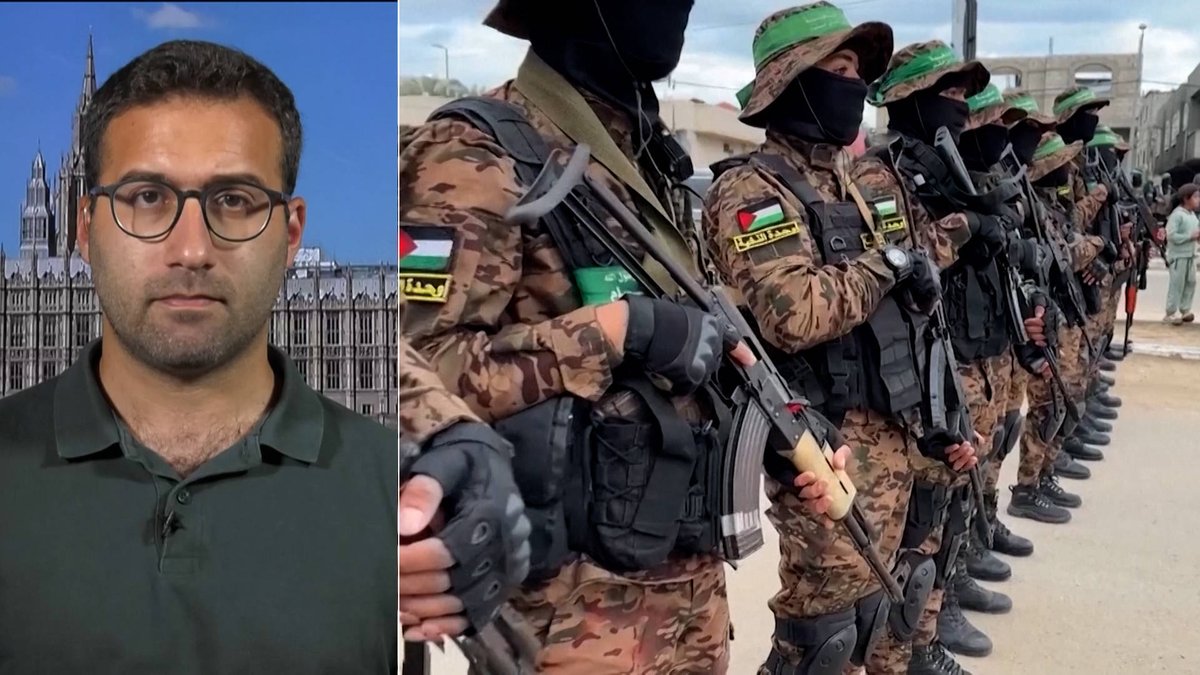
- Amjad Iraqisenior Israel-Palestine analyst at the International Crisis Group.
As part of the U.S.-backed “Board of Peace” 20-point plan to end Israel’s military assault on Gaza, Hamas is dissolving its civilian governing body in the Gaza Strip. Hamas’s head of administration, Mohammed al-Farra, resigned from his position on Monday. Hamas, which has controlled the territory for nearly two decades, has said that its ministries and staff will stay in place, and that it will still oversee security and policing in parts of Gaza left under its control.
The National Committee for the Administration of Gaza, NCAG, was formed in January 2026 and is meant to take transitional control. “In practice,” says Amjad Iraqi, senior Israel-Palestine analyst at the International Crisis Group, “Hamas is still the de facto governing authority on the Palestinian-populated side of Gaza. The NCAG, the Palestinian technocratic committee that’s supposed to take over those governing duties, is still basically stuck in Cairo and not allowed to enter into Gaza to assume those duties.”
Since the deal was signed in October, Israel has continued to uphold its blockade of Gaza, preventing people and aid from traveling through its heavily policed borders. It has also violated the deal’s ceasefire provisions on a near-daily basis, killing nearly 1,100 Palestinians, including women, children and other unarmed civilians. “Very little of this, if any, is actually being called out either by [Board of Peace High Representative for Gaza Nickolay Mladenov] or by the U.S. officials, and what they’re actually doing is allowing Israel to keep bending the terms of the ceasefire, if not openly violating it,” says Iraqi.
Transcript
AMY GOODMAN: This is Democracy Now!, democracynow.org. I’m Amy Goodman, with Juan González.
In other news from Gaza, Hamas has announced it will dissolve its civilian governing body in the Gaza Strip and will hand over power to an interim Palestinian administration overseen by President Trump’s Board of Peace. The establishment of the technocratic National Committee for the Administration of Gaza is part of the U.S.-backed 20-point plan to end Israel’s assault on Gaza. Israel agreed to the deal last October, has since violated it on a near-daily basis, killing nearly 1,100 Palestinians. Hamas has said its ministries and staff would stay in place, and it would still oversee security and policing in parts of Gaza left under its control following this U.S.-brokered truce.
For more on the significance of this political move in Gaza, we’re joined from London by Amjad Iraqi, senior Israel-Palestine analyst at the International Crisis Group.
Can you talk about the significance of what has taken place, Amjad? Mohammed al-Farra, the head of the Hamas administration, has resigned. What does this mean? What does all of this mean in this so-called technocratic group taking over of Palestinians from — is it the Palestinian Authority?
AMJAD IRAQI: Thanks for having me, Amy.
So, in practice, what this announcement does, at the moment does very little. In practice, Hamas is still the de facto governing authority on the Palestinian-populated side of Gaza. The NCAG, the Palestinian technocratic committee that’s supposed to take over those governing duties, is still basically stuck in Cairo and not allowed to enter into Gaza to assume those duties. And even if the NCAG did enter Gaza, the conditions are not ripe for any of these governing institutions to properly function. Israel is still maintaining a very serious blockade. It is not allowing sufficient aid to come in. As we heard from the previous segment, everything from hospitals to clinics to basic goods and services are still very short, and people are still suffering.
With that said, what this announcement does actually sends a very important political signal from Hamas to, first of all, the United States, as the head of the Board of Peace and as the main sort of broker of the ceasefire deal, to signal Hamas’s commitment to the ceasefire deal and trying to move it forward as much as possible. And tied with that is that the Hamas is trying to counter an Israeli claim that Hamas is not interested in seeing the truce upheld, that it is not interested in giving up power, even though Hamas officials have said for months now that they are ready to hand over all those duties. So far, we’ve seen a tepid response from the Board of Peace and from the United States, but we’ll probably see in the coming days whether this at least gesture to begin that process will actually unfold.
JUAN GONZÁLEZ: And, Amjad, no matter who administers Gaza, the key issue is who holds armed power in Gaza. Is there any indication that Hamas would disarm, something the ceasefire called for?
AMJAD IRAQI: So, for months, we’ve known that the regional mediators have actually come towards a sort of general framework that’s trying to divide the question of weapons into what they call heavy weapons versus light weapons. So, we’re talking about heavy weapons in terms of rockets, RPGs, and the smaller weapons being firearms that are quite pervasive across the strip. And the mediator saw this as a framework that can actually move the decommissioning or disarmament question forward. The problem is that Israel has actually maintained a very maximalist position, where even Prime Minister Netanyahu has said that, as far as he’s concerned, disarmament even goes as far as those firearms, as the AK-47. And so, you’re having a major clash with this.
And the Board of Peace, including Nickolay Mladenov, who is the, quote-unquote, “high representative for Gaza” under the Board of Peace, is supposed to be trying to sort of negotiate or mediate a process within those talks. But what we’ve actually heard is that Mladenov is mostly presenting a much more Israeli position about what that disarmament should look like, which Hamas and other Palestinian factions have pushed back on. So, the issue is not necessarily that there’s an absence of a framework, but there are still huge political divergences, and that the Board of Peace is still rather skewed in how it sees that disarmament question moving forward.
JUAN GONZÁLEZ: And how has the Board of Peace addressed the continued attacks, Israeli attacks, where more than a thousand Palestinians have been killed since the ceasefire was declared?
AMJAD IRAQI: This is clearly one of the blatant blind spots of the Board of Peace. I mean, the Palestinian authorities on the ground have recorded hundreds, if not thousands, of violations of the ceasefire terms. We’ve had over a thousand Palestinians killed since the truce was supposed to have gone into effect, and not to mention the fact that Israel, which was supposed to withdraw to a demarcation that would control about 53% of the Gaza Strip, has actually pushed that forward to between 65 and 70%. And Prime Minister Netanyahu himself has made it quite clear that he himself has been directing this. But we’ve also seen that movement precisely on the ground.
Very little of this, if any, is actually being called out either by Mr. Mladenov or by the U.S. officials. And what they’re actually doing is allowing Israel to keep bending the terms of the ceasefire, if not openly violating it, and such that they’re recarving the Gaza Strip in such a way as to entrench their presence rather than to withdraw. And so, the ceasefire terms itself, while it has certainly lessened the pace of the violence that we saw last year, the current conditions are — have now put about 2 million Palestinians in a humanitarian purgatory, where their fate and their lives, their access to food and to clean water and other basic needs are being held hostage at the moment to the question around disarmament and around guns in the Gaza Strip. And major pressure needs to be pushed onto Israel, onto the United States in order to flip those kind of priorities.
AMY GOODMAN: We’re going to have to leave it there, Amjad Iraqi, senior Israel-Palestine analyst at the International Crisis Group, speaking to us from London.
That does it for our show. I’ll be in Kansas City on July 17th and 18th. I’m Amy Goodman, with Juan González.
Media Options
Sentinel — Human
The text reads like a transcribed segment from an in-depth interview, characterized by expert commentary and contextual layering rather than synthetic summarization.