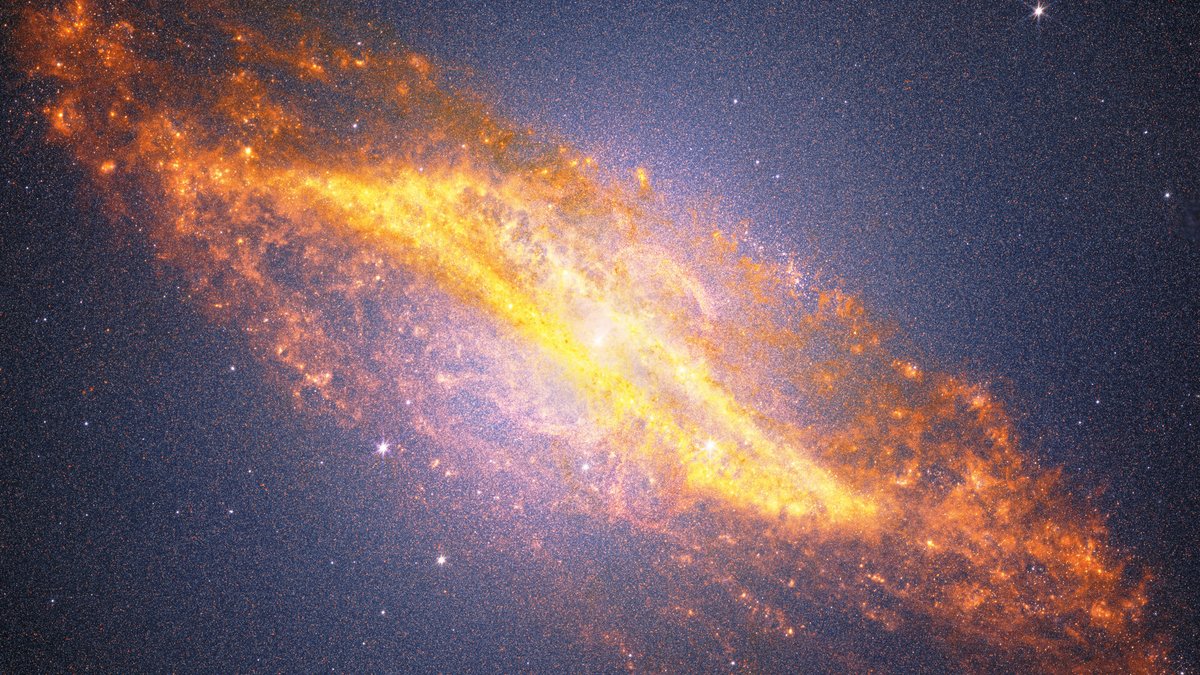
Agency Week in images: 06-10 July 2026 10/07/2026 285 views 6 likes ESA / About Us / Week in images Quasars discovered by Euclid The hidden flow The Copernicus Sentinel-2 mission captures Canada’s Great Bear Lake in striking colours. Sophie testing E4D's resistance training in space First light from the Hellenic Fire System MTG-I2 was taken out of its protective casing at Europe’s Spaceport in French Guiana Interferograms of Scar Inlet Ice Shelf in 1995 compared to 2026 Meet the team behind ESA’s AMAT (Advanced Mission Analysis Tools) project. Like Thank you for liking You have already liked this page, you can only like it once!
Facts Only
* Event dates: July 6-10, 2026.
* Topic: Week in images from an Agency Week.
* Content topics include: Quasars discovered by Euclid.
* Content topics include: Copernicus Sentinel-2 mission capturing Great Bear Lake.
* Content includes testing resistance training in space by Sophie.
* Content covers the exposure of the Hellenic Fire System MTG-I2.
* Content features interferograms of the Scar Inlet Ice Shelf from 1995 compared to 2026.
* Content mentions the team behind ESA’s AMAT project.
Executive Summary
The content features highlights from an Agency Week event spanning July 6-10, 2026. Featured topics include Quasars discovered by Euclid, the flow captured by the Copernicus Sentinel-2 mission over Great Bear Lake, testing resistance training in space by Sophie, the exposure of the Hellenic Fire System MTG-I2, and interferograms of the Scar Inlet Ice Shelf from 1995 compared to 2026. The event also involved acknowledging the team behind ESA’s AMAT project and providing a link to meet the team.
Full Take
The compilation mixes high-level astronomical and remote sensing achievements with personal scientific endeavors and institutional acknowledgments, suggesting a narrative built around the cutting edge of space science and data analysis. The juxtaposition of deep cosmological discoveries (Quasars), Earth observation (Sentinel-2), astrophysical modeling (interferograms), and human physical testing (resistance training) frames the work as an interconnected pursuit of understanding the universe across vast scales. The inclusion of specific mission names, like Euclid and Copernicus, establishes a foundation in verifiable scientific infrastructure. The pattern suggests an attempt to establish a holistic view of scientific progress by presenting disparate, yet related, high-impact data points. The underlying implication is that complex realities—from cosmic flows to terrestrial ice shelf changes—can be mapped through advanced technological systems, reinforcing the value of cross-disciplinary data synthesis for advancing knowledge. This approach positions the pursuit of truth as an expansive, tangible process involving both large instruments and individual contributions.
Sentinel — Human
Confidence
This text appears to be a collection of factual image captions and links related to space and Earth observation missions, exhibiting the style of standard press communication rather than synthetic argumentation.
Signals Detected
low severity: Sentence structure is highly varied (short captions vs. longer descriptive lines) typical of press releases or image captions.
low severity: The text functions as a collection of disparate, factual headlines with no overarching argumentative flow.
low severity: The text is fragmented and heavily reliant on linking specific, verifiable project names (Euclid, Copernicus Sentinel-2, MTG-I2) without presenting a cohesive argument.
low severity: The content relies entirely on recognizable institutional references (ESA, specific missions) suggesting direct sourcing rather than generative fabrication.
Human Indicators
The presence of specific, verifiable scientific mission names and dates strongly suggests the text is derived directly from official agency releases or press material.