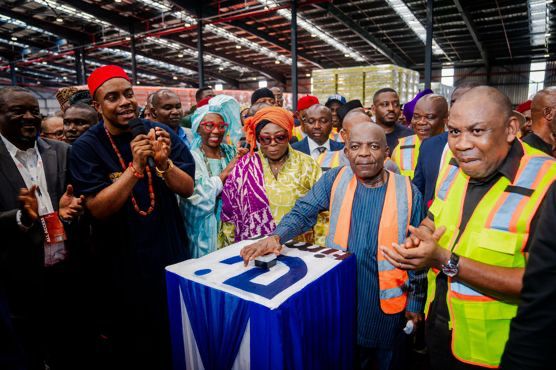
Ultimum Limited, a fast-growing food and beverage manufacturing company has commissioned its state-of-the-art beverage manufacturing plant in Aba, Abia State, marking a major step for the company and the Kadji Group.
Located in the Osisioma Industrial Layout, the new plant produces the high-quality variants of the Razzl brand of carbonated soft drinks (CSD) – Razzl Pamplemousse (a unique and special grapefruit flavour), Razzl Cola, Razzl Orange, and Razzl Lemon.
The facility will create jobs, support local businesses, and strengthen supply chains across South-East and South-South regions of Nigeria, with plans to expand distribution nationwide in the near future.
Commissioning the plant, the Executive Governor of Abia State, Dr Alex Chioma Otti, described the investment as a clear signal of economic revival and growing investor confidence in Abia State.
|
|
|---|
“Aba is alive again!, the Executive Governor said. “What we are witnessing here today is not just the opening of a factory, but the return of belief in our economy. This investment confirms that we are creating the right conditions for businesses to grow, thrive, and succeed.”
“Investors will always go where there is clarity, stability, and opportunity. Our focus has been to build that environment, and today’s commissioning shows that the strategy is working,” he added.
Chairman of Ultimum Limited and representative of the investor group, Mr Whalen Kadji, emphasized the company’s long-term commitment to Aba and Nigeria. He stated, “We did not come here by chance. We came because of the energy and entrepreneurial spirit of Aba. This city has always been a center of enterprise, and we believe strongly in its future. This plant is more than an investment in beverages; it is an investment in people, in jobs, and in the growth of local industry. We are here for the long term, and this is just the beginning of what we intend to build here.”
Managing Director of Ultimum Limited, Mr Austin Ufomba, described the plant as a bold step in the company’s journey.
“Ultimum Limited started with a simple idea, to build world-class products right here in Africa. Today, that idea has come to life in a very real way. This plant is not just infrastructure, it is a platform for innovation, for job creation, and for excellence. It sends a strong message that Nigeria can produce at global standards.”
He added that “Beyond the products, we are creating opportunities for young people, supporting communities, and contributing to the economic growth of Nigeria and the African continent. That is what this investment truly represents.”
The commissioning of the Ultimum Limited plant proves that government reforms and private investment can transform a region. Improved infrastructure is positioning Aba as a leading destination for large-scale industry.
This milestone expands our footprint and brings our ‘Refreshing Nigeria’ mission to life. Through bold flavours, affordability, and deep market access, we are ready to compete at the highest level of Nigeria’s beverage industry.
Facts Only
Ultimum Limited has commissioned a beverage manufacturing plant in Aba, Abia State, Nigeria.
The plant is located in the Osisioma Industrial Layout.
The facility produces four variants of the Razzl carbonated soft drink brand: Razzl Pamplemousse, Razzl Cola, Razzl Orange, and Razzl Lemon.
The plant aims to create jobs, support local businesses, and strengthen supply chains in Nigeria’s South-East and South-South regions.
Plans include expanding distribution nationwide in the future.
The commissioning event was attended by Abia State Governor Dr. Alex Chioma Otti.
Governor Otti described the investment as a signal of economic revival and growing investor confidence in Abia State.
Chairman of Ultimum Limited, Whalen Kadji, stated the company’s long-term commitment to Aba and Nigeria.
Managing Director Austin Ufomba described the plant as a platform for innovation, job creation, and excellence.
The plant is part of Ultimum Limited’s mission to produce world-class products in Africa.
The project is framed as contributing to Nigeria’s economic growth and the African continent.
The facility is positioned as a step toward competing in Nigeria’s beverage industry at global standards.
Executive Summary
Ultimum Limited, a food and beverage manufacturer, has launched a new beverage production plant in Aba, Abia State, Nigeria. The facility, located in the Osisioma Industrial Layout, will produce four variants of the Razzl carbonated soft drink brand: Pamplemousse, Cola, Orange, and Lemon. The plant is expected to generate employment, support local businesses, and strengthen supply chains in Nigeria’s South-East and South-South regions, with plans for nationwide distribution. The commissioning was attended by Abia State Governor Dr. Alex Chioma Otti, who framed the investment as evidence of economic revival and growing investor confidence in the state. Ultimum Limited’s leadership, including Chairman Whalen Kadji and Managing Director Austin Ufomba, emphasized the company’s long-term commitment to Aba, citing its entrepreneurial spirit and potential for industrial growth. The project aligns with broader efforts to position Aba as a hub for large-scale manufacturing, supported by government reforms and private sector collaboration.
The narrative highlights a convergence of economic optimism, regional development, and corporate expansion. While the immediate focus is on job creation and local industry support, the broader implications include Nigeria’s capacity to compete in the beverage sector at global standards. The perspectives presented—from government, corporate leadership, and community stakeholders—collectively underscore a shared vision of economic revitalization, though the long-term impact remains to be seen.
Full Take
The strongest version of this narrative is one of economic renewal and strategic investment. The commissioning of Ultimum Limited’s plant in Aba is presented as a tangible outcome of government reforms and private sector confidence, with clear benefits for local employment, supply chains, and regional development. The perspectives from Governor Otti, corporate leadership, and the company’s mission statement collectively reinforce a story of progress, positioning Aba as a resurgent industrial hub. The emphasis on long-term commitment and global standards lends credibility to the project’s ambitions.
However, the narrative leans heavily on optimism and forward-looking statements, which are common in corporate and political communications. The focus on job creation and economic growth is framed as a collective win, but the specifics of how these benefits will materialize—such as the number of jobs created or the exact impact on local businesses—are not detailed. This aligns with a pattern of **ARC-0024 Ambiguity**, where broad claims of positive impact are made without concrete metrics to hold stakeholders accountable. Additionally, the framing of Aba’s revival as a direct result of current governance could be seen as **ARC-0043 Motte-and-Bailey**, where the broader claim of economic transformation is supported by a single, albeit significant, investment.
The root cause of this narrative is the paradigm of economic development through private investment, a model often championed by governments seeking to attract capital. The unstated assumption is that such investments will inherently trickle down to benefit the broader population, a claim that requires scrutiny over time. Historically, industrial projects in emerging markets have had mixed outcomes, with benefits sometimes concentrated among elites or foreign investors while local communities see limited gains.
For human agency and dignity, the implications are dual-edged. On one hand, the plant offers employment and economic opportunities, which can empower individuals and communities. On the other, the lack of detailed commitments—such as wage standards, environmental safeguards, or community reinvestment—leaves room for exploitation or unmet expectations. Second-order consequences could include increased competition in the beverage sector, potential strain on local resources, or shifts in regional economic dynamics.
Bridge questions to consider: What specific metrics will measure the plant’s success in job creation and local economic impact? How will the benefits be distributed among stakeholders, particularly marginalized groups? What safeguards are in place to ensure the project’s long-term sustainability beyond initial investments?
Counterstrike scan: If this were part of a coordinated influence campaign, the playbook would involve amplifying narratives of economic revival to bolster political legitimacy, using corporate investment as a proxy for broader progress. The actual content aligns with this pattern to some extent, as it frames a single investment as evidence of systemic improvement. However, the presence of multiple stakeholders and concrete details about the plant’s operations mitigates concerns of outright manipulation. The narrative is more likely a genuine reflection of optimism than a calculated disinformation effort.
Sentinel — Human
The article appears to be written by a human journalist due to its emotional and idiosyncratic emphasis, personal voice, and stylistic fingerprint. Additionally, there are no clear signs of mechanical repetition or argumentative skeleton matching, which are common in synthetic content.