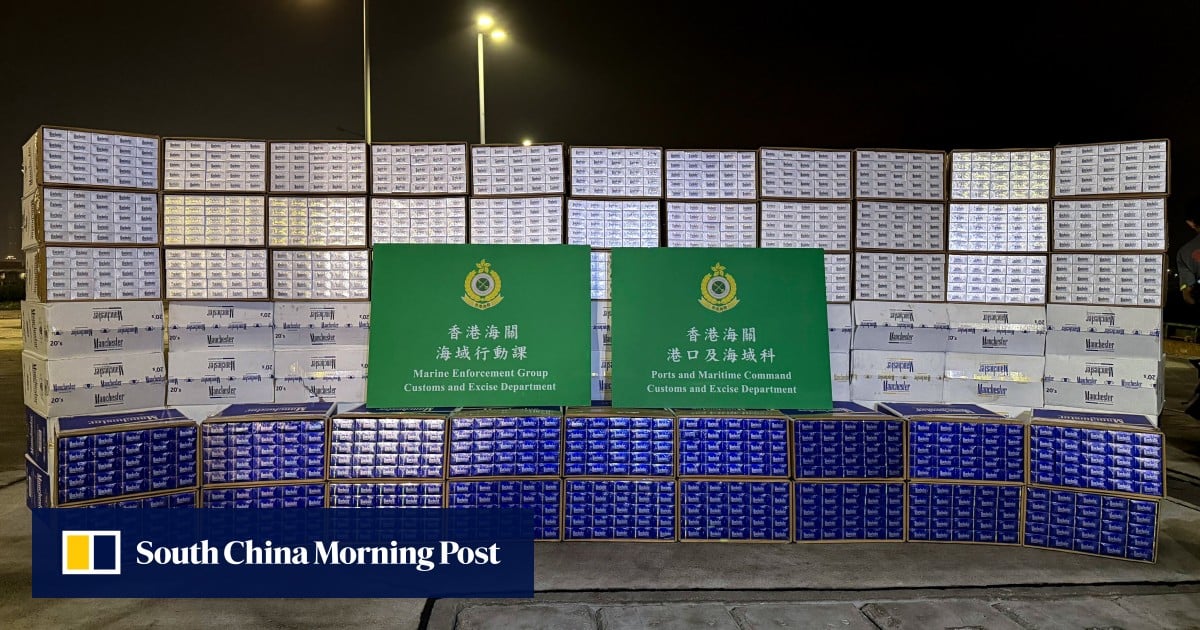
Customs officers, marine police and mainland law enforcement agencies intercept river trade vessel in waters off Waglan Island, southeast of Stanley
Hong Kong customs has seized about 20 million illicit cigarettes with an estimated market value of HK$92 million (US$11.46 million) from a cargo vessel during a joint anti-smuggling operation with authorities in mainland China.
The cigarettes would have generated about HK$68 million in tax revenue, authorities said on Saturday.
Officers from the Customs and Excise Department, marine police and mainland law enforcement agencies conducted the operation in the early hours of Friday based on risk assessment and intelligence analysis.
During the operation, they intercepted a river trade vessel in the waters off Waglan Island, 5.4 nautical miles southeast of Stanley.
Officers seized the cigarettes from two 45-foot containers on board.
The haul was estimated to be worth HK$92 million, with a duty potential of about HK$68 million.
Facts Only
Hong Kong customs, marine police, and mainland Chinese law enforcement conducted a joint anti-smuggling operation.
The operation occurred in the early hours of Friday.
Authorities intercepted a river trade vessel in waters off Waglan Island, 5.4 nautical miles southeast of Stanley.
Two 45-foot containers on board the vessel were found to contain approximately 20 million illicit cigarettes.
The estimated market value of the seized cigarettes is HK$92 million (US$11.46 million).
The duty potential of the cigarettes is about HK$68 million.
Four individuals were held in connection with the seizure.
The operation was based on risk assessment and intelligence analysis.
Executive Summary
Hong Kong customs, in collaboration with marine police and mainland Chinese law enforcement, intercepted a river trade vessel carrying approximately 20 million illicit cigarettes. The operation took place in the early hours of Friday near Waglan Island, southeast of Stanley. The seized cigarettes, found in two 45-foot containers, had an estimated market value of HK$92 million (US$11.46 million) and would have generated about HK$68 million in tax revenue. The joint effort was based on risk assessment and intelligence analysis, highlighting ongoing cross-border cooperation to combat smuggling. The scale of the seizure underscores the persistent challenge of illicit trade in the region, with significant financial implications for tax authorities.
While the operation demonstrates effective inter-agency coordination, the details of the vessel's origin, intended destination, or the identities of those detained remain undisclosed. The seizure reflects broader enforcement trends targeting smuggling routes in Hong Kong's territorial waters, where illicit goods often transit between mainland China and other markets. The financial stakes—both in lost revenue and the black-market value of the goods—suggest organized criminal involvement, though no further context about the suspects or broader networks was provided.
Full Take
This seizure of illicit cigarettes in Hong Kong’s waters is a textbook example of cross-border enforcement targeting organized smuggling networks. The operation’s success—yielding HK$92 million in contraband—highlights both the scale of the illicit trade and the financial incentives driving it. The duty potential of HK$68 million underscores why governments prioritize such crackdowns: tax evasion on this scale directly undermines public revenue. Yet the narrative also invites scrutiny of the broader ecosystem. Who benefits from the black market? Are these cigarettes destined for local consumption, or are they part of a larger regional distribution chain? The lack of detail about the suspects or the vessel’s origin leaves critical gaps, raising questions about whether this is an isolated incident or a symptom of systemic enforcement challenges.
The strongest version of this narrative is straightforward: law enforcement disrupted a major smuggling attempt, protecting tax revenue and public health (given the unregulated nature of illicit tobacco). However, the framing leans heavily on the financial impact, which could subtly reinforce a paradigm where enforcement is justified primarily by fiscal losses rather than broader societal harms. This aligns with a common pattern in anti-smuggling reporting, where the focus on monetary value risks overshadowing other dimensions, such as the role of corruption or the demand-side drivers of illicit trade.
Root cause assumptions here include the idea that smuggling is primarily a supply-side problem solvable through interdiction. But history shows that without addressing demand or the economic conditions fueling black markets, seizures alone may only displace rather than eliminate the trade. The implications for human agency are mixed: while enforcement protects legitimate revenue streams, it also risks perpetuating a cat-and-mouse dynamic that empowers more sophisticated criminal networks over time.
Bridge questions: What would a demand-side strategy to reduce illicit cigarette consumption look like? How might corruption within enforcement agencies or supply chains enable such large-scale smuggling? If the financial incentives for smugglers remain unchanged, can interdiction alone be sustainable?
Counterstrike scan: If this were part of a coordinated influence campaign, the playbook might emphasize the financial losses to stoke public support for harsher enforcement while downplaying systemic factors like demand or corruption. However, the actual content does not exhibit this pattern—it presents a factual account without overt manipulation. The focus on monetary value is standard in such reports, but it doesn’t rise to the level of a structured influence operation.
Patterns detected: none
Sentinel — Human
The analyzed text exhibits signs consistent with human authorship, such as varied sentence length, idiosyncratic emphasis, and a personal voice. However, there's still some uncertainty, as the article follows a structured format and contains no overtly unusual language or phrasing.