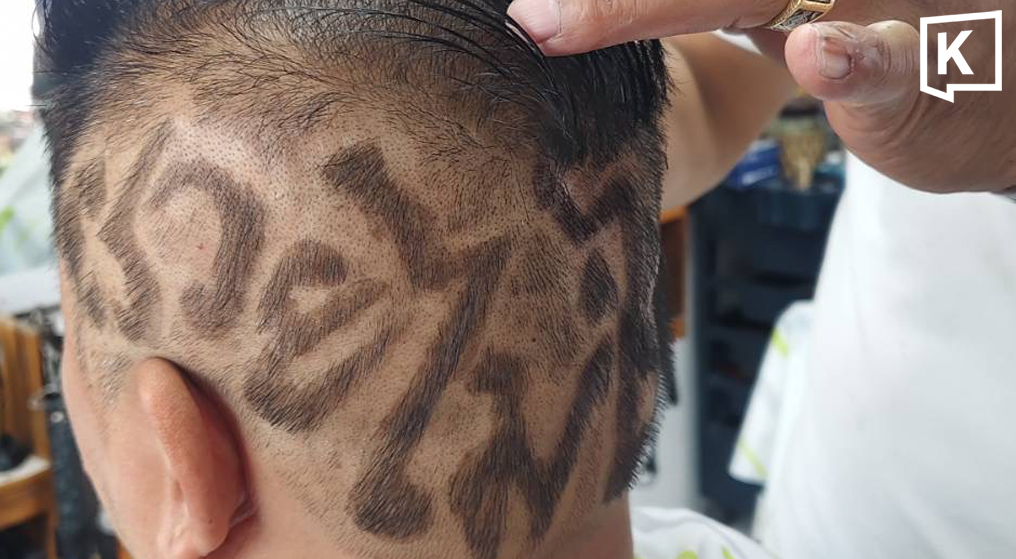
AYUTTHAYA — 27 March 2026, A barber shop in Ayutthaya has gone viral after carving the phrase “too rich to handle” into a customer’s hair, following a popular catchphrase associated with Thailand’s prime minister.
Reporters visited “Hai Huang Barber” at Khok Chang market in tambon Uthai, Uthai district, where a regular customer from Ang Thong province had travelled specifically to have the slogan shaved onto his head.
Shop owner Wongwiset Menklai, 53, said the customer had booked an appointment earlier in the day and clearly requested the phrase, which has recently gained traction online.
“The customer said he is a fan of the prime minister and really likes the phrase, so he wanted it on his head as a symbolic expression,” Wongwiset said, adding that the customer was pleased with the result.
He noted that while the idea may seem unusual, it reflects creativity and current social trends, particularly as the phrase has been widely discussed amid rising fuel prices.
A video of the haircut has since circulated widely on social media, drawing large numbers of views and comments and bringing attention to the barber shop.
Facts Only
Who: Wongwiset Menklai (shop owner), customer from Ang Thong province, Thailand's prime minister
What: Shaving a political slogan onto a customer's hair; gaining viral attention on social media
When: 27 March 2026
Where: "Hai Huang Barber" at Khok Chang market, Uthai district, Ayutthaya, Thailand
Executive Summary
Full Take
As this incident illustrates, political discourse can manifest in unexpected ways. The barber shop's decision to carve a slogan into a customer's hair reflects a growing trend of using personal expression as a means of political affiliation, particularly during times of economic strain such as rising fuel prices.
This event could be analyzed through the lens of ARC-0024 Ambiguity, as the slogan "too rich to handle" has various interpretations beyond just supporting the prime minister. It raises questions about the role of popular catchphrases in political discourse and their potential for misinterpretation or appropriation.
The viral nature of this incident also highlights the power of social media in shaping public opinion, particularly when it comes to content that taps into current events and emotional responses. It underscores the need for critical thinking when consuming information online, especially politically charged content.
Questions to consider: What role does personal expression play in political affiliation? How can we navigate ambiguous slogans or phrases in political discourse? What are the implications of social media's influence on public opinion, and how can we promote critical thinking in this context?