Trump-Xi summit in Beijing: What’s at stake
-
Click here to listen to this article - Share via
- The state visit is the first by an American president to China since President Trump went in 2017.
- Trump downplayed recent tensions between the two countries, by calling Chinese President Xi Jinping a ‘wonderful guy.’
BEIJING — President Trump’s first visit to China in nine years is a high-stakes trip reflecting the rivalry and mutual dependence of two superpowers hoping to avoid a collision course — even if Trump cast it more as a meeting between close friends and business partners.
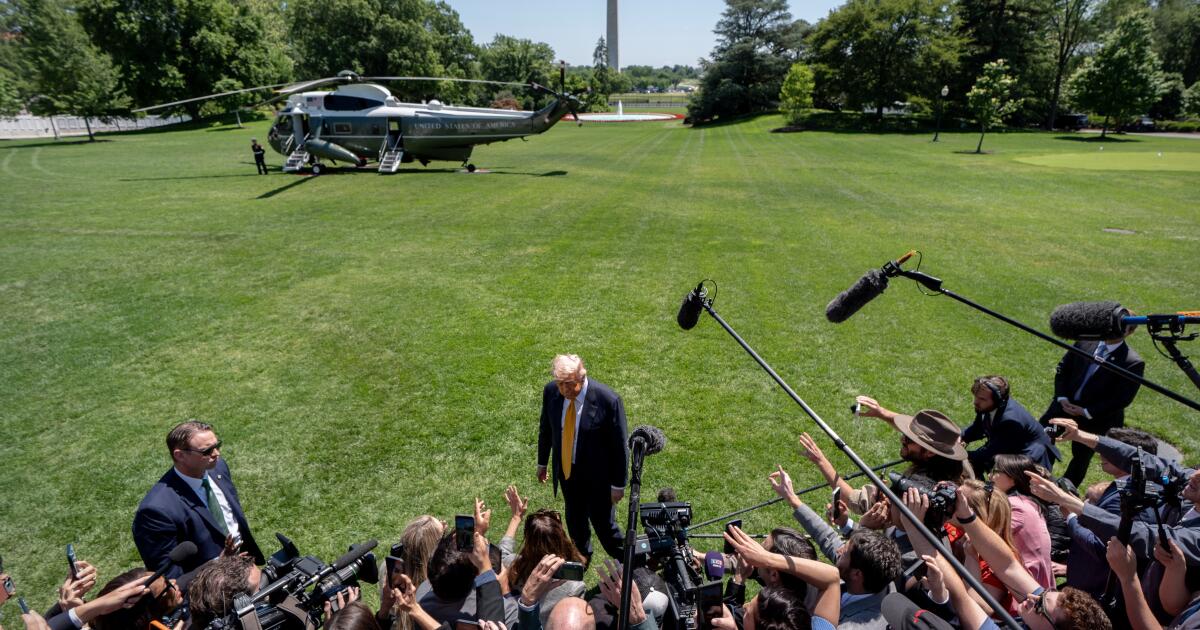
Speaking to reporters before departing Washington on Tuesday, Trump downplayed tensions between the two countries, including on trade, calling Chinese President Xi Jinping a “wonderful guy” and a friend and saying the working relationship between the two countries is “very good.”
Trump acknowledged China’s might — saying that the Asian nation and the United States are clearly the world’s two superpowers — and that the focus of the meeting “more than anything else will be trade.”
“We’re gonna have a great relationship for many, many decades to come,” Trump said. “My relationship with President Xi is a fantastic one. We’ve always gotten along, and we’re doing very well with China, and working with China’s been very good — so we look forward to it.”
Trump also downplayed the importance of the meeting for the war in Iran. He said Xi might be able to help the United States reach a deal to end the war, but that he doesn’t need it, “because we have Iran very much under control.”
The state visit marks the first by an American president to China since Trump’s trip here in 2017, only months into his first term. President Biden never came, becoming the first to not do so since diplomatic ties were normalized, an absence that underscored simmering distrust and animosity between Washington and Beijing that has only worsened since.
- Share via
In the capital, security forces sealed off an area around the Temple of Heaven roughly the size of 400 football fields ahead of the U.S. president’s visit, anticipating a stop at the monument to imperial China and Confucian thought.
On his previous trip, Trump received the rare honor of a state banquet inside the Forbidden City. This time he is expected to dine at the Great Hall of the People, an imposing structure off Tiananmen Square that hosts high-level gatherings of the Chinese Communist Party.
Trump’s positive spin on Tuesday aside, his agenda for meetings beginning Thursday with Xi highlights the vast array of American interests that depend on — and often clash with — Beijing’s policies.
After launching a trade war against China at the beginning of his second term, Trump now comes hat in hand requesting an extension of a tariff truce, fearful Xi might follow through on his threats to halt the export of rare earth minerals to the United States that are vital to the manufacturing of American goods, including everyday consumer equipment and advanced defense technologies.
President Trump arrives in Beijing this week for talks with a Chinese government that is confident as ever in its ascendance on the world stage.
His visit comes as a ceasefire in the war with Iran, brokered with help from Beijing, is on “massive life support,” according to the president. Trump is expected to appeal to Xi for assistance in getting Tehran to restore free and open passage through the Strait of Hormuz.
And in a dramatic reversal, the Trump administration has begun discussions with the Chinese about establishing a channel of communication on artificial intelligence, alarmed that recent technological leaps could pose global risks.
All of these requests are expected to come at a cost.
In earlier remarks before the trip, Trump said he expected U.S. arms sale to Taiwan — including one already approved by Congress — to become a chip in the negotiations.
“I’m going to have that discussion with President Xi,” Trump said. “President Xi would like us not to, and I’ll have that discussion. That’s one of the many things I’ll be talking about.”
The notion that U.S. support for Taiwan is a negotiable matter is sure to rattle America’s allies throughout the region, from Japan to the Philippines, which are reliant on U.S. security guarantees amid China’s Indo-Pacific military aggression.
Despite geopolitical tensions, both sides are expected to announce business and investment agreements, underscoring how deeply intertwined the world’s two largest economies remain.
A Trump administration once eager to gun for technological supremacy is now, for the first time, reckoning with the power AI could unleash if left unchecked.
China plans on making a significant purchase of Boeing aircraft, and the president has brought 17 American corporate leaders with him on the trip to discuss additional opportunities, including Apple’s Tim Cook, BlackRock’s Larry Fink, Meta’s Dina Powell McCormick and Tesla’s Elon Musk.
The two leaders are expected to have other opportunities to talk in person throughout the coming year, including potential meetings at the Group of 20 summit in Florida, the APEC summit in Shenzhen, China, and a state visit in Washington that Trump said he will host for Xi at some point in the coming months.
Trump on Tuesday said Xi’s visit will be “toward the end of the year” and “exciting.” He also lamented that the ballroom he is building on the White House grounds — on the site of the historic East Wing he demolished — won’t be ready in time.
Jennifer Hong, senior director at the Institute for Indo-Pacific Security, said her concern is that the state visit becomes part of a “tyranny of calendaring,” where the Chinese agree to schedule more high-level meetings sought by Trump that put off vital U.S. decision-making.
“I do think this trip is necessary for the U.S. government — I think that there are things that are on hold because he doesn’t want to rock the boat,” Hong said, noting the Trump administration’s delay in arms sales to Taiwan, despite the packages already having received congressional approval.
“I’m just worried this will be a stringing along of promises, or maybe some reprieve for a year or so,” she added, “as we continue to handicap ourselves on national security matters for the sake of more meetings.”
Trump on Tuesday repeatedly dismissed China’s potential help in resolving the war in Iran, which has driven up prices domestically and around the world as oil shipments through the strategic Strait of Hormuz have been badly disrupted and U.S. efforts to fully reopen the channel have so far been unsuccessful.
“I don’t think we need any help with Iran, to be honest with you,” Trump said. “They’re defeated militarily.”
Trump also said the financial pain many Americans are feeling from the war, including at the gas pump, simply isn’t a factor — “not even a little bit,” he said — in his ongoing negotiations with Iran.
“The only thing that matters when I’m talking about Iran [is that] they can’t have a nuclear weapon,” he said. “I don’t think about Americans’ financial situation. I don’t think about anybody.”
Facts Only
President Trump is visiting China for the first time in nine years.
The visit is the first by a U.S. president to China since Trump’s 2017 trip.
Trump described Chinese President Xi Jinping as a “wonderful guy” and a friend.
The focus of the meeting is primarily on trade, with Trump acknowledging China and the U.S. as the world’s two superpowers.
Trump downplayed tensions, including the war in Iran, stating the U.S. has Iran “very much under control.”
Security forces in Beijing sealed off an area around the Temple of Heaven ahead of Trump’s visit.
Trump is expected to dine at the Great Hall of the People, a key venue for Chinese Communist Party gatherings.
The U.S. is seeking an extension of a tariff truce with China, fearing potential halts to rare earth mineral exports.
Trump is appealing to Xi for assistance in restoring free passage through the Strait of Hormuz.
The U.S. and China are discussing establishing a communication channel on artificial intelligence.
Trump indicated that U.S. arms sales to Taiwan could be a negotiating point with China.
China plans to purchase Boeing aircraft, and Trump is accompanied by 17 American corporate leaders.
Future meetings between Trump and Xi are expected, including at the G20 summit and a state visit to Washington.
Analysts express concern that the visit may delay critical U.S. decisions, particularly on Taiwan.
Executive Summary
President Trump is making his first visit to China in nine years, marking a significant diplomatic engagement between the two superpowers. The trip, framed by Trump as a meeting between close friends and business partners, focuses heavily on trade and geopolitical tensions, including the war in Iran and Taiwan. Trump has downplayed recent tensions, emphasizing his personal relationship with Chinese President Xi Jinping and describing their working relationship as "very good." The visit includes high-level meetings, business agreements, and discussions on artificial intelligence, rare earth minerals, and regional security. Trump is accompanied by 17 American corporate leaders, signaling efforts to strengthen economic ties. However, the trip also highlights underlying tensions, such as China’s military aggression in the Indo-Pacific and the U.S. delay in arms sales to Taiwan. Both sides are expected to announce business deals, underscoring their deep economic interdependence despite geopolitical rivalries.
The visit comes at a critical juncture, with a ceasefire in the Iran war on "massive life support" and the U.S. seeking China’s assistance in restoring stability in the Strait of Hormuz. Trump has dismissed the need for China’s help, claiming the U.S. has Iran "very much under control," but the war’s economic impact, including rising gas prices, remains a domestic concern. The trip also reflects a shift in the U.S. approach to China, with the Trump administration now engaging in discussions about AI risks and seeking extensions on tariff truces. While Trump has framed the visit as a success, analysts warn that the focus on high-level meetings could delay critical U.S. decisions, particularly on Taiwan, as China seeks to leverage its influence.
Full Take
The narrative surrounding Trump’s visit to China presents a carefully curated balance of diplomacy and tension, with Trump framing the relationship as one of friendship and mutual benefit while underlying geopolitical rivalries persist. The strongest version of this narrative highlights the necessity of engagement between the two superpowers, particularly on trade and regional stability, and acknowledges the personal rapport between Trump and Xi as a stabilizing factor. However, the framing also risks downplaying the structural conflicts—such as China’s military aggression and the U.S. delay in arms sales to Taiwan—that could undermine long-term stability.
Patterns detected in the coverage include a potential **ARC-0024 Ambiguity** in Trump’s dismissal of China’s role in the Iran war, where the claim that the U.S. has Iran “under control” contrasts with the economic disruptions caused by the conflict. There’s also a **ARC-0043 Motte-and-Bailey** dynamic in the portrayal of U.S.-China relations, where the public emphasis on friendship and cooperation (the motte) masks the underlying strategic competition (the bailey). The article’s focus on high-level meetings and business deals, while important, may obscure the deeper systemic tensions, such as China’s leverage over rare earth minerals and the U.S. hesitation on Taiwan.
The root cause of this narrative is the paradox of interdependence and rivalry: both nations rely on each other economically but are locked in a struggle for global influence. The implications for human agency are significant, as the outcomes of these negotiations could shape everything from global trade to regional security. Who benefits? Corporate leaders and political elites on both sides stand to gain from continued economic ties, while ordinary citizens—particularly those affected by the Iran war’s economic fallout—may bear the costs. Second-order consequences could include further delays in U.S. support for Taiwan, emboldening China’s regional ambitions, or a breakdown in tariff negotiations that disrupts global supply chains.
Bridge questions to consider: How might the U.S. reconcile its economic dependence on China with its strategic need to counter China’s military expansion? What would it take for the U.S. to shift from personal diplomacy to a more structured, long-term strategy in dealing with China? And how might the focus on high-level meetings distract from the broader geopolitical shifts underway?
Counterstrike scan: If this narrative were part of a coordinated influence campaign, the playbook would likely emphasize the benefits of U.S.-China cooperation while minimizing the risks of strategic competition. The actual content aligns with this pattern to some extent, particularly in Trump’s framing of the relationship as one of friendship. However, the inclusion of critical perspectives—such as the concerns about Taiwan and the economic impact of the Iran war—suggests a more balanced approach, reducing the likelihood of a full-scale manipulation effort.
Sentinel — Human
The text demonstrates the structure and tone of human geopolitical reporting, successfully synthesizing multiple viewpoints while maintaining a clear, if critical, focus on the underlying tensions.