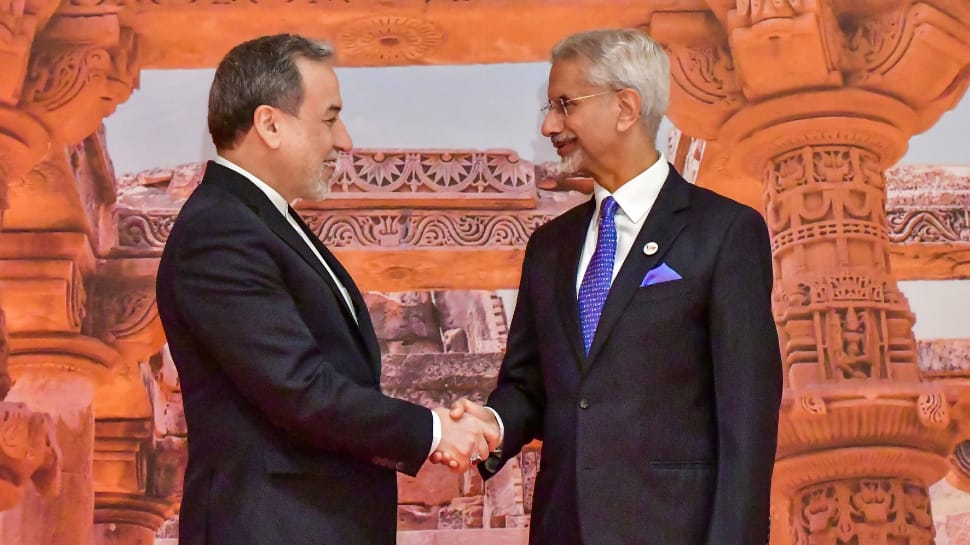
From the BRICS+ Foreign Minsiter's meet in New Delhi, Iranian FM Abbas Araghchi condemned what he described as repeated aggression, by the west, calling it a decline of Imperial power.'
Trending Photos
In a fiery and defiant address at the 18th BRICS Foreign Ministers' Meeting in New Delhi on Thursday, Iranian Foreign Minister Seyed Abbas Araghchi delivered a sharp critique of the United States, calling it an "imperial power in decline" desperately clinging to hegemony amid shifting global realities.
Speaking at the gathering hosted by India's External Affairs Minister S Jaishankar, Araghchi positioned Iran's recent emblematic of a broader struggle by the Global South against Western dominance. His remarks came against the backdrop of ongoing tensions in West Asia, including US-Israel war with Iran and a fragile ceasefire.
Araghchi condemned what he described as repeated aggression, by the west, "As you have all witnessed, my country has within the span of less than a year twice been subjected to brutal and unlawful aggression by the United States and Israel. The attacks on my people have been justified with false claims that run counter to the informed assessments of the International Atomic Energy Agency and even America's own intelligence community, he said.
He portrayed Iran as a victim rather than an aggressor, saying, "The truth is that Iran, like many other independent nations, is the victim of illegal expansionism and warmongering. These are ugly things which have no place in today’s world. ... regional instability is a lose-lose proposition for all sides, including the aggressors."
Highlighting Iranian resilience, he invoked the sacrifices of the Iranian people. "In the face of horrific violence, the Iranian people have firmly and proudly stood up for themselves. Did we retreat from our ideal of independence? Did we surrender to the will and whims of imperial power? The answer is clear: we did not, and never will," added Araghchi.
He emphasised Iran's dual commitment to strength and diplomacy, "By now, it ought to be clear that Iran is unbreakable and only emerges stronger and more united when under pressure. While ready to fight with everything we have in defense of our freedom and our soil, we are equally ready to pursue and defend diplomacy. There is no such thing as a military solution to anything related to Iran. We Iranians never bow to any pressure or threat, but we reciprocate the language of respect.... my people are peace-loving and do not seek war. We are not the aggressor in this sordid situation, but the aggrieved," added Iranian FM.
Also Read: Fueling the future: Why the BRICS Delhi meet is a high-stakes game for global oil
In Delhi, Iran's FM Araghchi tells BRICS ministers, "we are unbreakable" after 40 day war & a fragile ceasefire. Slamming US, says,"imperial power in decline wants to turn back the clock"
Full address at Delhi BRICS FMs meeting pic.twitter.com/QrSsq0zVsu — Sidhant Sibal (@sidhant) May 14, 2026
Attack on US 'Imperial Power' and call for Global south architect
In blunt words, Araghchi targeted the perceived decline of US influence, he said, "Over the past year... this platform [BRICS] symbolises the emergence of a new global order—an order in which the Global South is a primary architect of the world’s future. What was once a lofty aspiration is now a reality. But it is a fragile reality. Imperial power in decline wants to turn back the clock, and is desperately lashing out on its way down."
He linked Iran's resistance to the collective interests of BRICS nations saying, "This all matters to the BRICS+ group of countries because the battle Iran has fought is in defense of all of us—of the new world that we are building together. Our brave soldiers have given their lives to resist Western hegemony and the sense of impunity that the U.S believes it is entitled to."
He highlighted that resisting U.S. bullying is a shared struggle for most countries present. He urged member nations to unite and consign such coercive practices to the dustbin of history.
Araghchi warned of the dangers posed by a declining empire, "History has shown that Empires in decline will stop at nothing to arrest their inevitable fates. A wounded animal will desperately claw and roar on its way down."
He accused the West of enabling atrocities through impunity, "The putting away of all pretenses is apparent in the horrors that the West has shamelessly underwritten or outright pursued in the Global South... horrific genocide, shocking violations of the sovereignty of nations, and outright state piracy on the high seas... That false sense of entitlement must be shattered, by all of us."
Also Read: From Iran to UAE: Leaders from 10 Countries Arrive in India Ahead of BRICS Foreign Ministers' Meet
Calls to Action for BRICS
Araghchi called on BRICS+ nations and the wider international community to take firm action against what he described as Western violations.
"Iran therefore calls upon BRICS member states and all responsible members of the international community to explicitly condemn violations of international law by the United States and Israel, including their illegal aggression against Iran; prevent the politicization of international institutions; and take concrete action to halt warmongering and to bring an end to the impunity of those who violate the UN Charter, said Iranian FM.
Emphasising BRICS’ role in building a new global order, Araghchi said, "We believe that BRICS can and must become one of the principal pillars in shaping a more just, balanced, and humane global order; an order in which might can never make right. Nations which stand up for their dignity and independence may endure hardship, but they will never be defeated."
The address highlights the complexities facing the BRICS bloc as it seeks to address regional conflicts while managing diverse economic and geopolitical interests in its push toward a more multipolar world.
A BRICS finds itself in a delicate position, carefully balancing relations with various partners. Araghchi’s strong remarks are expected to stimulate discussions on the scope and pace of collective action within the BRICS framework on such sensitive issues.
Stay informed on all the latest news, real-time breaking news updates, and follow all the important headlines in india news andworld News on Zee News.
Live Tv
Facts Only
Iranian Foreign Minister Seyed Abbas Araghchi spoke at the 18th BRICS Foreign Ministers' Meeting in New Delhi on May 14, 2026.
Araghchi criticized the United States, calling it an "imperial power in decline."
He accused the U.S. and Israel of repeated aggression against Iran, citing two instances of unlawful attacks within a year.
Araghchi claimed these attacks were justified with false claims contradicted by the International Atomic Energy Agency and U.S. intelligence.
He positioned Iran as a victim of illegal expansionism and warmongering, emphasizing its resilience and refusal to surrender to imperial power.
Araghchi called on BRICS nations to condemn U.S. and Israeli violations of international law and to prevent the politicization of international institutions.
He urged BRICS to become a pillar in shaping a more just and balanced global order.
The meeting was hosted by India's External Affairs Minister S Jaishankar.
Araghchi linked Iran's resistance to the collective interests of BRICS nations, framing it as a defense against Western hegemony.
He warned of the dangers posed by declining empires, comparing them to wounded animals lashing out.
The address highlighted tensions in West Asia, including a fragile ceasefire and ongoing U.S.-Israel-Iran conflicts.
Araghchi emphasized Iran's dual commitment to strength and diplomacy, rejecting military solutions.
Executive Summary
Full Take
Araghchi’s speech at the BRICS meeting is a calculated narrative of resistance, framing Iran as a defender of the Global South against Western hegemony. The strongest version of his argument is that Iran’s struggles are emblematic of a broader shift toward a multipolar world, where BRICS nations must unite to counter U.S. and Israeli aggression. This narrative leverages emotional appeals—victimhood, resilience, and moral outrage—to rally support, while also employing a motte-and-bailey tactic: the "motte" (defensible claim) is that nations should resist coercion, while the "bailey" (contestable claim) is that the U.S. is an irredeemable imperial power in decline.
The root cause of this narrative is a paradigm of anti-imperialism, where the West is cast as the sole aggressor and BRICS as the architect of a new order. This echoes Cold War-era rhetoric but updates it for a 21st-century context, where economic blocs like BRICS challenge U.S. dominance. The implications are significant: if BRICS nations adopt this framing, it could accelerate a bifurcation of global governance, with competing legal and normative systems. However, this also risks entrenching divisions rather than fostering cooperation.
Key questions arise: How does Iran’s portrayal of itself as a victim align with its own regional actions? What would a truly multipolar world look like, and who defines its rules? If the U.S. is indeed in decline, what mechanisms ensure that new powers like BRICS do not replicate the same coercive behaviors they condemn?
Counterstrike scan: A coordinated influence campaign would amplify Araghchi’s framing to sow division between the West and BRICS, using emotional triggers (e.g., "wounded animal" metaphors) to harden positions. The actual content aligns with this pattern but does not exceed typical diplomatic rhetoric. No overt manipulation is detected, though the framing is strategically polarizing.
Patterns detected: ARC-0043 Motte-and-Bailey, ARC-0024 Ambiguity