The Downlink • Mar 27, 2026
On the launchpad
Space Snapshot
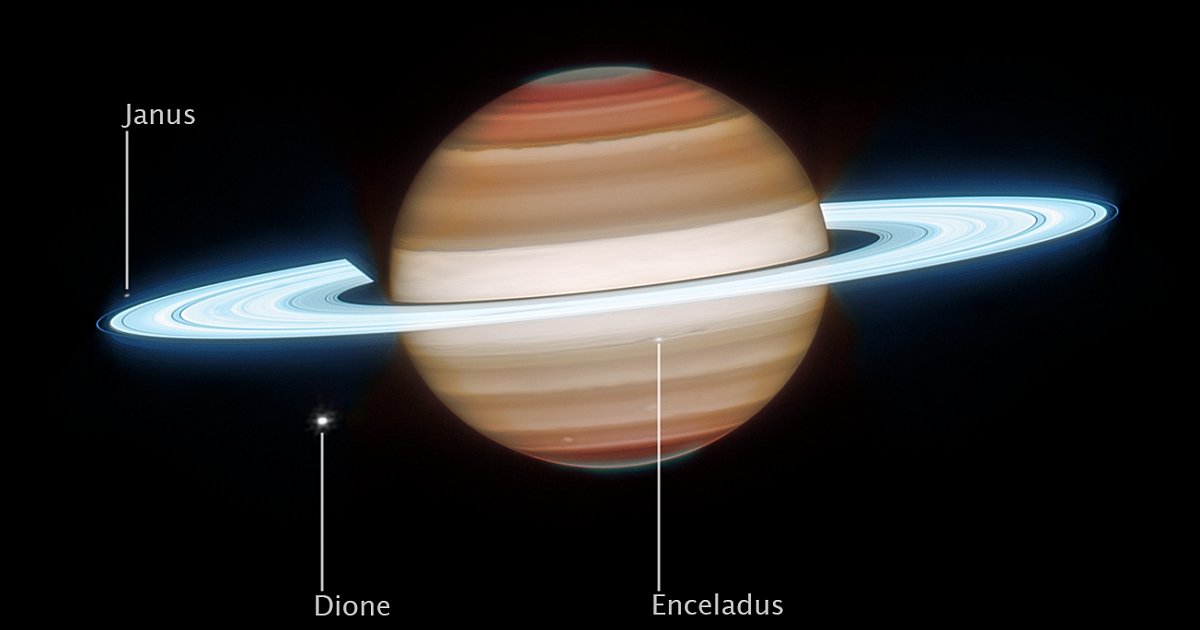
As you’ll read below, NASA dropped some big news this week. The agency also released this new image from the James Webb Space Telescope, showing an infrared view of Saturn. You can see bands of clouds in the planet’s atmosphere, its bright, highly reflective rings, and several of its moons including Janus, Dione, and Enceladus. Image credit: NASA/ESA/CSA/STScI/Joseph DePasquale.
Fact Worth Sharing
Saturn’s rings are probably a relatively new addition to the planet. They are thought to have formed more than 4 billion years after Saturn, likely through the destruction of a moon or other icy body.
Mission Briefings
NASA is making sweeping changes to its Moon and Mars exploration plans. This week, the agency announced a series of dramatic changes, including landing humans on the Moon every six months after Artemis V and building a lunar base instead of the orbiting Gateway station. NASA also announced a new mission, called the Space Reactor‑1 Freedom, that would use advanced nuclear electric propulsion to send a fleet of Ingenuity‑class helicopters to Mars. Learn more about the rest of the changes and read The Planetary Society’s statement on the announcement. Pictured: A representation of NASA’s plans for the Artemis program and beyond. Image credit: NASA.
ESA has restored contact with Proba-3. The Coronagraph spacecraft, which had been out of contact for a month, works in tandem with another spacecraft to create artificial solar eclipses to study the Sun’s corona. This week, the mission team announced that they had re-established the lost connection.
Artemis II could launch as soon as April 1. The mission will send four astronauts on a 10-day journey around the Moon and back to Earth. This upcoming launch window stretches from April 1-6.
From The Planetary Society
Artemis is often compared to Apollo. But how do they actually stack up? Planetary Society Chief of Space Policy Casey Dreier unpacks how funding, workforce, and robotic lunar exploration compare between NASA's two lunar exploration programs. Pictured: A chart comparing workforce between Apollo and Artemis. Image credit: The Planetary Society.
Artemis II is about more than getting four humans to the Moon and back. This week on Planetary Radio, hear from Steve Platts, chief scientist of NASA's Human Research, about the suite of human health experiments on this mission. Plus, Casey Dreier joins the show to explain all the new initiatives that NASA announced this week.
Hear even more from Casey Dreier on PBS News Hour. Our space policy and advocacy expert recently joined PBS News science correspondent Miles O'Brien and retired astronaut and engineer Leroy Chiao to discuss the Artemis program and NASA’s science goals.
New in the Planetary Society Book Club: Dispersal and a pastoral. On Wednesday, April 1, Planetary Society members can join a live virtual Q&A with award-winning poet and author Diane Ackerman, whose book “The Planets: A Cosmic Pastoral” brings together poems devoted to the worlds of our Solar System. If you missed the February book club meeting, you can listen to the interview with astrobiologist Caleb Scharf in the latest Planetary Radio: Book Club Edition, where he discusses dispersal — the idea that life and humanity will inevitably expand across our solar neighborhood.
Saving NASA Science
Thank you for being with us as we expanded our advocacy efforts this past year. Still, our work together is far from over. Your support today directly benefits future space science. With your gift of any amount, we’ll continue to organize Days of Action, expand our training programs, and build rapid-response tools so we can act quickly when new challenges arise. Your contribution ensures that we are ready to respond to whatever comes next. Donate today to power our advocacy when it matters most!
What's Up
This week, look for very bright Jupiter high in the east after sunset, with super bright Venus low in the west. Learn more at planetary.org/night-sky.
Join now and save space missions
If you are not one already, become a member TODAY and help shape the future of space science and exploration by fueling mission-critical advocacy efforts. Here’s just one example: The Planetary Society led efforts in Washington to Save NASA Science in 2026. Thanks to the support of our members, we were able to prevent an extinction-level budget cut to planetary exploration this year. This means more missions, more science, and exploration in our Solar System.
Will you join us and protect the future of exploration?
Wow of the Week
Talk about a launch with a view! This image shows the aurora borealis over the launch pad at the Andøya Spaceport in Norway, where the German company Isar Aerospace was preparing for the second launch of its Spectrum rocket. Image credit: Isar Aerospace.
Send us your artwork!
We love to feature space artwork in the Downlink. If you create any kind of space-related art, we invite you to send it to us by replying to any Downlink email or writing to [email protected]. Please let us know in your email if you’re a Planetary Society member!
Facts Only
NASA has made changes to its Moon and Mars exploration plans
Announced Space Reactor-1 Freedom mission for Mars helicopters
ESA restored contact with Proba-3 spacecraft
Artemis II launch window: April 1-6
Comparisons between Apollo and Artemis programs discussed
The Planetary Society Book Club event on April 1
Executive Summary
Full Take
In this article, we observe patterns suggesting an emphasis on human exploration of the Moon and Mars (ARC-0038 Focused Narrative), as well as efforts to engage public interest through educational initiatives and updates on ongoing missions (ARC-0041 Incremental Progress). However, the report also illustrates the complexities and challenges associated with such ambitious projects, including technological advancements, funding, and human health considerations. It is crucial for readers to remain informed about these developments and actively participate in discussions surrounding space exploration, particularly as they pertain to the potential benefits and costs for humanity.
Questions for further reflection: What are the long-term implications of these changes in NASA's Moon and Mars exploration plans? How can public engagement contribute to the success of these missions, and what role should private companies like Isar Aerospace play in space exploration?