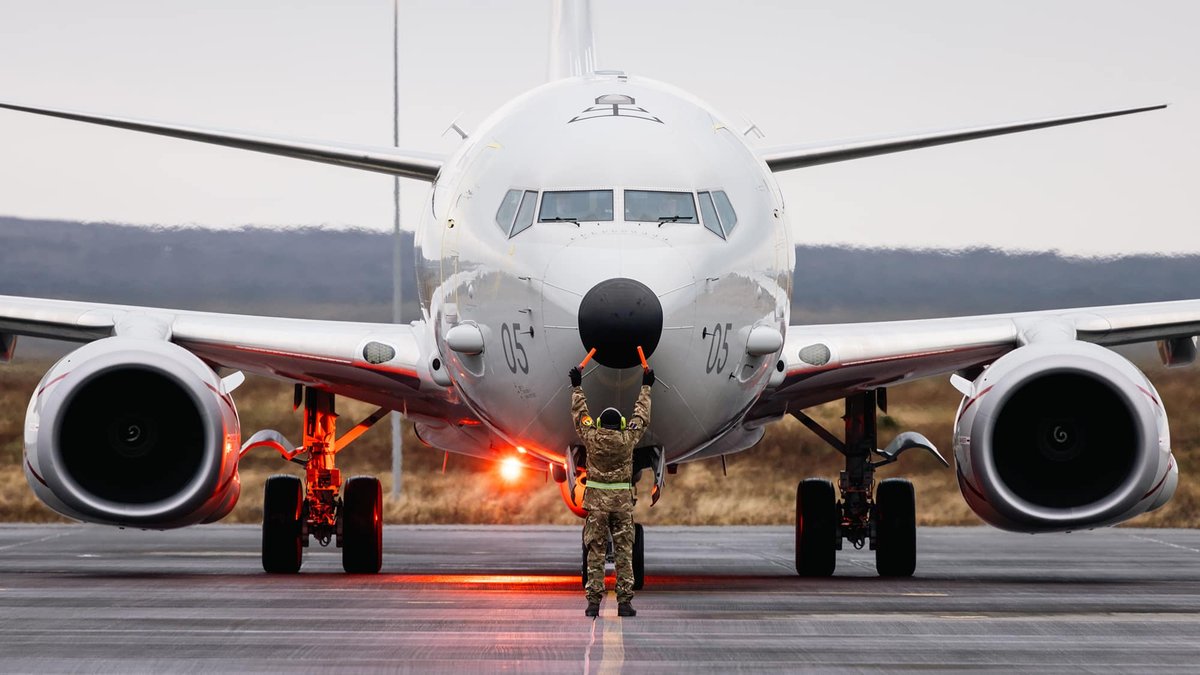
Despite tensions once again rising with the U.S. over the future of Greenland, Denmark has chosen Boeing’s P-8 Poseidon to fulfil an expanded maritime patrol capability across the North Atlantic and Arctic regions.
In an announcement on Jul. 7, 2026, the Danish Ministry of Defence confirmed that the provisional decision to buy two P-8A aircraft had been made following a recommendation from Chief of Defence, General Michael Hyldgaard. The announcement coincided with news that Denmark will join Finland, Norway, and Germany in a joint acquisition of MQ-4C Triton drones as a NATO force focused on the high north.
As per today’s announcement from the 🇩🇰Ministry of Defence, Denmark will acquire initially two Boing P-8A Poseidon maritime patrol aircraft for operations the Arctic and North Atlantic area. Cooperation with e.g. P-8 operators like Norway, UK and/or Germany is very likely. https://t.co/HywgAUAHxc
— Hans Tino Hansen (@HthHans) July 7, 2026
Likely a consideration as part of the decision, the P-8 and MQ-4C have a high degree of interoperability. The use of an MQ-4C by P-8 crews as a remote sensor platform via a datalink was demonstrated as early as 2016, and these capabilities have continued to receive upgrades ever since. As partners Germany and Norway are also P-8 customers, the addition of MQ-4Cs into the mix opens up significant opportunities for manned-unmanned teaming (MUM-T) operations.
Denmark’s current maritime patrol capability is provided by a multirole fleet of modified Challenger 604 business jets. While very adaptable, these aircraft are naturally limited by their modest package of modifications. Unable to launch sonobuoys, they are prevented from taking part in anti-submarine warfare (ASW) missions – a role made ever more critical by the need to safeguard critical undersea infrastructure (CUI). Without a payload bay, they are also unable to independently engage a hostile target or, in search and rescue scenarios, deploy emergency lifesaving equipment.
“We must be able to defend all parts of the kingdom. This also applies to the Arctic and North Atlantic areas. And we have an obligation to NATO to contribute to collective defense, not least in terms of delivering on force targets for anti-submarine warfare. With the acquisition of two new P-8 aircraft, we are strengthening the Armed Forces’ task performance in terms of interception and surveillance at very long distances. This will, among other things, contribute to our being able to achieve an even better common situational understanding,” said Chief of Defence Hyldgaard.
“In recent years, the Danish Defence Force has strengthened its military presence with close involvement from Greenland’s Naalakkersuisut, and with maritime patrol aircraft, Denmark’s ability to enforce sovereignty and monitor the region is significantly strengthened. In addition, the acquisition is a clear indication that we take our common task in NATO seriously,” said Minister of Defence Jeppe Bruus.
Bruus’ predecessor, Troels Lund Poulsen, previously expressed a preference for collaboration with NATO partners rather than direct acquisition of P-8 aircraft. Poulsen, leader of the Venstre party, was replaced by Bruus on Jun. 3, 2026, following the 2026 Danish General Election. Venstre, formerly a junior partner in a governing coalition led by the Social Democrats, was pushed into opposition by a new coalition comprising the Social Democrats, Green Left, Moderates, and Danish Social Liberal Party.
The U.S. approved Denmark for a foreign military sale (FMS) purchase of up to three P-8 aircraft towards the end of 2025. Additionally, in August 2025, Danish firm Terma signed a memorandum of understanding (MoU) with Boeing focused on the development and provision of sovereign maintenance, repair, and overhaul (MRO) facilities within Denmark for any future P-8 purchase.
Greenland Back in Focus
Longstanding and controversial demands from U.S. President Donald Trump to see Denmark give up sovereignty of Greenland in favor of the U.S. once again made headlines as NATO leaders met for the alliance’s annual summit, taking place in Ankara.
Donald Trump has revived plans to buy Greenland, according to officials close to the discussions.
A deal to purchase the territory is now the US president’s preferred option to end a long-running dispute with Denmark.
The new position would represent a collapse in talks between… pic.twitter.com/76ZuJz00i6
— The Telegraph (@Telegraph) July 7, 2026
President Trump claimed that Greenland is ‘not important’ for Denmark, but ‘very important for the U.S.’. Danish Prime Minister Mette Frederiksen was quick to fight back at Trump’s remarks: “I heard the US president yesterday and I think the US position is unfortunately very clear on this topic. Our position is as clear as it has been all through: Greenland is, of course, not for sale”
“We are ready to defend every inch of NATO, including our own territory,” she told reporters. “One of the reasons why we built NATO many, many years ago is if anything happens to one of us then everybody should stand up for each other.”
For over a year, Denmark and European allies have increased the frequency and size of military deployments to Greenland in an attempt to reinforce the argument that Greenland is amply defended – both from the U.S. and from Russia and China, who Trump has used as a justification for wanting the territory.
Danish officials have repeatedly made it clear that, as it has for decades, Denmark is ready and able to cooperate with the U.S. to reinforce Greenland’s security, and that a transfer of sovereignty is not necessary to ensure it is defended.