Lesotho’s laws and policies, institutional arrangements, together with the work of human rights defenders from civil society, should be reformed and harnessed to advance women’s social and economic rights and counter economic gender-based violence and femicide.
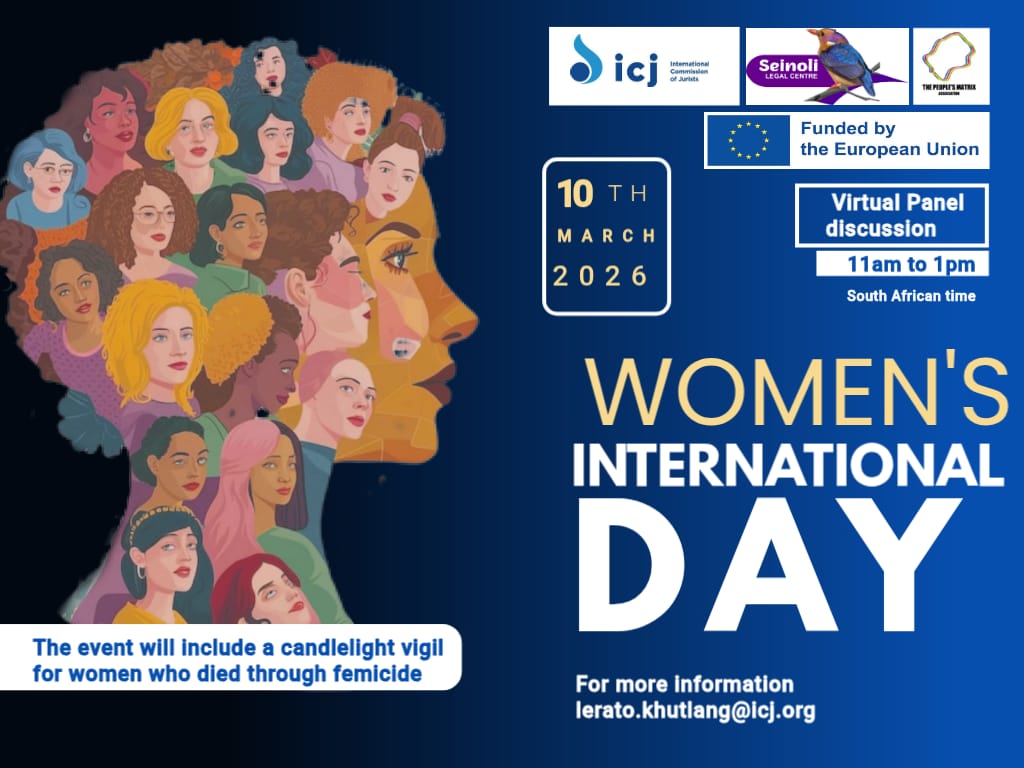
That was the main takeaway at an online commemoration of International Women’s Day convened by the International Commission of Jurists (ICJ) on 10 March.
The event brought together members of the judiciary, executive, civil society, private sector and academia to advance dialogue on protecting women’s economic rights and strengthening access to justice for women in Lesotho. Participants assessed Lesotho’s compliance with its international obligations under the Convention on the Elimination of All Forms of Discrimination against Women (CEDAW) and the Protocol to the African Charter on Human and Peoples’ Rights on the Rights of Women in Africa (Maputo Protocol), particularly in relation to gender-based violence.
The central feature of the commemoration was a panel discussion under the theme “Protecting the Economic Rights of Women.” Magistrate Puseletso McPherson of the Children’s Court addressed the role of the judiciary in safeguarding the economic rights of the girl child, including access to education, inheritance, maintenance and protection from harmful practices that undermine long-term economic security.
The ICJ raised concerns that economic gender-based violence and femicide were being exacerbated by systemic delays within the justice system.
“A critically understaffed judiciary has led to significant case backlogs, delaying the delivery of justice and effective remedies for survivors of gender-based violence. Such delays weaken accountability and erode survivors’ confidence in the legal system” said Lerato C. Khutlang, ICJ Associate Legal Advisor.
Senior Inspector Petje Teke of the Lesotho Mounted Police Service (CGPU) presented data on gender-based violence, highlighting the need for coordinated institutional responses. Adv. Ithabeleng Phamote, on behalf of the Law Society, addressed shortcomings in women’s participation in leadership positions and the persistent barriers limiting equal representation.
Seinoli legal Centre, through Adv. Lerato Rabatho examined the impact of development projects on women’s economic rights, measures to combat gender-based violence, and the critical role of advocacy in promoting accountability. From the private sector, Puseletso Putsoane of Vodacom Business- Women Network Forum, discussed technologically facilitated gender-based violence and its economic implications, particularly for women’s participation in digital spaces.
Adv. Mamello Makau, from the National University of Lesotho Faculty of Law shared an assessment about international and domestic legal frameworks protecting women’s economic rights and the evaluation of Lesotho’s progress in implementing these protections. The People’s Matrix further highlighted the importance of including LBTQI+ women in economic empowerment and leadership initiatives.
The commemoration included a virtual candlelight vigil to honour women who had lost their lives to gender-based violence, reinforcing collective and institutional accountability.
During the event, ICJ delivered a statement calling for an end to economic gender-based violence and femicide in Lesotho, while highlighting persistent gaps in sexual and reproductive health rights, including limited access to safe and legal abortion services.
Contact
Adv. Lerato C. Khutlang, ICJ Associate Legal Advisor, lerato.khutlang@icj.org
Facts Only
The International Commission of Jurists (ICJ) convened an online commemoration of International Women’s Day on 10 March.
The event focused on protecting women’s economic rights and strengthening access to justice in Lesotho.
Participants included members of the judiciary, executive, civil society, private sector, and academia.
Lesotho’s compliance with CEDAW and the Maputo Protocol was assessed, particularly regarding gender-based violence.
Magistrate Puseletso McPherson discussed the judiciary’s role in safeguarding the economic rights of girls, including education and inheritance.
The ICJ highlighted systemic delays in the justice system due to an understaffed judiciary, worsening economic gender-based violence.
Senior Inspector Petje Teke of the Lesotho Mounted Police Service presented data on gender-based violence.
Adv. Ithabeleng Phamote addressed barriers to women’s participation in leadership positions.
Seinoli Legal Centre examined the impact of development projects on women’s economic rights.
Puseletso Putsoane of Vodacom Business discussed technologically facilitated gender-based violence.
Adv. Mamello Makau assessed international and domestic legal frameworks protecting women’s economic rights.
The People’s Matrix emphasized the inclusion of LBTQI+ women in economic empowerment initiatives.
A virtual candlelight vigil honored women who lost their lives to gender-based violence.
The ICJ called for an end to economic gender-based violence and femicide, noting gaps in sexual and reproductive health rights.
Executive Summary
An online commemoration of International Women’s Day, convened by the International Commission of Jurists (ICJ) on 10 March, brought together stakeholders from Lesotho’s judiciary, executive, civil society, private sector, and academia to address women’s economic rights and access to justice. The event highlighted systemic challenges, including delays in the justice system due to an understaffed judiciary, which exacerbate economic gender-based violence and femicide. Participants assessed Lesotho’s compliance with international obligations under CEDAW and the Maputo Protocol, focusing on gender-based violence and economic empowerment. Key discussions included the judiciary’s role in protecting the economic rights of girls, the impact of development projects on women’s rights, and the barriers to women’s leadership. A virtual candlelight vigil honored victims of gender-based violence, reinforcing calls for institutional accountability. The ICJ also emphasized gaps in sexual and reproductive health rights, including limited access to safe abortion services.
The event featured contributions from magistrates, police officials, legal experts, and private sector representatives, each addressing different facets of the issue. While progress in legal frameworks was noted, persistent challenges such as case backlogs, underrepresentation of women in leadership, and technologically facilitated violence were underscored. The dialogue aimed to strengthen coordinated responses and advocacy to advance women’s rights in Lesotho.
Full Take
The strongest version of this narrative is a principled call for systemic reform in Lesotho to address economic gender-based violence and femicide, grounded in legal frameworks like CEDAW and the Maputo Protocol. The event’s focus on institutional accountability, judicial delays, and the economic implications of gender-based violence is well-supported by contributions from diverse stakeholders, including the judiciary, police, and civil society. The inclusion of a candlelight vigil and the emphasis on LBTQI+ women’s rights add moral weight to the discussion, framing it as both a legal and humanitarian issue.
Pattern scan: The narrative avoids overt manipulation, but the framing of systemic delays as a primary cause of gender-based violence could risk oversimplifying complex social dynamics. The focus on legal and institutional solutions, while necessary, may understate cultural or economic root causes. No clear distortion or bad faith is detected, but the emphasis on international obligations could imply a top-down approach that might not fully capture grassroots perspectives.
Root cause: The paradigm driving this narrative is one of legal and institutional reform as the primary lever for gender equity. The unstated assumption is that strengthening legal frameworks and judicial efficiency will sufficiently address economic gender-based violence. This echoes historical patterns of rights-based advocacy that prioritize formal systems over informal or cultural change.
Implications: For human agency, the narrative empowers women by demanding systemic accountability but may overlook the role of community-led solutions. The costs of inaction—continued violence, economic disempowerment—are clear, but the second-order consequences of legal reforms (e.g., unintended bureaucratic burdens) are less explored. The beneficiaries of this narrative are women and marginalized groups, while the costs are borne by institutions tasked with reform.
Bridge questions: How might cultural norms in Lesotho interact with legal reforms to either hinder or accelerate progress? What role could grassroots movements play in complementing institutional changes? Would a focus on economic empowerment alone address the root causes of gender-based violence, or are broader societal shifts needed?
Counterstrike scan: A coordinated influence campaign might weaponize the narrative by exaggerating institutional failures to undermine trust in governance or by framing gender-based violence as solely a legal issue to avoid addressing deeper societal divides. However, the actual content does not align with this pattern; it presents a balanced, evidence-based call for reform without sensationalism or partisan framing.
Patterns detected: none