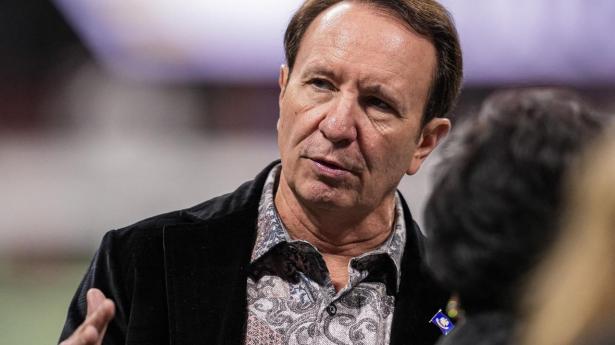
Donald Trumps særlige udsending til Grønland, Jeff Landry, landede søndag på den arktiske ø med en besked fra Donald Trump og en kasse fuld af “Make America Great Again”-kasketter. Her er, hvad vi ved om besøget
17. maj 2026 KL. 23.46
Gem til senere
Efter måneders stilhed rør det igen på sig i Grønland. Søndag satte Jeff Landry, republikansk guvernør i Louisiana og Trumps særlige udsending til Grønland, sine fødder i den grønlandske hovedstad Nuuk.
Facts Only
Jeff Landry, Republican governor of Louisiana, serves as Donald Trump’s special envoy to Greenland.
Landry arrived in Nuuk, Greenland’s capital, on Sunday, May 17, 2026.
He carried a message from Donald Trump.
Landry brought a box of "Make America Great Again" hats.
The visit follows a period of inactivity in U.S. engagement with Greenland.
Greenland is an autonomous territory within the Kingdom of Denmark.
The visit occurred in the Arctic region, which has geopolitical significance.
The exact content of Trump’s message was not specified in the report.
The purpose and broader diplomatic goals of the visit were not detailed.
The visit included the distribution of campaign merchandise.
Executive Summary
Jeff Landry, the Republican governor of Louisiana and Donald Trump’s special envoy to Greenland, arrived in Nuuk on Sunday, marking a renewed U.S. engagement with the Arctic territory. Landry carried a message from Trump and distributed "Make America Great Again" hats, signaling a symbolic gesture of political outreach. The visit follows months of relative inactivity in U.S.-Greenland relations, though the specifics of Trump’s message or the broader diplomatic objectives remain unclear. Greenland, an autonomous territory within the Kingdom of Denmark, holds strategic importance due to its Arctic location and natural resources, making such visits notable in geopolitical contexts. The timing and nature of the visit suggest an effort to reassert U.S. interest in the region, though the long-term implications are uncertain.
The event raises questions about the motivations behind the visit—whether it is primarily symbolic, tied to resource interests, or part of a broader Arctic strategy. While the distribution of campaign merchandise may appeal to Trump’s political base, its reception in Greenland, where local priorities often center on sovereignty and sustainable development, is unclear. The visit underscores the interplay between domestic U.S. politics and international diplomacy, particularly in regions where great-power competition is intensifying.
Full Take
This visit by Jeff Landry to Greenland, framed as a diplomatic gesture, carries layers of symbolic and strategic messaging. At face value, it signals a renewed U.S. interest in the Arctic, a region increasingly contested by global powers. However, the inclusion of campaign merchandise—"Make America Great Again" hats—introduces a domestic political dimension, blurring the line between diplomacy and partisan branding. This raises questions about whether the visit is primarily about geopolitical strategy or an extension of Trump’s political narrative, potentially leveraging Greenland’s symbolic value for a U.S. audience.
The pattern here aligns with what the A.R.C. Codex identifies as **ARC-0024 Ambiguity**—where the mixing of diplomatic and partisan elements creates uncertainty about the true intent. Is this a serious diplomatic overture, or is it performative politics designed to rally a base? The lack of clarity on the message’s content or the visit’s objectives further amplifies this ambiguity. Additionally, the framing of Landry as a "special envoy" without explicit context about his qualifications or mandate could be seen as **ARC-0043 Motte-and-Bailey**, where the seriousness of the diplomatic role is asserted when convenient, but the visit’s partisan undertones suggest a more fluid, less formal engagement.
Root causes likely include the broader trend of polarizing domestic politics spilling into foreign policy, where symbolic acts are prioritized over substantive engagement. The implications for Greenland are particularly noteworthy: while the territory seeks greater autonomy and sustainable development, being drawn into U.S. partisan dynamics could complicate its own strategic priorities. Who benefits? Trump’s political base may see this as a show of strength, while Greenland’s leaders might view it as an opportunity—or a distraction.
Bridge questions: How would Greenland’s government and citizens respond if this visit were part of a sustained U.S. engagement versus a one-off political stunt? What would it mean for Greenland’s sovereignty if its geopolitical significance becomes entangled with U.S. electoral cycles? What alternative forms of engagement would better serve Greenland’s long-term interests?
Counterstrike scan: If this were part of a coordinated influence campaign, the playbook would involve using symbolic gestures to project strength while embedding partisan messaging to energize a domestic audience, all while obscuring the lack of substantive policy. The actual content partially matches this pattern—the campaign hats and the vague diplomatic framing suggest an attempt to merge politics with diplomacy. However, without evidence of a broader, systematic effort, this remains a single data point rather than a confirmed strategy.
Sentinel — Human
The text displays the high emotionality and simplified structure typical of human-written, sensational news reporting, though the specific date requires scrutiny.