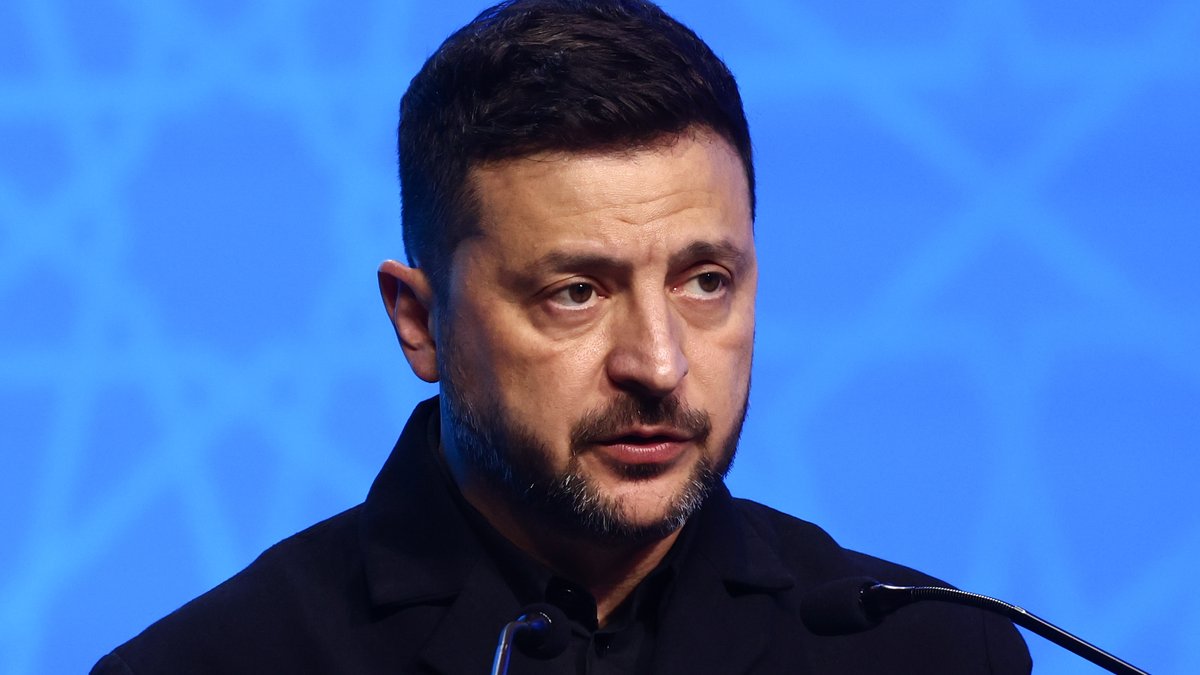
When it comes to war, both Trump and Zelensky should return to reality.
At time of writing, it looks like the U.S.-Iran ceasefire may be on its last legs. On Tuesday, the U.S. military launched strikes against more than 80 targets in Iran, retaliating for what the Pentagon termed Iran’s “unwarranted aggression” in firing on three commercial ships earlier in the week. President Trump, asked about the situation at the NATO summit in Ankara, called dealing with the Iranians “a waste of time” and pronounced the interim agreement signed last month “over.”
Even before the latest strikes, however, the president had been sounding a more bellicose note. In his Fourth of July speech, he invoked America’s “recent victory” in Iran, claiming that America “wiped out their military.” And when asked earlier this week about the prospects for a final agreement with Tehran, he doubled down, telling reporters “We’re either going to make a deal, or we’re going to finish the job. It won’t be tough to finish the job.”
Trump reminds one of a baseball team that, after losing 1–0, claims victory because it outhit its opponent—and demands a rematch. The lesson that the rest of the world has learned seems to have escaped him. Iran’s military and its infrastructure have indeed been pummeled, but Iran has not lost the war.
Iran maintains the ability to operate most of the missile sites it uses to close the Strait and put American and allied targets at risk. It has restored access to 90 percent of its underground missile storage and launch facilities. It still has 75 percent of its mobile missile launchers, 70 percent of its ballistic and cruise missiles and 50 percent of its drones. The regime remains sturdily ensconced in Tehran, with little prospect of a popular uprising or an internal coup.
The United States has suffered far less damage—yet failed to accomplish its aims. And there have been costs. Thirteen American service members have been killed. Vast quantities of scarce and expensive (“exquisite,” as the Pentagon calls them) munitions have been expended, including Patriot and THAAD interceptors, Tomahawk and JASSM cruise missiles, and Precision Strike Missiles. Unprecedented damage has been inflicted upon American bases in the region, including the Bahrain headquarters of the U.S. Navy’s Fifth Fleet. At home, American consumers endured months of high gas prices and creeping inflation at home. Not to mention the political cost to the Trump administration of owning a war three in five Americans oppose.
Though pounded, Iran is in many ways stronger today than it was before the war. It has shown that it can survive the application of America’s two greatest sources of leverage: military superiority and economic pressure. And it has shown that the United States cannot stop it from applying leverage of its own. Today, Iran exercises more control over the Strait of Hormuz than ever before. Iran now has, at least temporarily, access to oil revenue and frozen assets (though this may be changing; earlier this week, the U.S. revoked the waiver allowing Iran to sell oil). And it has not yielded on its insistence on its right to a civilian enrichment program.
“Iran has clearly won the war and enjoys a significant advantage over the U.S. in the balance of coercive leverage,” John Mearsheimer, a professor of political science at the University of Chicago, told The American Conservative. “That is why President Trump signed the Memorandum of Understanding with Iran, even though it is effectively a surrender document."
The danger is that the White House doesn’t seem to realize this fact. And that could lead us back into the morass of an unwinnable war.
A similar delusion is prolonging the bloodletting in Ukraine. Ukrainian President Volodymyr Zelensky and his European boosters are apparently convinced that the tide of the war has turned, and that a Ukrainian victory is not only possible but even imminent.
Delusion has, of course, characterized this war since its outset. Just as Zelensky was reportedly persuaded by European hawks to reject a peace deal in the spring of 2022, he is now listening to his European—and, recently, American—friends who tell him to continue the fight and force Russia to the negotiating table on his terms.
It is true that Ukrainian drone strikes represent a change in the conflict’s dynamics. The ability to hit the Russian heartland—from symbolic targets in St. Petersburg and Moscow to the petroleum refineries that keep Russia’s economy humming—is certainly having an impact. Indeed, Putin conceded as much in an interview last month (while also maintaining that they would “have no impact whatsoever on the situation at the front”).
But so far, Ukraine’s new reach does not seem to pose an existential threat to the Russian war machine. And Russian missile and drone attacks continue to deal more damage to Ukrainian cities and infrastructure than the reverse.
Consider Russia’s most recent barrage, launched against Ukrainian cities earlier this week: according to the BBC, “Ukraine did not stop a single ballistic missile.”
This has led to increasing desperation in Kiev. According to Putin, Zelensky even proposed that both sides agree to halt their long-range drone and missile exchanges.
And for all that these attacks have grabbed global headlines, the overall situation for Ukraine remains decidedly grim. As one expert at the Harvard Kennedy School observed late last month, Ukraine’s new drone strike capabilities “have not produced a decisive, durable shift in the overall direction or balance of the war.” Or, as another analyst wrote a few weeks earlier, “the drone war is a distraction.”
Subscribe Today
Get daily emails in your inbox
The reason for this is simple: the conflict’s outcome will be determined by what happens on the Donbas front. And there, Russia continues to make slow but steady advances, and Ukraine looks ever more likely to lose a region it might well have kept under the Minsk accords.
In parts of the key stronghold of Konstantinovka, for example, depleted and exhausted Ukrainian units appear on the verge of collapse amid a relentless Russian assault. Ukraine’s manpower limitations are keenly felt, and the city’s fall seems only a matter of time. The tide, in other words, has not turned.
In both Ukraine and Iran, the delusions of leaders bent on winning the unwinnable threaten to create more misery and loss for all concerned. Both Zelensky and Trump should return to reality. Otherwise, the countries they lead face the prospect of yet more fruitless, endless war.
Facts Only
* The U.S. military launched strikes against more than 80 targets in Iran.
* The Pentagon termed the action Iran’s “unwarranted aggression” over firing on three commercial ships earlier in the week.
* President Trump called dealing with the Iranians “a waste of time.”
* Trump stated the interim agreement signed last month was “over.”
* Iran maintains the ability to operate most missile sites used to close the Strait and risk American and allied targets.
* Iran has restored access to 90 percent of its underground missile storage and launch facilities.
* Iran still possesses 75 percent of mobile missile launchers, 70 percent of ballistic and cruise missiles, and 50 percent of drones.
* The United States suffered the death of thirteen service members.
* Unprecedented damage was inflicted upon American bases in the region.
* Ukraine did not stop a single ballistic missile from being launched in its recent barrage.
* An expert observed that Ukrainian drone strike capabilities have not produced a decisive, durable shift in the overall direction or balance of the war.
Executive Summary
Full Take
The narrative presented draws a sharp contrast between leaders operating under a perceived delusion of imminent victory and the demonstrable reality of coercive leverage in international conflict. In the Iran scenario, the observation that Iran remains capable of retaining strategic assets despite significant military pressure suggests that external force alone does not guarantee capitulation; instead, internal resilience can be maintained. The assertion that Iran has won the war in terms of leverage challenges a simplistic view of military superiority as the sole determinant of outcome, pointing toward a dynamic where asymmetric control and economic maneuvering play a decisive role. This raises the question of whether external interventions aimed at coercion are succeeding or merely creating new forms of intractable deadlock.
Similarly, the Ukraine situation highlights a pattern where perceived shifts in battlefield dynamics do not necessarily correlate with overall strategic outcomes. The persistence of slow advances on the ground indicates that localized tactical gains, such as drone strikes, may function more as distractions than as decisive levers for changing the macro-level trajectory of a protracted conflict. This pattern suggests that leaders may prioritize short-term narrative control—convincing allies or domestic audiences of an imminent victory—over confronting the deeper, slower processes of territorial and strategic collapse. The underlying implication is that delusional belief in immediate success can obscure the necessity of pragmatic engagement with potentially unwinnable scenarios, leading to prolonged suffering for all parties involved rather than a swift resolution based on verifiable shifts in power.
What assumptions are driving the calls for continued conflict when empirical indicators suggest otherwise? If leaders operate under a framework where victory is absolute and imminent, it creates an environment where acknowledging stalemate becomes psychologically untenable, regardless of the material realities of military attrition or strategic control. This dynamic suggests that the danger lies not just in the external geopolitical situation, but in the internal cognitive frame that rejects objective assessment in favor of desired outcomes.
Sentinel — Human
The text is structured as an opinion piece synthesizing geopolitical events and expert commentary to argue that current leaders in both Iran and Ukraine are operating under false assumptions regarding the outcome of their conflicts, leveraging historical/military context for rhetorical effect.