Tenzin Nyidon
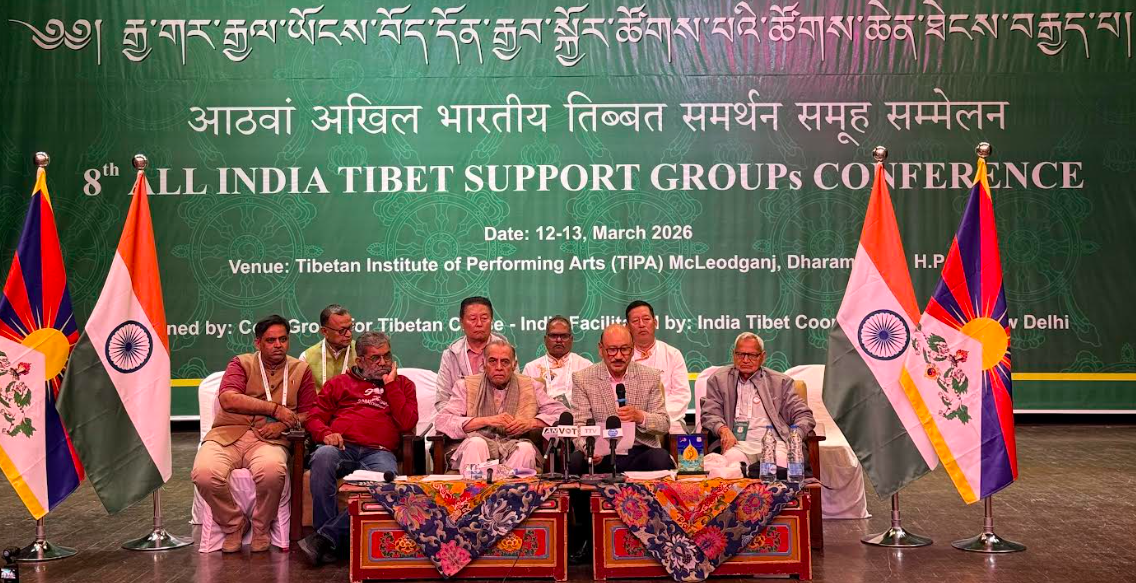
DHARAMSHALA, March 14: The 8th All India Tibet Support Groups Conference, held from March 12 to 13 at the Tibetan Institute of Performing Arts (TIPA) in Dharamshala, concluded with the adoption of a declaration reaffirming solidarity with the Tibetan people and their aspirations for freedom and cultural preservation. The two-day gathering brought together more than 200 supporters and participants, including presidents and members of Tibet Support Groups from across India.
The conference was convened by the Core Group for the Tibetan Cause – India and facilitated by the India Tibet Coordination Office (ITCO). During the concluding session, Rinchen Khandu Khrimey, the National Convener of the Core Group for the Tibetan Cause – India, announced the conference declaration summarizing the collective positions and commitments of the participating support groups.
The declaration recalled the historic support extended by the Indian people to Tibet since 1950, citing the positions of Sardar Vallabhbhai Patel, Dr. B. R. Ambedkar in 1954, and the All India Tibet Convention of 1959 initiated by Loknayak Jayaprakash Narayan. It reaffirmed the deep civilizational, spiritual, and cultural ties shared between India and Tibet.
It expressed serious concern over what they described as the “continued occupation” of Tibet by the People’s Republic of China and the policies that threaten Tibet’s unique cultural identity, religious traditions, language, and fragile environment. The declaration also condemned reported human rights violations in Tibet, including restrictions on religious freedom, mass surveillance, the expansion of colonial-style boarding schools for Tibetan children, and efforts aimed at annihilating Tibetan identity.
The conference called for the recognition of the Central Tibetan Administration (CTA) as the legitimate representative of the Tibetan people. It also urged the resumption of dialogue between representatives of His Holiness the Dalai Lama and the CTA and the People’s Republic of China to peacefully resolve the Sino-Tibet conflict. Khrimey said the appeal for the Government of India to raise the Tibet issue on such a platform in support of dialogue marks the group’s first such call to the Indian government.
The declaration further expressed appreciation for the lifelong contributions of His Holiness the 14th Dalai Lama in promoting world peace, compassion, non-violence, environmental awareness, and the revival of the Nalanda tradition of Buddhism.
The conference also rejected China’s claim over the reincarnation of the Dalai Lama and reaffirmed that the centuries-old tradition governing the recognition of the reincarnation rests with the Gaden Phodrang Trust.
In addition, participants congratulated His Holiness the Dalai Lama on receiving a Grammy Award this year, noting that it coincides with the “Year of Compassion,” marking his upcoming 90th birthday anniversary.
The declaration concluded with a resolution to strengthen Tibet Support Groups across India, expand public awareness through academic programs and social media campaigns, organize cultural and environmental initiatives, and encourage greater participation from youth, women, and civil society in supporting the Tibetan cause.
Facts Only
The 8th All India Tibet Support Groups Conference was held from March 12 to 13 at the Tibetan Institute of Performing Arts (TIPA) in Dharamshala.
Over 200 participants attended, including presidents and members of Tibet Support Groups from across India.
The conference was convened by the Core Group for the Tibetan Cause – India and facilitated by the India Tibet Coordination Office (ITCO).
Rinchen Khandu Khrimey, National Convener of the Core Group for the Tibetan Cause – India, announced the conference declaration.
The declaration recalled historical support for Tibet from Indian leaders such as Sardar Vallabhbhai Patel, Dr. B. R. Ambedkar, and Loknayak Jayaprakash Narayan.
It expressed concern over China's continued occupation of Tibet and policies threatening Tibetan culture, religion, language, and environment.
The declaration condemned human rights violations in Tibet, including restrictions on religious freedom, mass surveillance, and colonial-style boarding schools.
The conference called for the recognition of the Central Tibetan Administration (CTA) as the legitimate representative of the Tibetan people.
It urged the resumption of dialogue between the CTA and the People’s Republic of China to resolve the Sino-Tibet conflict.
The declaration rejected China’s claim over the reincarnation of the Dalai Lama, affirming the tradition rests with the Gaden Phodrang Trust.
Participants congratulated His Holiness the Dalai Lama on receiving a Grammy Award and noted his contributions to peace and environmental awareness.
The declaration resolved to strengthen Tibet Support Groups across India through public awareness campaigns, cultural initiatives, and greater youth participation.
Executive Summary
Full Take
The strongest version of this narrative centers on the enduring solidarity between India and Tibet, framed through historical, cultural, and spiritual ties. The conference declaration effectively steelmans the Tibetan cause by invoking India’s legacy of support, from early 20th-century leaders to contemporary advocacy. It presents a coherent case for Tibetan autonomy, grounding its claims in human rights concerns, cultural preservation, and the legitimacy of the CTA. The rejection of China’s authority over the Dalai Lama’s reincarnation is a bold stance, reinforcing Tibetan sovereignty over religious traditions.
Pattern scan reveals no overt manipulation, but the framing leans on moral urgency—highlighting "continued occupation" and "annihilation of Tibetan identity"—which could resonate as emotional exploitation (ARC-0043). The appeal to historical figures like Patel and Ambedkar serves as borrowed credibility (ARC-0024), lending weight to the cause. However, the narrative remains principled, avoiding exaggeration or false binaries.
Root cause analysis suggests a paradigm of resistance against cultural erasure and political marginalization. The unstated assumption is that international pressure, particularly from India, can shift China’s stance—a premise that hinges on geopolitical leverage. This echoes historical patterns of diaspora advocacy, where exiled communities mobilize global support to challenge occupying powers.
Implications for human agency are significant: the declaration empowers Tibetan voices while urging Indian civil society to amplify their cause. The costs are borne by those facing repression in Tibet, while the benefits accrue to the CTA’s legitimacy and the broader movement for self-determination. Second-order consequences may include strained India-China relations if New Delhi heeds the call to raise the Tibet issue diplomatically.
Bridge questions: How might China respond to the conference’s demands, and what leverage does India realistically hold? What perspectives from Tibetan communities inside Tibet are missing from this diaspora-led narrative? Would evidence of improved human rights conditions in Tibet alter the movement’s strategic priorities?
Counterstrike scan: A coordinated influence campaign would likely amplify divisive rhetoric, frame the CTA as a separatist threat, or dismiss the conference as a fringe movement. This content does not match that pattern; it is a principled advocacy piece, not a disinformation play. The focus on dialogue and cultural preservation aligns with nonviolent resistance, not escalation.
Sentinel — Human
The article exhibits strong human authorship signals, including domain-specific knowledge, historical precision, and narrative idiosyncrasies, with minimal stylometric or structural red flags.