- Published
Chelsea have been handed a Premier League record fine of £10.75m and a suspended transfer ban.
It was a result of the club making secret payments to unregistered agents and third-parties over transfers between 2011 and 2018.
But it could have been a lot worse. Only a frank admission of guilt and full co-operation avoided a larger fine - and a potential points penalty.
The Premier League published a 28-page document highlighting all the wrongdoings - how much money was paid out, by who, and for which transfer deals.
This is what the written reasons tell us.
What did Chelsea do wrong?
Chelsea made 36 separate payments totalling £47.5m to 12 individuals or corporate entities.
They were made via a series of third-parties, which were primarily registered in the British Virgin Islands.
The payments either completed the signings of players and/or acquired transfer options without the payments appearing on the club's accounts.
It was found that they were "obvious and deliberate breaches" which also "involved deception and concealment in relation to financial matters".
Former Chelsea owner Roman Abramovich was implicated.
The payments happened "with the knowledge and approval of certain senior former officers and/or Directors" and using funds "controlled by or associated with the former owner".
Which player transfers came under scrutiny?
The documents name most of the players, though they are not accused of being involved.
The biggest payment, £23m, accounts for almost half the total.
The money was paid to seven unregistered agents (or entities associated with them) to sign players including Eden Hazard (Lille), Ramires (Benfica), David Luiz (Benfica), Andre Schurrle (Bayer Leverkusen) and Nemanja Matic (Benfica).
The combined £19.3m transfer fees for Samuel Eto'o and Willian from Anzhi Makhachkala were also paid off the books.
Payments of £1.37m were paid to director of football Frank Arnesen, plus scout and advisory Piet de Visser and an unnamed third member of staff. This was considered to be their wage.
The final payment of £3.8m was in relation to a redacted player transfer.
Why have some names and details been redacted?
It is common practice for names to be removed from official sanction documents or commission judgments.
This usually applies to any person who is not directly connected to football.
Other times it may relate to the identity of minors or there could be data protection issues.
However, in this document there are three players and one member of staff who have had their names redacted.
No reason has been given for their identities being protected.
Did Chelsea unduly benefit from the transfer deals?
The majority of Chelsea's misconduct happened between approximately 2013 and 2017. But they were charged for offences over an eight-year period.
It was a period when Jose Mourinho returned to the club, and they won six pieces of silverware.
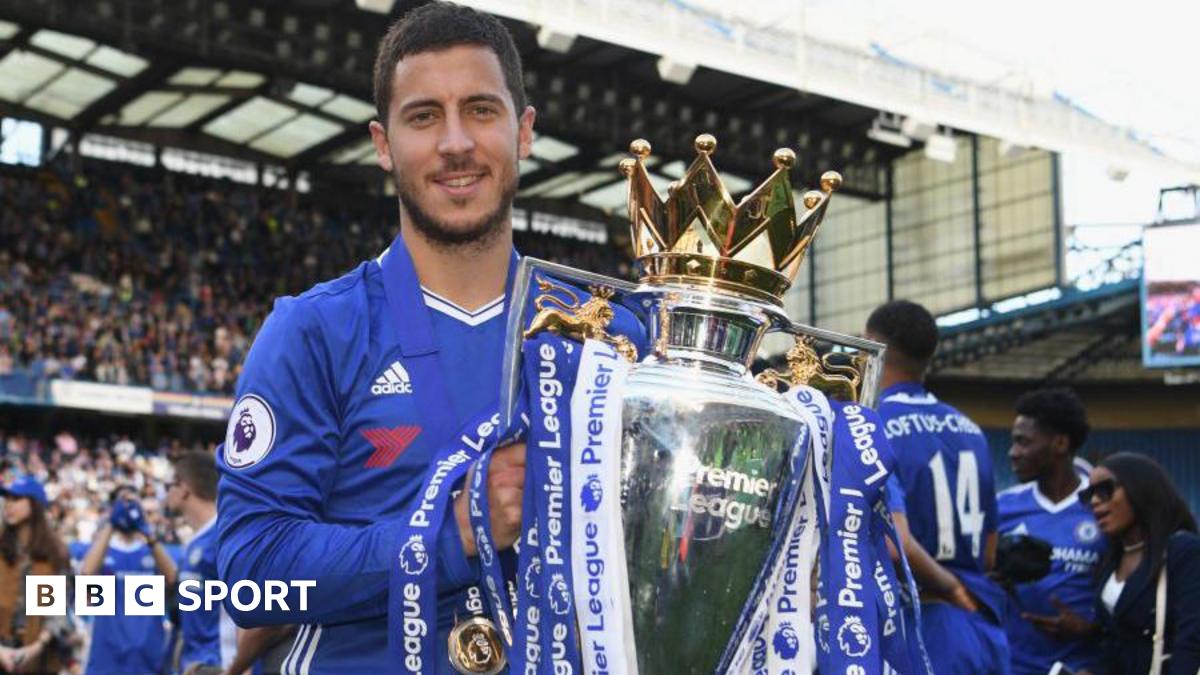
Chelsea took two Premier League titles (2014-15, 2016-17), two FA Cups (2011-12, 2017-18), the EFL Cup (2014-15) and the Europa League (2018–19).
Most of the players named in the document had glittering careers at Stamford Bridge. They became vital players and helped the club win many trophies.
Chelsea fought off most of Europe's top clubs to the £32m signing of Lille's Hazard, who would score 110 goals in 352 games across all competitions.
The Belgium international was in the PFA Team of the Year four times, and was the PFA Young Player of the Year in 2013-14.
Willian played 339 matches for Chelsea, and Matic 121 after signing for the club for a second time.
David Luiz made 248 appearances across two spells, with Ramires playing 251 times.
Two were not quite so successful.
Germany forward Schurrle failed to find his form across 65 appearances in two seasons in West London. Eto'o scored 12 goals in 35 games and left after one campaign.
Arsene Wenger will remember the players well.
Five of them started Chelsea's 6-0 win over Arsenal on 22 March, 2014 - Wenger's 1,000th game in charge of the Gunners.
Eto'o, Schurrle and Hazard all scored in the match.
Why did Chelsea escape stronger punishment?
With Chelsea enjoying so much success after signing star players through secret payments, did they get off lightly?
If the club had not been so co-operative they would have faced a much tougher financial penalty and potentially a points deduction.
The starting point was the aggravating factors - length of time of the wrongdoing, the size of payments, that they were made with the knowledge of senior figures and the seriousness of the breaches.
The Premier League Board concluded Chelsea should be fined £20m with a transfer ban for two complete and consecutive windows.
But there were mitigating factors to take into account.
BlueCo, which bought Chelsea out of Abramovich's ownership, self-reported the breaches once it had looked through the club's books.
Added to that, BlueCo made voluntary disclosures and showed "exceptional co-operation".
This saw the fine halved to £10m and the two-window transfer ban suspended.
The suspension will be activated if they commit a similar breach in the next two years.
The Board also reserved the right to be able to trigger the suspension at any time in the future if the club makes intentionally untrue declarations.
Chelsea were, however, ordered to pay an unpaid transfer levy of £771,288 in connection to Willian and Eto'o.
Importantly, there was no breach of profit and sustainability rules.
When the payments were added to Chelsea's accounts they were not in excess of the £105m, three-season spending limit.
If they had been then the prospect of a points deduction would have been real.
They were, however, banned from signing academy players for nine months. This was related to separate charges involving impermissible contact to register academy players between 2019 and 2022.
The Blues had already been fined 10m euros (£8.6m) by Uefa over the payment offences between 2011 and 2018.
And Chelsea still have to face a hearing over 74 Football Association charges, which is likely to be another hefty fine.
So this is not quite over yet.
Facts Only
Chelsea was fined £10.75 million and given a suspended transfer ban by the Premier League.
The club made 36 secret payments totaling £47.5 million to 12 individuals or entities between 2011 and 2018.
Payments were routed through third-parties, primarily registered in the British Virgin Islands.
The payments facilitated player transfers and transfer options without appearing in Chelsea’s official accounts.
Former owner Roman Abramovich was implicated, with payments made using funds linked to him.
Key transfers involved included Eden Hazard (£32 million), Ramires, David Luiz, André Schürrle, Nemanja Matić, Samuel Eto’o, and Willian.
A £23 million payment accounted for nearly half the total, distributed among seven unregistered agents.
£1.37 million was paid to former director of football Frank Arnesen, scout Piet de Visser, and an unnamed staff member as wages.
Chelsea’s new ownership, BlueCo, self-reported the breaches and cooperated fully with the investigation.
The original proposed penalty was a £20 million fine and a two-window transfer ban, later reduced due to cooperation.
Chelsea was also banned from signing academy players for nine months for separate violations between 2019 and 2022.
The club still faces 74 FA charges related to the same period.
Executive Summary
Chelsea Football Club has been fined £10.75 million and given a suspended transfer ban by the Premier League for making secret payments totaling £47.5 million to unregistered agents and third-parties between 2011 and 2018. The payments, often routed through entities in the British Virgin Islands, were used to facilitate player transfers and acquire transfer options without proper disclosure in the club’s accounts. Key transfers involved included Eden Hazard, Ramires, David Luiz, André Schürrle, Nemanja Matić, Samuel Eto’o, and Willian. The misconduct was found to involve senior officials and funds linked to former owner Roman Abramovich. Chelsea’s cooperation and self-reporting under new ownership mitigated the penalty, reducing a potential £20 million fine and two-window transfer ban to the current sanctions. The club also faced a nine-month ban on signing academy players for separate violations. While the payments did not breach financial sustainability rules, Chelsea still faces additional FA charges, suggesting further legal and financial repercussions.
The case highlights systemic issues in football governance, where financial irregularities can persist under previous ownership while new regimes face the consequences. The suspended transfer ban serves as a warning, but the lack of a points deduction or harsher penalties raises questions about deterrence in elite football. The involvement of high-profile players and trophies won during this period adds complexity to the narrative of competitive fairness.
Full Take
**Steelman:** The strongest version of this narrative is that Chelsea’s historical financial misconduct—systematic, deliberate, and involving senior leadership—was exposed through transparency under new ownership. The club’s cooperation and self-reporting demonstrate a commitment to reform, while the reduced penalties reflect a balanced approach to accountability. The case underscores the challenges of regulating elite football, where competitive success can be intertwined with financial irregularities.
**Pattern Scan:** The article avoids overt manipulation but leans into a subtle "everyone does it" framing by noting Chelsea’s trophies during the period, implicitly questioning whether the penalties are proportional. The redaction of certain names without explanation could be seen as a form of ambiguity (ARC-0024), though it may also reflect legal constraints. The focus on Abramovich’s involvement risks oversimplifying systemic issues in football governance.
**Root Cause:** The paradigm here is the tension between competitive advantage and regulatory compliance in modern football. The assumption is that financial flexibility—even if unethical—is necessary to win, and that penalties are negotiable if cooperation is shown. This echoes historical patterns of clubs exploiting loopholes until governance catches up.
**Implications:** Human agency is diminished when clubs prioritize success over integrity, but the new ownership’s cooperation suggests a path to redemption. The beneficiaries are Chelsea’s rivals, who may now question past competitive fairness, while the costs are borne by fans and the sport’s credibility. Second-order consequences include increased scrutiny of other clubs’ financial dealings.
**Bridge Questions:**
How should football govern bodies balance punishment with incentives for self-reporting?
What structural changes could prevent such breaches in the future?
Does the focus on Abramovich obscure broader systemic issues in football finance?
**Counterstrike Scan:** A bad actor pushing this narrative might emphasize Chelsea’s past success to downplay the severity of the breaches, framing it as "just how the game works." The actual content does not fully align with this, as it acknowledges the seriousness of the violations and the need for accountability. The tone remains factual, though the mention of trophies could be exploited to normalize misconduct.
Patterns detected: ARC-0024 Ambiguity (redactions), ARC-0043 Motte-and-Bailey (implicit "everyone does it" framing)
Sentinel — Human
The article exhibits strong human characteristics, including narrative voice, digressions, and specific sourcing, with minimal stylometric or coherence red flags.