By Nina Scally
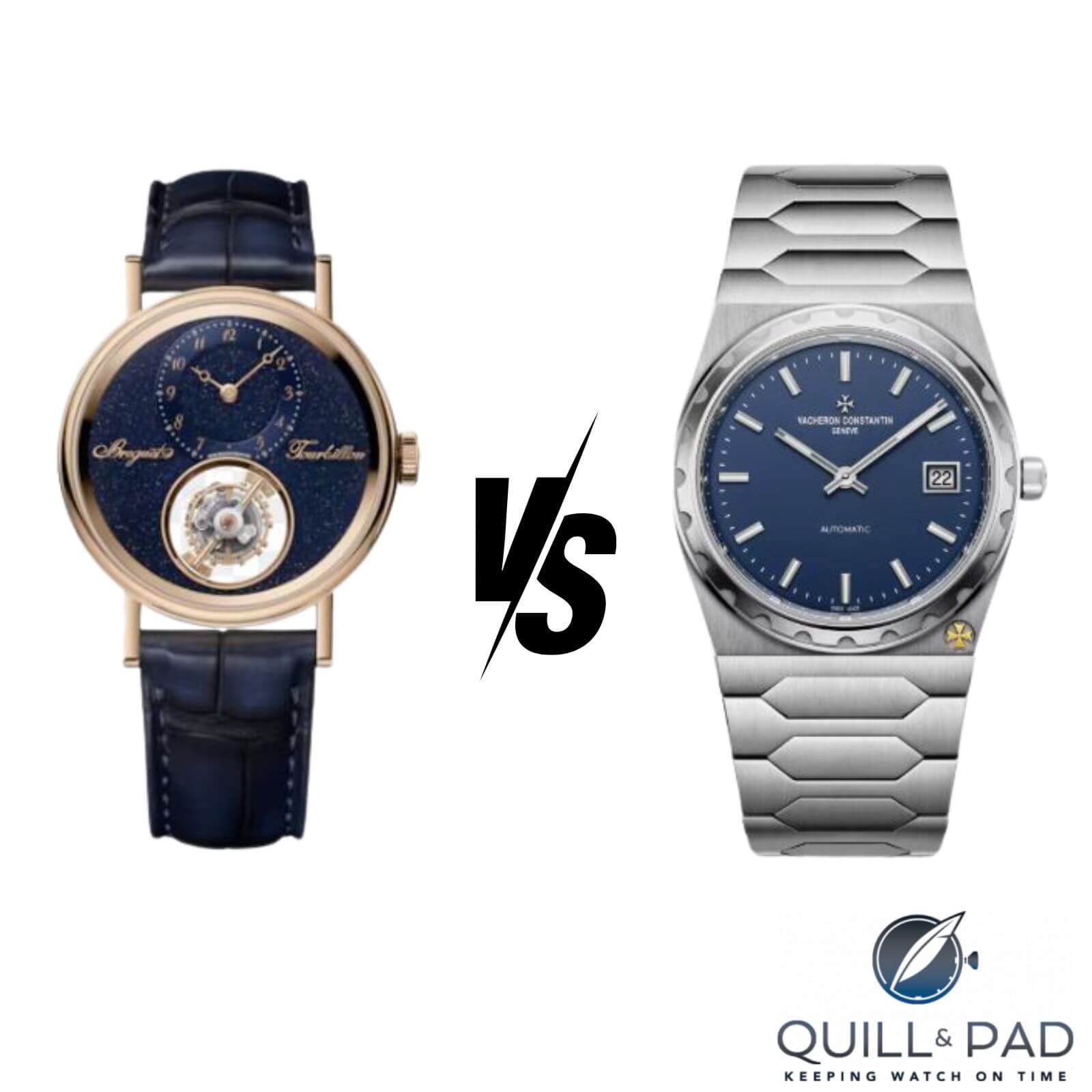
Put two authentic, luxury timepieces on a table, and you won’t kill a conversation. There may, however, be a second or so of awkward silence, as the recipient takes in what the hand has achieved. Profound, technical timekeeping of the traditional kind, stamped with the names of two industry greats, like Vacheron Constantin and Breguet, for example. These two luminaries, defined by their brilliance, stand today as proud foundational pillars within the world of haute horlogerie. Neither one is better than the other, I should add. Yet, to compare the two side-by-side is probably one of the most rewarding studies in all of horology. It’s a comparison that offers endless fascination for seasoned veterans and newcomers alike.
Whenever I find myself engaged in a debate similar to the above, the conversation inevitably circles back to the historical weight each brand carries. Suffice it to say, both contenders here have much to offer in that respect. Vacheron Constantin famously holds the title of the oldest continuously operating watchmaker, having kept the lights on since 1755, while Breguet was founded just twenty years later and is every bit the endless well of ingenuity and wisdom. But there are other things to consider when exploring the Breguet vs Vacheron Constantin debate. Both maisons take different approaches to reaching the same pinnacle of technical and aesthetic mastery. Let’s explore them both in more detail.
The Weight of the Past: Heritage Versus Invention
To understand the modern context of these brands, it makes sense to look closely at their foundational myths, because on the one hand, we’re comparing a story of unyielding survival, and on the other, a story of relentless innovation. So, let’s start with Vacheron Constantin. Established in 1755 by Jean-Marc Vacheron, this Geneva-based brand has never stopped ticking, keeping its doors open through the French Revolution, two World Wars, and the brutal Quartz Crisis of the 1970s and 1980s. For some perspective and for those less familiar with this era, it’s only fair to say that the arrival of the affordable, mass-produced battery-powered quartz completely decimated the Swiss watch industry. As CV continues to celebrate its monumental anniversaries each year, that unbroken status only serves to leverage its strength and endurance. After all, few other brands, not even Patek Philippe or Audemars Piguet, can legitimately claim to have survived this crisis in quite the same way.
On the other side of the ring sits Breguet. You could say that Abraham-Louis Breguet is essentially the history of the mechanical watch. He founded the company in 1775 in Paris and, without him, we wouldn’t have the tourbillon to counteract the effects of gravity on a pocket watch escapement or the overcoil hairspring that improves a movement’s concentric “breathing.” We wouldn’t even have the parachute shock protection system or the first true wristwatch designed for the Queen of Naples. Whether you consider Breguet watches to be some of the most beautiful in the world or not, there is no denying how fundamentally important this brand is in the evolution of mechanical watchmaking. Even today, virtually every brand, from entry-level to ultra-luxury, relies on technology that Abraham-Louis Breguet conceptualised in his candlelit workshop over two centuries ago.
Here’s some food for thought: Is it more impressive to have stayed in business the longest, through centuries of global turmoil, or to have invented the very tools that everyone else uses to stay in business?
The Architecture of Light: Guilloché and the Coin-Edge
Readers here know that the dial of a watch speaks volumes about the personality of the person wearing it. The visual lexicons of these two houses could not be more distinct, so let’s look at what each manufacturer offers.
Even though modern Breguet watches bestow nineteenth-century design elements, they somehow feel strikingly relevant today. This can be attributed to their hand-turned guilloché dials. Rather than stamping out a texture in seconds using a huge industrial machine, guilloché is an exhausting exercise in light management where a pattern is carved into a solid gold dial plate using antique rose engines guided by an artisan’s hand. The way the ambient light catches the intricate “Clous de Paris” or “Vieux Panier” patterns in a Breguet watch provides a visual depth that flat, painted dials can’t compete with. Then there are the instantly recognisable blued steel Breguet hands, with their eccentric moon-like tips, and Breguet’s beautifully fluted coin-edge case middles, welded straight lugs with screw pins, and neo-classical architecture. I’ve always found so many of this manufacturer’s secret signatures fascinating to behold, but mostly, the beautiful guilloché dial.
Vacheron Constantin’s design language is one of restraint. The manufacturer relies on perfect mathematical proportions to create its masterpieces as opposed to focusing on elaborate dial textures. The focal point of its many impressive designs is often the Maltese Cross, a symbol inspired by an obscure historical movement component that once limited the tension of the mainspring to ensure constant force. Whether you see it subtly integrated into the curved lugs of a Patrimony watch or find it in the bold bezel of an Overseas watch, the Maltese Cross is a hallmark of elite Genevan pedigree that you will see throughout its portfolio. Vacheron’s dials also embrace the luxury of negative space, using applied faceted markers and razor-sharp dauphine hands to create a harmonious balance across their expanse.
The Dandy and the Purist: A Head-to-Head Comparison
Let’s look at what happens when Vacheron and Breguet are asked to make a watch whose only job is to tell the time and slip under the cuff of a shirt. To do this, we can put two of their most emblematic modern references head-to-head to see how they compare: the Vacheron Constantin Historiques American 1921 and the Breguet Classique 7147.
I’ll be completely honest. I used to think the Vacheron Constantin American 1921 was more of a novelty than anything else; something you’d wear to show off at a dinner party. That was until I had the chance to take a much closer look at the 40mm pink gold version, and it entirely recalibrated how I viewed the collection thereafter. The 1921 model is famous for its distinctive cushion-shaped case, and its dial rotated at a 45-degree angle to the right. Playfully, the crown is placed at the top corner. It goes against all conventional rules. But historically, lore claims it was designed as a driver’s watch, allowing the wearer to read the time without even needing to take his hands off the steering wheel. Case shapes can be incredibly deceptive on the wrist, but the American 1921 is designed to drape beautifully. It manages to give you the experience of substance and restraint, all at the same time. My own preference often leans toward vintage hues, since there’s something undeniably evocative about pairing them with a distressed brown leather strap.
On the other hand, the Breguet Classique 7147 wears like the literal blueprint of the modern dress watch, sitting at 40mm wide and a whisper-thin 6.1 thickness. Where Vacheron uses an unusual case shape to infuse the watch with a retro charm, Breguet relies on the rules of tradition. The dial, textured and intricate, is balanced by a hobnail pattern in the centre with a delicate crosshatch pattern in the off-centre small seconds sub-dial at 5 o’clock. Flip it over, however, and you are greeted with more artistry, as the Calibre 502.3 SD is laid out for all to see. It’s an ultra-thin automatic movement with a quirky off-centre rotor that leaves the escapement totally unobstructed for your viewing pleasure.
Clearly, neither of these watches follows the easy path. Moreover, the question remains as to whether you’re more drawn to Vacheron Constantin’s Art Deco profile or Breguet’s strict, neoclassical elegance.
Technical Mastery: The Geneva Seal Versus the Lemania Legacy
Now we’re really getting into battleground territory. Passions and opinions among collectors run extremely high when it comes to movement finishing, and Vacheron Constantin is one of the few absolute masters of the Poinçon de Genève, or the Geneva Seal. Explain why this matters to a novice, and they might shrug. But explain it to a purist, and their eyes will immediately light up. The Geneva Seal is a legally binding, independent certification that dictates not only the aesthetic of the movement but its functional perfection. What this Seal does is stipulate that every single component, even the microscopic screw heads and the hidden undersides of the bridges, is meticulously polished, chamfered, and finished by hand to meet this level of superiority. When you look through the sapphire caseback of a Vacheron, this is precisely what you’re witnessing: a movement designed to pass an impossibly strict exam set by the city of Geneva itself. It’s the ultimate certificate of origin and quality.
For Breguet, the movement story takes a slightly different path, drawing heavily from their acquisition of the legendary Lemania manufacture. Breguet’s movements are often more architectural in their presentation. They are beautifully finished but frequently prioritise a technical, almost industrial elegance over the ultra-florid Geneva style that you’d expect to see in a VC watch. And there’s really nothing wrong with that. A Breguet movement, particularly one from the Tradition line, exposes the gear train on the dial side and looks like a tiny, functioning city of wheels and pinions. The finishing is immaculate and deeply traditional, but it answers only to the ghost of Abraham-Louis Breguet, not to a modern Swiss testing board. What you’re seeing in a Breguet caseback is small slivers of ingenuity, like the “pare-chute” shock protection, exactly as the founder himself intended back in the 1800s.
The Modern Battleground: Overseas and Marine
Because we live in the era of the integrated-bracelet sports watch, we can’t ignore the sport-chic rivalry that goes on between these two giants. The Vacheron Constantin Overseas has become an absolute juggernaut in the industry, forming the crucial third pillar of the Holy Trinity of sports watches and standing shoulder to shoulder with the likes of the Nautilus and Royal Oak (and for very good reason). The bezel gives it an aggressive character, but its true superpower is the quick-change strap system. With a simple click, you can swap from a beautifully brushed steel bracelet to a rubber strap to leather, changing the watch’s entire personality in seconds. Features like the latter make the Overseas the ultimate luxury travel companion for 2026.
The Breguet Marine, however, is a much more controversial topic, and here’s the question that normally divides opinion. Does the Marine lose some of the brand’s classical DNA by trying to compete in the luxury sports watch arena? Or is this nautical design just deeply misunderstood? The Marine features unique integrated lugs, a captivating, textured wave-pattern guilloché dial, and a robust, highly capable movement. I used to think the Marine was having an identity crisis—too dressed up for the beach, but too muscular for the office. Now, I see that tension as its greatest strength. Its brilliance isn’t found in looking like another Gérald Genta tribute but in the fact that it refuses to look like anything else at all.
Richemont Vs Swatch – Navigating the Market Heat
Breguet is the crown jewel of the Swatch Group, projecting a legacy fiercely championed by the late Nicolas Hayek, who poured immense resources into reviving the name. Vacheron Constantin sits as a prestigious pillar of the Richemont Group. These corporate backers provide the stability and R&D budget that allow both maisons to push boundaries, like Vacheron’s incredible Les Cabinotiers department, for example, which produces one-of-a-kind, astronomical masterpieces.
Currently, Vacheron enjoys immense secondary market heat, and this is largely driven by a feverish demand for the Overseas and the brand’s tier-one liquidity among collectors. Demand consistently and heavily outstrips supply across the globe, so acquiring an Overseas watch from a boutique today requires a level of patience and grafting. It demands a relationship between collector and retailer that most casual buyers simply don’t possess.
Breguet, on the other hand, is widely considered the ultimate ‘smart buy’ for serious collectors. While its auction momentum is steadily rising, you can still acquire a remarkable, hand-finished Breguet on the secondary market for significantly less than a hyped steel sports watch from a competitor. Indeed, if you know exactly where to look, a pre-owned Breguet Classique or even a Tradition offers an entry point into the world of high-end watchmaking, allowing you to flex something that the Instagram follower might easily overlook.
Inheriting a Legacy: The Final Decision
So, where does this leave us in the grand scheme of things? Breguet or Vacheron Constantin? We shouldn’t try to pick a definitive winner because horology at this level can only boil down to the choice of the collector and the brand philosophy that resonates best with them.
If you want a timepiece that tells the world you deeply respect the history of time and buy watches solely for your own private, intellectual satisfaction, you buy the Breguet. If you want a watch that announces you belong to the elite, unbroken lineage of Geneva, you buy the Vacheron Constantin.
Whichever you choose, you’re inheriting a slice of watchmaking legacy. Both Breguet and Vacheron Constantin are manufacturers we should all be thankful for, reminding us that even though the industry continues to become smarter and more sophisticated, some things, like the perfect bevel on a bridge or a beautifully decorated balance wheel, will always matter.
Read more like this:
Watches & Wonders 2026: See for Yourself
An Overview of the New Czapek & Cie Antarctique Titanium Cosmic Blue Releases
New Release: Laurent Ferrier Sport Traveller Slate Grey