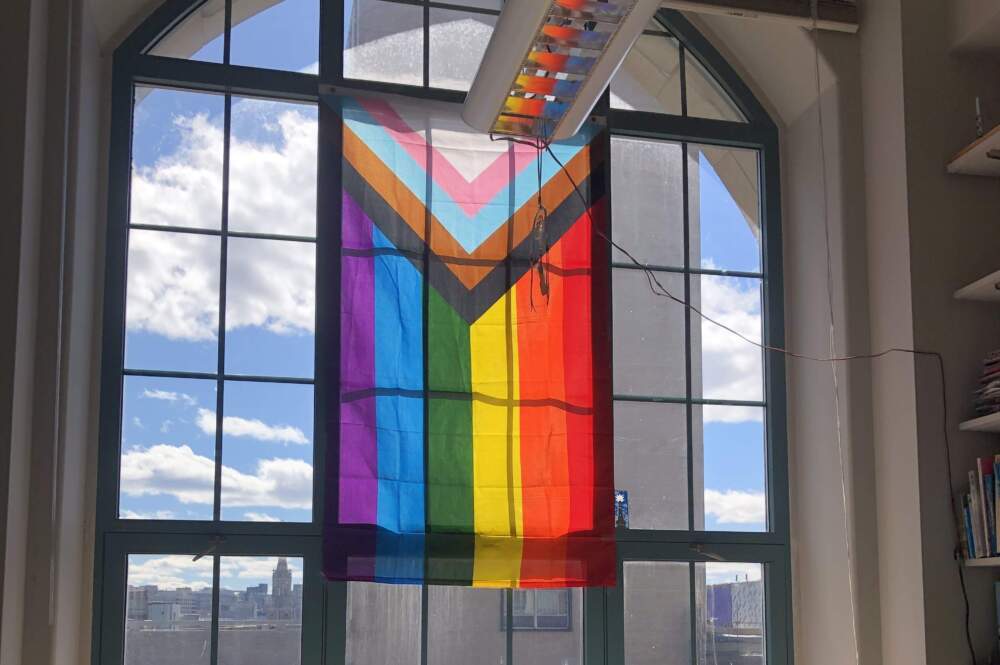
Boston University’s policies on free expression are facing scrutiny this week after the university removed a pride flag from a faculty office window. “If you have the privilege of having a window that faces campus, you don’t get the privilege of speaking for the university,” BU’s president Melissa L. Gilliam explained to WBUR. The controversy in this case rests on two questions: is a flag considered a sign? Are things visible in a faculty office assumed to be institutional speech?
The answers to both of these questions are unclear according to BU’s own policies — one of which governs event signs and the other publication distributions. As I explained to The Chronicle of Higher Education earlier this week, nowhere in these policies are flags mentioned, nor is it clear that a faculty office is a special place of concern for events or “publication distribution.” The policies are far too ambiguous in this case to be of decisive use here; policies are only effective if they are clear.
A similar free expression controversy is playing out across the Charles River at Harvard. There, the Harvard Faculty of Arts and Sciences revised its signage policy to now allow students, faculty, and staff to mount publicly visible signs in private spaces on campus — like faculty office windows — after two professors hung a “Black Lives Matter” sign across their office windows.
HxA members Jeffrey S. Flier and Steven A. Pinker penned a letter to the editorial board of the Harvard Crimson on Tuesday pointing out that such policies must be viewpoint neutral and enforced (and revised) evenly. In the Harvard case they questioned whether the policy would have been reversed if a “Make America Great Again” sign had been plastered across the faculty office windows. I question whether at BU a U.S. flag would have been interpreted as a sign and promptly removed from sight.
Cases such as these are becoming increasingly controversial at private universities because they are not bound to the same First Amendment speech protections as public institutions. The Chronicle of Higher Education explains that speech and expression “policies are increasingly dictated by college leaders’ efforts to prevent unwanted attention. Under the microscope of big donors, politicians, and trustees, private colleges are growing skittish.”
In these cases, things can get legally complex, as HxA member Nadine Stroseen expounded to The Chronicle:
First Amendment principles can be enforceable even at private colleges, said Nadine Strossen, the former president of the American Civil Liberties Union, through contracts, state statutes, and state constitutional rulings. (For example, California’s Leonard Law codifies the First Amendment at all private colleges.) Beyond that, Strossen said, private institutions are largely free to change their policies as much as they want and as often as they want — as long as they refrain from viewpoint discrimination.
An opinion piece in The Hill this week illuminates the hazy limits of faculty speech and boundaries of academic freedom. Legislation in places like Florida and Indiana have shown how the lines can be drawn differently based on legal interpretation:
We agree that universities must have some authority to evaluate and regulate faculty speech. A professor assigned to teach physics cannot be expected to teach poetry instead. But academic freedom has always rested on a simple premise: experts in their disciplines — not politicians or even administrators — are best qualified to decide the content of teaching and research.
Recent events highlight the dangers. In addition to passing laws dictating curriculum and mandating viewpoint diversity, red state governors and legislatures are increasingly shifting power from faculty to politically appointed governing boards. In Texas, for example, a statute adopted last June gives boards the power to reverse changes to the curriculum and block key academic appointments.
If courts accept the views advanced by Florida and Indiana, legislators could dictate what faculty may say in public university classrooms.
Many universities are now working to codify academic freedom definitions to get in front of potential faculty expression controversies on campus, as I explained a few weeks ago in these pages. Now, the AAUP's Center for the Defense of Academic Freedom published a report detailing how academic freedom has been written into collective bargaining agreements across U.S. universities. This can serve as a useful resource for universities as they work to embed academic freedom protections in institutional policy.
Debates about the role of faculty expertise and academic freedom also continue to play out in the classroom, especially as questions over whether courses are viewpoint-diverse enough continue to take center stage. “Some of the critiques that conservatives have made about college curricula are sound,” Danielle S. Allen, a political theorist at Harvard, told The Chronicle of Higher Education. “We haven’t taught enough bread-and-butter basics of U.S. history, constitutionalism, and the like. Some of the critiques from Black studies, which require us to expand our horizon of what voices matter, are also sound.”
In this ongoing battle between politicians and the academy, Florida officially removed sociology from Gen Ed across the 12 state public universities on Thursday after weeks of headline-making controversies. Ray Rodrigues, chancellor of the State University System, argued during Thursday’s board meeting that “sociology as a discipline is now social and political advocacy dressed in the regalia of the academy.”
At the federal level, “area studies” and “critical studies” have taken significant funding hits under the second Trump administration, creating uncertainty around the future of these programs, majors, and centers on campuses. Inside Higher Ed this week reports on the historical federal partnership that launched many of these programs decades ago and how that relationship may ultimately be their undoing:
For years, area studies centers were funded through National Resource Center grants as part of Title VI of the Higher Education Act of 1965. Congress partially restored this funding in its most recent budget, but the damage to area studies may be irreversible. The University of Washington, home to one of the nation’s oldest area studies centers, lost $2.5 million in National Resource Center and foreign language grants — half of which went directly to student scholarships — for the 2025–26 academic year. The University of Michigan lost about $3.4 million and the University of Kansas lost $2 million. Western Washington University’s Center for Canadian-American Studies reportedly took a 70 percent hit to its budget after the Title VI funds were pulled.
These cuts — though small compared to STEM fields — represent huge proportions of funding for humanities and social sciences, as a new analysis by the American Enterprise Institute this week shows. As federal cuts occur in these disciplines, the outsized influence of private foundations will play an even bigger role.
What connects a flag in a faculty window to a sociology department in Florida and private disciplinary funding is the same question: who decides what speech belongs where in the academy and on what authority? Until institutions build clearer, viewpoint-neutral policies, these controversies won't slow down.
Related Articles
Your generosity supports our non-partisan efforts to advance the principles of open inquiry, viewpoint diversity, and constructive disagreement to improve higher education and academic research.
Facts Only
Boston University removed a pride flag from a faculty office window.
BU President Melissa L. Gilliam stated that visible displays in campus-facing windows should not represent institutional speech.
BU’s policies on signs and publications do not mention flags or faculty offices, creating ambiguity.
Harvard revised its signage policy to allow publicly visible signs in private spaces, such as office windows.
Harvard faculty Jeffrey S. Flier and Steven A. Pinker argued that signage policies must be viewpoint-neutral.
Private universities are not bound by First Amendment protections, unlike public institutions.
California’s Leonard Law enforces First Amendment principles at private colleges.
Florida removed sociology from general education requirements at state public universities.
Florida officials argued that sociology has become "social and political advocacy."
Federal funding cuts have impacted "area studies" and "critical studies" programs, including losses at the University of Washington, University of Michigan, and University of Kansas.
The University of Washington lost $2.5 million in National Resource Center and foreign language grants for the 2025–26 academic year.
Western Washington University’s Center for Canadian-American Studies saw a 70% budget cut after Title VI funds were pulled.
Executive Summary
Boston University and Harvard are currently grappling with controversies over faculty expression, particularly regarding flags and signs displayed in office windows. At BU, a pride flag was removed from a faculty office window, with President Melissa L. Gilliam stating that visible displays in campus-facing windows should not be interpreted as institutional speech. BU’s policies on signs and publications do not explicitly address flags or faculty offices, leaving ambiguity in enforcement. Meanwhile, Harvard revised its signage policy to allow publicly visible signs in private spaces, such as office windows, following a dispute over a "Black Lives Matter" sign. Critics, including Harvard faculty Jeffrey S. Flier and Steven A. Pinker, argue that such policies must remain viewpoint-neutral to avoid bias.
The broader debate extends to academic freedom and political influence on universities. Private institutions, unlike public ones, are not bound by First Amendment protections, allowing them to set their own speech policies. However, legal experts note that some states, like California, enforce First Amendment principles at private colleges through legislation. Recent legislative actions in Florida and Indiana highlight growing political intervention in higher education, with laws dictating curriculum and restricting faculty speech. Florida’s removal of sociology from general education requirements reflects this trend, with officials arguing that the discipline has become overly political. Federal funding cuts to humanities programs, particularly "area studies" and "critical studies," further complicate the landscape, shifting financial reliance toward private foundations. The core tension remains: who decides what speech is permissible in academia, and on what authority?
Full Take
The strongest version of this narrative highlights legitimate concerns about the erosion of academic freedom and the growing influence of political and donor pressures on universities. The ambiguity in BU’s policies and the selective enforcement of signage rules at Harvard underscore a broader tension: private institutions, unconstrained by the First Amendment, are increasingly shaping speech policies to avoid controversy or appease stakeholders. The inclusion of legal perspectives, such as Nadine Strossen’s, adds credibility by acknowledging the complex legal landscape. The piece also effectively ties local disputes to national trends, such as Florida’s curriculum restrictions and federal funding cuts, painting a coherent picture of systemic challenges to academic autonomy.
However, the narrative risks framing these issues as a binary struggle between "academic freedom" and "political interference," which may oversimplify the nuances of institutional governance. The focus on high-profile cases (pride flags, BLM signs) could inadvertently amplify emotional triggers, though the article avoids overt sensationalism. The mention of federal funding cuts and their disproportionate impact on humanities programs is a critical observation, but the piece does not explore whether these cuts reflect broader shifts in educational priorities or partisan agendas.
Root cause: The paradigm driving this narrative is the collision between traditional academic autonomy and the rising influence of external actors—politicians, donors, and governing boards—who seek to reshape higher education in their image. The unstated assumption is that universities should operate as neutral arenas for free inquiry, yet the reality is that they have always been shaped by power dynamics. This echoes historical patterns, such as McCarthy-era purges or 1960s campus protests, where ideological battles played out under the guise of institutional reform.
Implications: The second-order consequences are profound. If universities cede control over speech and curriculum to political appointees or donor interests, the integrity of academic inquiry erodes. Faculty may self-censor to avoid controversy, and disciplines deemed "too political" could face marginalization. The shift toward private funding may further entrench inequalities, as wealthy donors gain outsized influence over research and teaching priorities.
Bridge questions: What mechanisms could ensure viewpoint-neutral policies without stifling legitimate academic debate? How might universities balance institutional neutrality with the right of faculty to express personal or professional views? What role should federal or state governments play in protecting academic freedom, if any?
Counterstrike scan: A coordinated influence campaign would likely exploit the ambiguity in university policies to manufacture outrage, framing disputes as attacks on free speech while ignoring the structural pressures on institutions. The actual content does not fully match this pattern, as it presents multiple perspectives and avoids overt manipulation. However, the focus on high-profile symbols (flags, signs) could be leveraged by bad actors to polarize audiences further.
Patterns detected: ARC-0024 Ambiguity (exploiting unclear policies to create controversy), ARC-0043 Motte-and-Bailey (invoking "academic freedom" as a broad principle while retreating to narrow definitions when challenged).