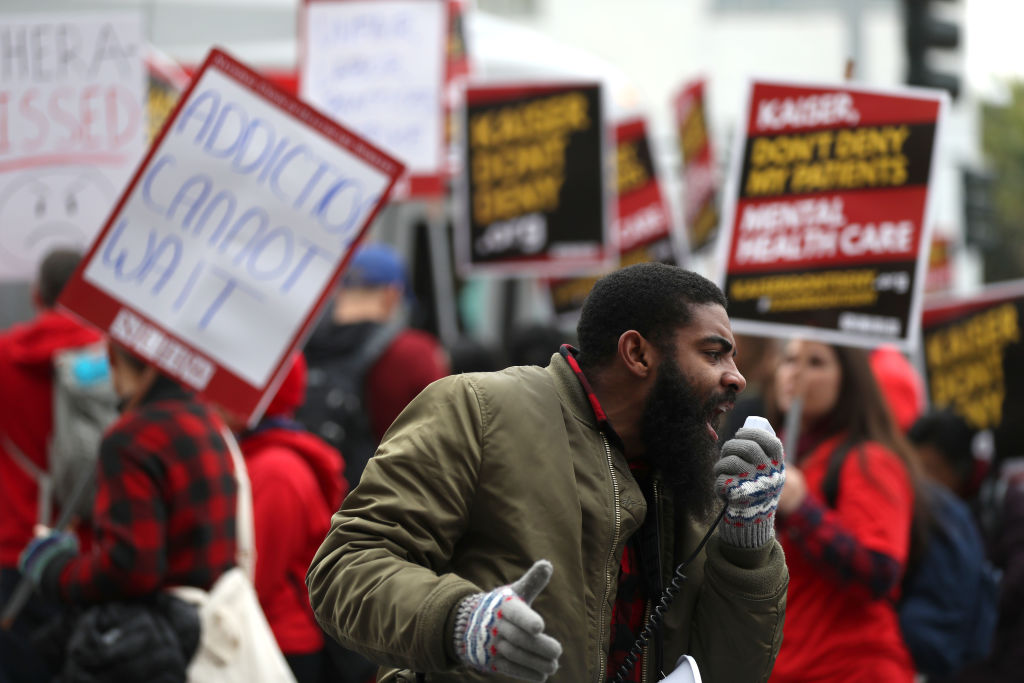
In Northern California, 2,400 mental health providers went on strike earlier this month against medical giant Kaiser Permanente. A major point of contention is Kaiser’s efforts to replace human-provided mental health care with artificial intelligence.
“Kaiser executives say they’re not using AI to make patient care determinations, but they won’t say what technology is underpinning the online questionnaires that automatically determine whether patients require urgent appointments and assess whether they may be a threat to themselves,” said Carolyn Staehle, a behavioral therapist in San Francisco. “Whatever Kaiser wants to call it, it’s not a human being making these potentially life-and-death decisions, and it’s not the same level of care as being assessed by a licensed therapist.”
Kaiser Permanente, the nation’s largest health maintenance organization (HMO), is forcing its therapists onto the streets in the ongoing battle to win parity for mental health care workers, in relation to traditional medical providers, in its services to twelve million members — also now confronting the challenge of artificial intelligence.
The 2,400 striking mental health care workers are members of the National Union of Health Care Workers (NUHW). They walked out on Wednesday, March 18, in a “practice” strike that is most likely a taste of what’s to come. In 2022, these workers struck for ten weeks, the longest mental health care workers’ strike on record. Two issues dominated negotiations from the start: workloads for Kaiser therapists and wait times for Kaiser patients. The strikers won on both, forcing concessions until then all but unheard of. They won breakthrough provisions to retain staff and reduce wait times for patients, with plans to collaborate on transforming Kaiser’s model for providing mental health care.
It’s inevitable that the current contract fight will be just as tough. But the NUHW members are battle-tested; each contract fight with Kaiser so far has included a strike. And this time, the NUHW members were joined in a sympathy strike by thousands of registered nurses who shared their concerns about Kaiser’s increasing use of artificial intelligence to the detriment of patient care.
The significance of this cross-union solidarity can hardly be overestimated. Since 2009, NUHW has fought alone in a workforce deeply divided. In January of that year, a long-standing dispute between SEIU’s national leader, Andy Stern, and the 150,000-strong United Healthcare Workers, based in the Bay Area, came to a head: after many hours of hearings, the SEIU-appointed former secretary of labor, Ray Marshall, ruled for the national union. The local was trusteed, no vote taken, its officers fired, offices occupied, and assets seized; it was widely seen as a travesty. Its core was left to start again as NUHW.
But not so much this time (though thousands of service workers still crossed picket lines). The registered nurses are represented by National Nurses United. Stationary Engineers, represented by IUOE Local 39, also held a sympathy strike with mental health workers and walked picket lines outside Kaiser medical centers in Oakland, Sacramento, Fresno, Santa Clara, and Santa Rosa.
“We’re proud to strike alongside registered nurses and engineers in the fight for human-centered care at Kaiser,” said Joshua Gibbons, a therapist for Kaiser in Sacramento. “Mental health care is about human connection, and Kaiser is recklessly forging ahead with untested artificial intelligence that it sees potentially replacing us and the care we provide our patients.”
Kaiser is determined to rescind past concessions; never mind that, in 2023, it was fined $200 million by the California Department of Managed Health Care for lacking sufficient behavioral health providers. And last month, Kaiser entered into a $31 million settlement with the US Department of Labor over violations of mental health parity laws.
Alas, in our new world, where “billions” have replaced “millions,” Kaiser has $67 billion in reserves. Kaiser’s CEO Greg Adams is reported to receive more than $20 million in compensation annually. Kaiser was forced to reimburse patients who had to pay out of pocket for mental health treatment they couldn’t get from Kaiser — but, millions, no problem.
“Kaiser has been punished and fined so many times for mental health violations; we can’t let it get away with more,” says Kaiser therapist Emma Olsen. “Our patients need human therapists, who can work seamlessly with their doctors and have enough time to do our jobs right — and it’s clear Kaiser doesn’t want to pay for that level of care.” Yet Kaiser wants to add AI to its array of extreme proposals — it is demanding “flexibility,” meaning all but a free hand in the introduction of AI.
The workers have been without a contract since September. The sides remain far apart, with Kaiser sticking to proposals that would reverse patient care safeguards previously won by therapists and open the door to replacing therapist jobs with artificial intelligence and further outsourcing care. When it comes to AI, Kaiser is setting the stage to not just replace work done by therapists but to replace therapists themselves.
The behemoth was once known as union-friendly; Kaiser Permanente was initially established, in collaboration with the unions, to provide medical services at Kaiser’s shipyards, steel mills, and other facilities, due in part to Henry Kaiser’s desire to treat all patients regardless of ability to pay, in the context of President Harry Truman’s failed national health care plan. Workers supported it and were central to its origins and growth. But ultimately, “it’s a corporation,” says Sal Rosselli, president emeritus of the union. “It’s the bottom line. Profit and competition.” Kaiser is a competitor, an empire builder, but this costs money. It spends its surplus on expansion. Kaiser, which began in California and stayed there for decades, now has hospitals and clinics in Hawaii, Washington state, Colorado, Maryland, Michigan, Pennsylvania, and Georgia. It’s comparable to General Motors in the 1950s or even Amazon today.
Health care is remaking the US economy. It’s the sector that employs the most workers, surpassing manufacturing and services; the industry is the biggest employer in thirty-eight states. Manufacturing cities like Cleveland and Pittsburgh have transitioned to health care as the driver of their economies. And hospitals are often the largest employers in small towns and rural settings. The industry will continue to grow (unlike manufacturing, it can’t be offshored), despite cuts in federal health care spending.
Twenty-four hundred workers is not so many, then. But they’re 2,400 in a union that fights, and the health care workforce needs fighters. Their example is incalculable.
Facts Only
2,400 mental health providers in Northern California, represented by the National Union of Health Care Workers (NUHW), went on strike against Kaiser Permanente in March.
The strike centers on Kaiser’s use of artificial intelligence to replace human-provided mental health care, including AI-driven questionnaires assessing patient urgency and risk.
Kaiser Permanente is the largest health maintenance organization (HMO) in the U.S., serving twelve million members.
In 2022, the same workers struck for ten weeks, the longest mental health care workers’ strike on record, securing concessions on workloads and patient wait times.
Kaiser was fined $200 million by California in 2023 for insufficient behavioral health providers and settled a $31 million case with the U.S. Department of Labor for mental health parity violations.
Registered nurses and stationary engineers joined the strike in solidarity, marking a shift from past divisions in Kaiser’s workforce.
Kaiser’s CEO, Greg Adams, earns over $20 million annually, and the organization holds $67 billion in reserves.
The current contract expired in September, with negotiations stalled over Kaiser’s proposals to reverse prior safeguards and expand AI use.
Kaiser was originally founded in collaboration with unions to provide care to industrial workers but has since expanded into multiple states.
Health care is now the largest employment sector in 38 U.S. states, surpassing manufacturing.
Executive Summary
In Northern California, 2,400 mental health providers employed by Kaiser Permanente went on strike in March, protesting the organization’s push to integrate artificial intelligence into mental health care. The workers, represented by the National Union of Health Care Workers (NUHW), argue that AI-driven assessments—such as online questionnaires determining patient urgency—lack the nuance and human judgment required for mental health care. Kaiser Permanente, the largest HMO in the U.S., has faced prior fines, including a $200 million penalty in 2023 for insufficient behavioral health staffing and a $31 million settlement for violating mental health parity laws. The strike highlights broader tensions over workloads, patient wait times, and the role of AI in health care, with workers demanding safeguards against job replacement by technology. Solidarity strikes by registered nurses and stationary engineers underscore growing cross-union resistance to Kaiser’s cost-cutting measures. The dispute reflects a clash between corporate efficiency and the human-centered demands of mental health care, set against Kaiser’s $67 billion in reserves and aggressive expansion strategy.
The strike follows a 2022 walkout that secured concessions on staffing and wait times, but current negotiations remain deadlocked. Kaiser’s proposals include greater "flexibility" in deploying AI and outsourcing care, which workers argue would undermine patient safety and therapist roles. The conflict also echoes historical labor disputes within Kaiser, including a 2009 split that led to the formation of NUHW. With health care now the largest employment sector in most U.S. states, the outcome of this labor action could set precedents for how AI is integrated into medical services nationwide.
Full Take
The strongest version of this narrative frames the strike as a David-and-Goliath struggle between frontline mental health workers and a corporate behemoth prioritizing profit over patient care. The workers’ argument—that AI cannot replicate the empathy and clinical judgment of licensed therapists—resonates in an era where automation threatens to dehumanize critical services. The article effectively highlights Kaiser’s history of fines and violations, reinforcing the union’s claim that cost-cutting undermines care quality. The cross-union solidarity, particularly with nurses, adds moral weight to the protest, suggesting a broader labor awakening in health care.
However, the narrative leans into emotional exploitation (ARC-0012) by framing AI as an existential threat to both jobs and patient lives, without exploring potential benefits of AI-assisted care, such as reducing administrative burdens or improving access in underserved areas. The focus on Kaiser’s $67 billion reserves and CEO pay could be seen as an appeal to class resentment (ARC-0021), though it also serves as evidence of misaligned priorities. The article avoids false equivalence but risks oversimplifying the AI debate by treating it as a binary choice between human care and corporate greed, rather than a complex integration challenge.
Rooted in the tension between labor rights and corporate efficiency, this dispute echoes historical battles over automation in industries like manufacturing. The unstated assumption is that AI in mental health is inherently dehumanizing, but the real issue may be *how* it’s implemented—without transparency, oversight, or worker input. The implications extend beyond Kaiser: if AI replaces therapists, who bears the cost of misdiagnoses or delayed interventions? And if unions succeed in blocking AI, could it slow innovation in a sector desperate for solutions to workforce shortages?
Bridge questions: What safeguards could make AI a tool for therapists rather than a replacement? How might Kaiser’s expansion strategy be driving its push for automation? Would you support AI in mental health if it guaranteed human oversight and reduced wait times?
Counterstrike scan: A coordinated influence campaign would amplify the "AI as villain" framing while omitting nuance about its potential benefits, using emotional triggers (patient harm, job loss) to polarize opinion. The article aligns with this pattern but stops short of outright distortion, relying on verifiable facts and worker testimonies. The absence of Kaiser’s detailed AI proposals or expert perspectives on AI’s role in mental health leaves room for skepticism, but the piece doesn’t cross into manipulative territory.